You saved for months. You booked the room with the view. You pictured slow breakfasts and long walks with nowhere to be.
Then the trip started, and it went the way it always seems to go.
Narcissists don’t take a vacation from being narcissists.
You came home more tired than when you left, quietly wondering if you were the one who ruined it.
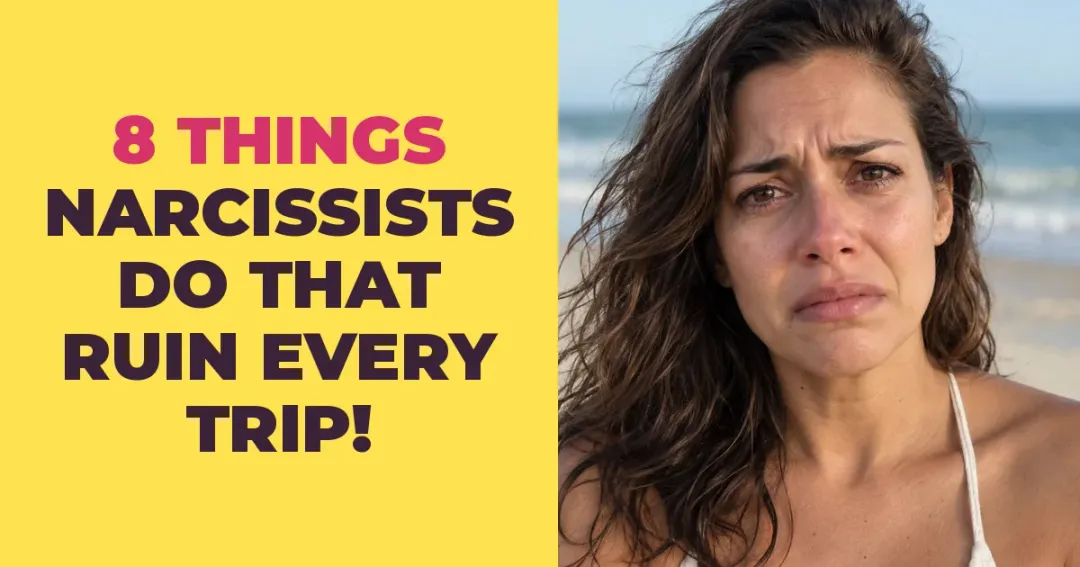
You weren’t. Here are 8 things narcissists do on vacation that ruin every trip, and why they do them.
#1 They start a fight before you leave
Your happiness about the trip can feel like a threat to a narcissist.
The bags are packed. The taxi is booked. And the night before, out of nowhere, there’s a fight about the dishes, your tone, or the way you looked at your phone.
“Why are you always like this?”
Sounds random. It often isn’t.
Psychologists who study narcissism link it with envy. When good things happen to someone else, it stings. Your excitement counts as a good thing happening to you. So it gets cut down before it can grow.
Over time, you stop saying how much you’re looking forward to anything. Joy starts to feel like a risk.
Notice who goes quiet, or loud, right when you’re glad. The timing is the tell.
#2 Every plan bends around them
On vacation, a narcissist often expects the whole trip to bend around them.
You wanted the museum. They wanted the beach club. Guess where you went?
Then there’s the waiting. A line at check-in, a slow waiter, a delayed flight. They act like each one was done to them personally. “Do these people know who they’re dealing with?”
Psychologists call this entitlement. Deep down, they feel owed more than anyone else, and rules feel optional. So a normal limit lands on them like an insult.
Your requests land that way too. Asking for one afternoon to yourself turns into a whole battle.
See also 8 Dirty Tricks Narcissists Pull Once They Realize You See Through Them
You give more. You get less.
Try keeping a quiet tally of whose plans actually happened. Whose trip was it?
#3 Strangers get the charming version

The narcissist often saves their best self for new people and onlookers.
They joke with the bartender. They tip big when the couple at the next table is watching. The tour guide thinks they’re wonderful.
Then the hotel room door closes, and the warmth goes with it.
Why? Their self-worth runs on admiration, so how strangers see them matters a lot. Psychologists who study narcissistic admiration and rivalry describe the same arc: dazzling with newcomers, cold or cutting with the people closest.
You keep chasing the person you met at the start. The bartender is meeting that person right now.
And when someone at the pool says, “You’re so lucky,” you smile and feel a little crazy.
What happens after the door shuts is the real trip. Believe that version.
#4 One wrong turn becomes a war
A narcissist may treat a simple correction like a public humiliation.
You’re in the rental car. You say, gently, “I think we missed the exit.” Suddenly you’re the problem. “Fine, you drive, since you know everything.”
The cold fury lasts all the way to the hotel. Sometimes it resurfaces two days later, over something you’d already forgotten saying.
Psychologists call this threatened egotism. In studies, narcissists hit back harder after a bruise to their ego, and they aimed it at the person they held responsible. Your comment about the exit was that bruise.
So you begin checking every word before it leaves your mouth. The map. The menu. Your face.
If the shouting ever turns into threats, get out of the room. Your safety matters more than any itinerary.
You don’t owe anyone an apology for reading a road sign.
#5 Silence follows you to the beach
Silence can be a punishment, and a narcissist may pack it for every trip.
See also 10 Things Narcissists Hate Watching You Enjoy
A small disagreement at breakfast. Then nothing. They chat with the waiter, the pool attendant, the couple from the next room. Just not you.
You spend a whole day of your vacation trying to work out what you did.
Studies on ostracism explain the sting. Being frozen out hits your need to feel included and to count for something. The hurt can register a lot like bodily pain, and giving in starts to look like the only way out.
So you say sorry just to make the quiet stop. Later they act like the whole day never happened.
One thing helps. Tell them one time that you’re ready to talk whenever they are. Then go enjoy the place you flew all this way for.
The ocean doesn’t need their permission.
#6 Their eyes wander at the pool
A narcissist often keeps one eye on other options, even on a romantic trip.
The long look at the woman by the pool. The friendly chat that runs a little too long. The phone lighting up with an ex’s name, right at dinner.
“Relax, I’m just being friendly.”
Psychologists have tied narcissism to treating love like a game. Commitment runs low, and the back door often stays open.
So on a trip meant for just the two of you, you’re fighting for attention that used to come without asking.
You feel replaceable. On a sunbed. In paradise.
Judge commitment by what they do, day after day. Not by what they post.
#7 Their bad mood becomes your fault
However hard you plan, a narcissist’s disappointment somehow lands on you.
The hotel is lovely, but the pillows are wrong. The restaurant you booked is “fine.” The rain is your fault too, apparently.
They sulk. They sigh. “I guess this is what you wanted.”
Researchers have described a quiet side to narcissism: prickly, sulky, full of self-pity. Feeling hard done by shields an ego that bruises easily. Plenty of narcissists flip between this and the loud, showy side.
See also The One Thing You Should Never Tell a Narcissist
So you tiptoe around their mood all week, even at a beach bar with a cocktail in your hand.
One way to tell: listen for an apology with no “but” attached.
Have you ever heard one?
#8 The photos tell a different story
Once the trip is over, the narcissist may rewrite what happened on it.
You bring up the night they yelled at you in the parking lot. “That never happened. We had an amazing time.” Then they post the sunset photo with a caption about the best trip ever.
Everyone likes it. Nobody saw the parking lot.
Psychologists call this gaslighting. The goal is to make you distrust your own memory until their story is the only one left. It works best when they hold more power and get to tell the tale.
Soon you’re asking yourself whether you overreacted. You end up saying sorry for a night that hurt you.
Jot it down the same day, even in your phone’s notes. Then talk it over with a friend who isn’t inside the relationship.
You were there. Your memory counts.
A ruined trip can make you feel like you failed at something simple. You didn’t. Many narcissists act the same wherever they are, so a new place rarely brings a new person.
So pay attention to who you are when you get a moment to yourself on the trip. The woman who wanted the museum and the slow breakfast is worth listening to.
If you feel unsafe: in the US, call the National Domestic Violence Hotline at 1-800-799-7233 (thehotline.org). In the UK, call the National Domestic Abuse Helpline on 0808 2000 247. If you are in immediate danger, call your local emergency number.
Sources
- American Psychiatric Association. (2022). Diagnostic and Statistical Manual of Mental Disorders (5th ed., text rev.).
- Pincus, A. L., & Lukowitsky, M. R. (2010). Pathological narcissism and narcissistic personality disorder. Annual Review of Clinical Psychology, 6, 421-446.
- Krizan, Z., & Johar, O. (2012). Envy divides the two faces of narcissism. Journal of Personality, 80(5), 1415-1451.
- Campbell, W. K., Bonacci, A. M., Shelton, J., Exline, J. J., & Bushman, B. J. (2004). Psychological entitlement: Interpersonal consequences and validation of a self-report measure. Journal of Personality Assessment, 83(1), 29-45.
- Goffman, E. (1959). The Presentation of Self in Everyday Life. Doubleday.
- Back, M. D., Kufner, A. C. P., Dufner, M., Gerlach, T. M., Rauthmann, J. F., & Denissen, J. J. A. (2013). Narcissistic admiration and rivalry. Journal of Personality and Social Psychology, 105(6), 1013-1037.
- Bushman, B. J., & Baumeister, R. F. (1998). Threatened egotism, narcissism, self-esteem, and direct and displaced aggression. Journal of Personality and Social Psychology, 75(1), 219-229.
- Williams, K. D. (2009). Ostracism: A temporal need-threat model. Advances in Experimental Social Psychology, 41, 275-314.
- Campbell, W. K., Foster, C. A., & Finkel, E. J. (2002). Does self-love lead to love for others? A story of narcissistic game playing. Journal of Personality and Social Psychology, 83(2), 340-354.
- Wink, P. (1991). Two faces of narcissism. Journal of Personality and Social Psychology, 61(4), 590-597.
- Miller, J. D., Lynam, D. R., Hyatt, C. S., & Campbell, W. K. (2017). Controversies in narcissism. Annual Review of Clinical Psychology, 13, 291-315.
- Sweet, P. L. (2019). The sociology of gaslighting. American Sociological Review, 84(5), 851-875.
- Stern, R. (2007). The Gaslight Effect. Morgan Road Books.
Belle Souls articles explain patterns described in psychology research and recovery writing. They are not a diagnosis and not a substitute for help from a qualified professional.