
10 Painful Ways Narcissists Treat Their Kids
REVIEWED BY Belle Souls · November 6, 2026

Narcissists don't soften when they become parents — they sharpen. Instead of raising a child with warmth and patience, they raise one who learns, early, that love has conditions and attention has a price.
If you grew up under a narcissistic parent, you may recognize pieces of your own childhood below. Read slowly, and be gentle with yourself while you do.
1. Affection With Conditions Attached

Picture a seven-year-old running home with a drawing she made at school, beaming, holding it out for her father to see. He barely glances up from his phone.
But the next day, she wins a ribbon at a swim meet — suddenly he's beaming, hugging her in front of everyone, telling strangers how talented she is.
She learns the lesson by heart: love arrives when you perform, and vanishes when you don't. There is no cuddle after a bad day, no comfort when she cries.
She starts chasing achievements the way other kids chase their parent's attention, because in her house, the two are the same thing. The worst part is she grows up believing this is simply how love works.
2. The Silent Treatment as Punishment

Imagine an eleven-year-old boy who forgot to take out the trash. No yelling, no discussion — just cold silence. His mother speaks to his siblings, laughs at the dinner table, answers the phone cheerfully, and looks straight through him as if he's furniture.
Days pass. He tiptoes around the house, apologizing to walls, wondering what he did wrong and how to make it stop. Each unanswered 'Mom?' tightens something in his chest.
Eventually he breaks down and apologizes for everything he can think of, and only then does she speak to him again. He hasn't learned a lesson about chores.
He's learned that connection can be yanked away without warning, and that keeping someone happy is his job to figure out alone.
3. Feelings Dismissed or Mocked

A thirteen-year-old comes home in tears because friends excluded her at lunch. She takes a breath and tells her mother, hoping for comfort. Instead: 'Oh, please.
You're so dramatic. When I was your age, real things happened to me.' Or worse — a little smirk, a retelling of the story later at a family gathering, everyone laughing.
She stops bringing her feelings home. She cries in the bathroom with the fan on. By adulthood, she can't always tell you what she feels, only that something is wrong.
She apologizes for being upset, downplays hurt, and treats her own emotions as inconveniences — exactly as she was taught to.
4. Treating Kids as Extensions of Themselves

A father signs his son up for the sport he once played, buys him the instrument he always wished he'd mastered, and proudly tells coworkers, 'He's just like me.' When the boy says he'd rather join the art club, it doesn't land as a preference — it lands as a betrayal. 'After everything I've done for you?' The child's choices become reflections on the parent, so every independent thought feels like an attack.
The message, delivered a hundred quiet ways, is: your job is to be my continuation. As an adult, that child struggles to answer the simplest questions — what do I want, what do I like — because no one ever let him practice wanting anything for himself.
5. Claiming Credit for Every Success

A daughter gets accepted to a program she worked toward for two years. Before she can finish sharing the news, her mother is on the phone: 'I always knew she'd get in — I stayed up with her every night.' The father adds, 'Her tuition didn't pay itself.' The achievement dissolves in her hands.
Every good grade, every job offer, every compliment gets swept into the parent's trophy case. If she fails, it's her fault alone; if she succeeds, it was never hers at all.
She stops telling them her good news. As an adult, she deflects praise so automatically she barely notices doing it — celebration feels stolen before it even begins.
6. Mocking Their Interests
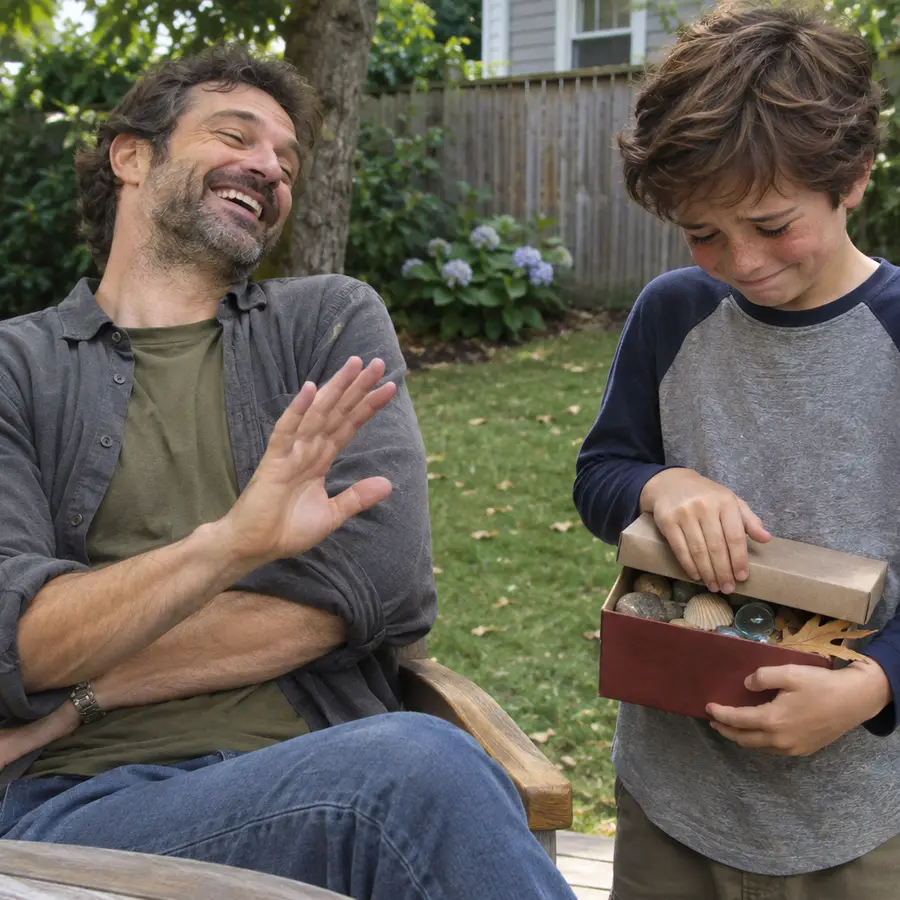
A boy shows his father the bug collection he's carefully labeled, glowing with pride. His father snorts: 'What are you, five? Bugs are for babies.' Laughter, a little shake of the head.
The boy closes the shoebox and doesn't open it again. Next month it's the same story with his drawing, his jokes, the music he likes — every enthusiasm met with a smirk, a nickname, a sarcastic impression of him.
He learns to keep his excitement private, then to stop having it at all. As a grown man, when someone asks what he enjoys, he draws a blank.
Hobbies feel like risks. Liking something out loud feels like handing someone ammunition.
7. Belittling and Put-Downs

Dinner at a relative's house, and a mother gestures at her daughter: 'Don't mind her, she's hopeless in the kitchen — I still cut her meat for her.' Laughter around the table.
The daughter, sixteen, smiles because smiling is the fastest way out. It could be anything: her weight, her laugh, her 'weird' walk, her grades being 'fine, for you.' At home, the comments sharpen — 'You'll never amount to anything,' delivered flatly, like weather.
The cruelty has a purpose: her flinch is the point. She grows into a woman who hears criticism in every compliment, who checks her reflection looking for the flaw someone will name first.
8. No Respect for Boundaries

A twelve-year-old closes her bedroom door to change. Within seconds, her father walks in without knocking — 'It's my house.' Her diary is read out loud and quoted at dinner.
When she says 'stop tickling me,' the tickling continues because 'you love it, really.' Saying no is called attitude; wanting privacy is called secrets. She learns her body and her space are not fully hers to govern, that her 'no' is a suggestion others can override.
The lesson follows her into adulthood: she struggles to tell friends she can't make it, freezes when someone stands too close, apologizes for taking up room — because no one ever taught her that her boundaries were allowed to exist.
9. Emotional Parentification

A nine-year-old learns to read her mother's moods like weather — the slammed cabinet means tiptoe, the sigh means ask what's wrong, the tears mean climb into the parental role. 'You're the only one who understands me,' her mother says, crying on her small shoulder about her marriage.
The child becomes the comforter, the mediator, the little therapist, managing the household's emotional temperature while no one asks how she's doing. She's praised for being 'so mature.' By twenty-five, she's everyone's rock, everyone's first call in a crisis — and completely lost about her own needs, because for as long as she can remember, someone else's feelings always came first and hers went unasked about.
10. Jealousy of Their Own Children

A daughter lands her first real job and comes home glowing. Her mother's face tightens. 'Must be nice. Nobody ever handed me opportunities like that.' Within minutes the conversation is about her own career, her own sacrifices.
The daughter's joy shrinks in her chest — she's felt this before, at her graduation, her birthday, anytime the room's attention drifted toward her. She learns to keep her wins quiet, to shrink her celebrations, to feel a flicker of guilt whenever good things happen.
As an adult, the pattern goes underground: just as something starts going well, she finds a way to undo it — quitting, procrastinating, picking a fight — because shining was never safe when someone at home was watching with narrowed eyes.
One last look back
If these scenes felt familiar, know this: nothing you experienced was normal parenting, and none of it was your fault. What happened to you explains your struggles — it does not doom them. You can learn your own feelings, set your own boundaries, and celebrate your own wins. Healing begins the moment you stop blaming yourself.
 12 Things Narcissists Do in Public That Reveal Who They Really Are
 18 Moments When the Narcissist Knows You Know