The narcissist rarely calls it control. They call it love.
They check your phone because they worry. They pick at your clothes because they want you to look your best. They go quiet for three days because, apparently, you hurt them.
And somehow you’re the one saying sorry.
Each one comes with a loving reason. That’s what makes them so hard to call out.
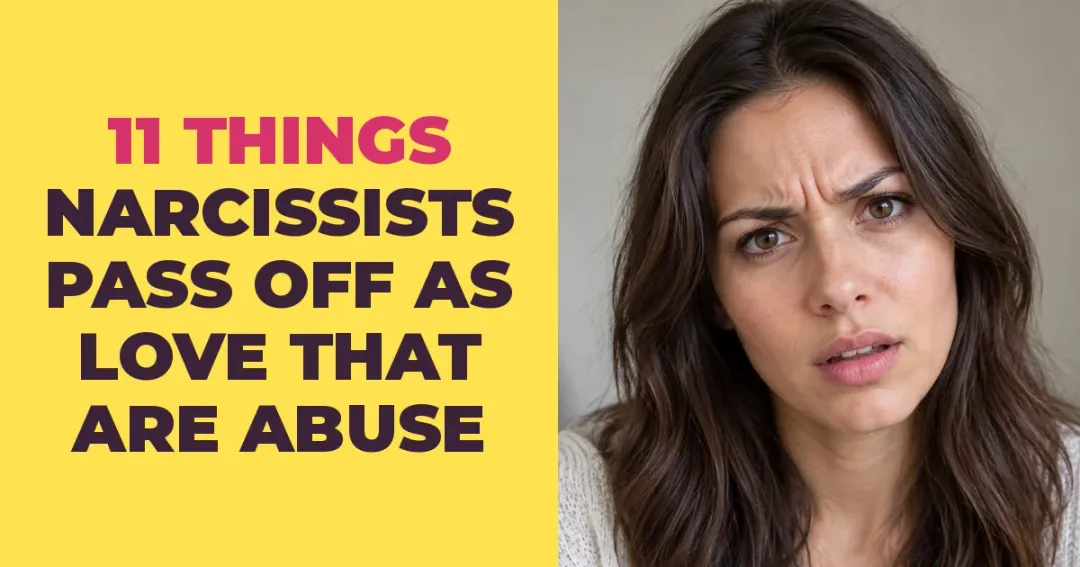
Here are 11 things narcissists pass off as love that are really abuse, and how to tell the difference.
#1 Jealousy gets sold as proof they care
Checking your phone and your location is control, however sweetly it’s said.
“I just worry about you.” So they want your passcode. They ask who texted. They sulk when you see your sister without them, and slowly you stop going.
Coercive control rarely starts with one big incident. Many small rules and punishments add up, until you’re asking permission for ordinary things.
Your world gets smaller one ‘harmless’ request at a time.
Keep some money and some contacts that are only yours. Quietly.
#2 Cruelty dressed up as honesty
Some cruelty is aimed exactly where it hurts, then called a joke.
At dinner with friends, they bring up your weight, the exam you failed, the thing you told them in confidence. You flinch. They laugh. “God, you’re so sensitive. I’m just being honest.”
Research on what’s called everyday sadism describes people who find small cruelties rewarding in themselves. Not a means to an end. The point.
Playful teasing stops when you ask. This doesn’t.
Next time you’re hurt, notice their face. Do they look sorry, or pleased?
#3 Too much, too soon feels like fate
Love that arrives at full speed is built to bond you fast.
Week two, and they’re planning holidays. Morning texts, midnight texts, flowers at your work. “I’ve never felt like this. You’re my soulmate.”
Love bombing creates a strong bond before you’ve seen how they act under stress. Later, that dazzling start becomes the memory you keep chasing.
See also 5 Unsettling Things Narcissists Keep Hidden In Their Home
Then you blame yourself for the change.
Watch how they react to your ‘not yet’. Enthusiasm can wait. Pressure can’t.
#4 Real life always starts after this busy patch
A promise about next year can keep you waiting through this one.
They’re working late again. “It’s for us. Once this project’s done, we’ll book the trip, look at houses, do it properly.” The project ends. Another one starts.
There’s a popular name for this: future faking. It isn’t a formal diagnosis. It describes big promises that keep you invested in a shared future, so leaving starts to feel like losing it.
Judge by what has actually happened.
Count the trips you’ve taken. Not the ones you’ve planned.
#5 Taking over the money to ‘protect’ you
When they hold all the money, they also hold the door shut.
“Let me handle the bills, babe. You’ve got enough on.” Then your card lives in their wallet, and a new pair of tights needs explaining.
Financial abuse works quietly. Without money of your own, leaving gets harder, and that keeps you dependent.
Couples budgeting together is normal. One person holding every key isn’t.
If you’re hiding a coffee receipt, ask yourself why.
#6 Your choices become their punchline
An eye-roll can say more about how they see you than any ‘I love you’.
You mention the course you want to take. They do your voice back at you. “Oh, look at you, Miss Career Woman.” Everyone laughs. Except you.
Long-term studies of couples found contempt and stonewalling among the strongest predictors of a relationship breaking down. Mockery is not a love language.
So you start keeping your plans to yourself.
Feeling small in your own home isn’t you being oversensitive.
#7 Guilt trips that look like devotion
Guilt can be used as a lever, and a narcissist may pull it hard.
You want one evening with your friends. “After everything I’ve done for you? Fine. Go. I’ll just sit here on my own.” You stay home.
See also 7 Hobbies That Tell You Right Away You Are Dealing With a Narcissist
There’s a popular term for this: FOG, short for fear, obligation and guilt. It isn’t a clinical label. It describes emotional blackmail that makes saying no feel costlier than giving in, one more small lever of control.
Soon yes comes out automatically.
Pause before you answer. Their disappointment is theirs to carry.
#8 Silence they call ‘needing space’
Being shut out by the person you love can hurt like physical pain.
Three days. They chat to the dog, the neighbour, their mum on speaker. Not you. Then one morning they’re whistling over the kettle as if nothing happened.
Being ignored hits your basic need to belong and to matter. That’s why you end up apologising just to make it stop.
Cooling off, and saying so, is healthy. Punishment isn’t.
Say once that you’re open to talking. Then go live your day.
#9 Their sweetest side is for an audience
The most loving version of them often shows up only when someone’s watching.
At the party they hold your hand, top up your drink, and tell everyone how they knew on the first night. Your friend whispers, “You’re so lucky.” In the car home, silence. Or worse.
Many narcissists invest heavily in their public image, because admiration feeds their sense of worth. Your relationship is part of the display.
So nobody believes you.
Trust what happens behind closed doors. That’s the real relationship.
#10 Your hurt somehow turns into theirs
Raise a problem, and somehow you end the night apologising to them.
You finally say it: “You humiliated me today.” Ten seconds later it’s “I never said that. How dare you. Do you know how hard my day was?” Then the tears. You end up comforting them.
Psychologists call this DARVO: deny, attack, reverse victim and offender. Research found it makes the person raising the issue blame themselves more, which is how it shuts the conversation down so fast.
Name the original issue and go back to it. Don’t argue every counter-attack. Your hurt still counts.
See also 4 Cruel Things Narcissists Do Just Before They Leave You
#11 The make-up feels like proof of love
Kindness that comes unpredictably hooks you harder than kindness that comes every day.
After the screaming, breakfast in bed. The long hug. “I don’t know what I’d do without you.” And for one day, it’s the person you fell for.
Rewards on an unpredictable schedule are the hardest to walk away from, the same principle that keeps people at slot machines. Research on trauma bonding describes how cycles of harm and kindness can build a bond stronger than calm love.
That pull is a known reaction. Not weakness.
Count the good days and the bad ones this month. Which column is longer?
You weren’t foolish for believing it was love. It was dressed up to look exactly like it.
You don’t have to untangle this alone. Talk to someone outside the relationship, ideally a person who has seen how they act both in public and at home.
And when you’re unsure what’s real, look at the car ride home. Not the party.
If you feel unsafe: in the US, call the National Domestic Violence Hotline at 1-800-799-7233 (thehotline.org). In the UK, call the National Domestic Abuse Helpline on 0808 2000 247. If you are in immediate danger, call your local emergency number.
Sources
- Dutton, D. G., & Painter, S. (1993). Emotional attachments in abusive relationships: A test of traumatic bonding theory. Violence and Victims, 8(2), 105-120.
- Goffman, E. (1959). The Presentation of Self in Everyday Life. Doubleday.
- Stark, E. (2007). Coercive Control: How Men Entrap Women in Personal Life. Oxford University Press.
- Buckels, E. E., Jones, D. N., & Paulhus, D. L. (2013). Behavioral confirmation of everyday sadism. Psychological Science, 24(11), 2201-2209.
- Strutzenberg, C. C., Wiersma-Mosley, J. D., Jozkowski, K. N., & Becnel, J. N. (2017). Love-bombing: A narcissistic approach to relationship formation. Discovery, The Student Journal of Dale Bumpers College of Agricultural, Food and Life Sciences, 18, 81-89.
- Arkes, H. R., & Blumer, C. (1985). The psychology of sunk cost. Organizational Behavior and Human Decision Processes, 35(1), 124-140.
- Postmus, J. L., Plummer, S.-B., McMahon, S., Murshid, N. S., & Kim, M. S. (2012). Understanding economic abuse in the lives of survivors. Journal of Interpersonal Violence, 27(3), 411-430.
- Gottman, J. M. (1994). What Predicts Divorce? The Relationship Between Marital Processes and Marital Outcomes. Lawrence Erlbaum.
- Forward, S., & Frazier, D. (1997). Emotional Blackmail. HarperCollins.
- Williams, K. D. (2009). Ostracism: A temporal need-threat model. Advances in Experimental Social Psychology, 41, 275-314.
- Freyd, J. J. (1997). Violations of power, adaptive blindness, and betrayal trauma theory. Feminism & Psychology, 7(1), 22-32.
- Harsey, S. J., Zurbriggen, E. L., & Freyd, J. J. (2017). Perpetrator responses to victim confrontation: DARVO and victim self-blame. Journal of Aggression, Maltreatment & Trauma, 26(6), 644-663.
- Ferster, C. B., & Skinner, B. F. (1957). Schedules of Reinforcement. Appleton-Century-Crofts.
Belle Souls articles explain patterns described in psychology research and recovery writing. They are not a diagnosis and not a substitute for help from a qualified professional.