You said sorry again last night. Still not sure what for.
Maybe you snapped back once. Maybe you only asked a simple question. Either way, it ended with you apologising, and somehow everything got worse.
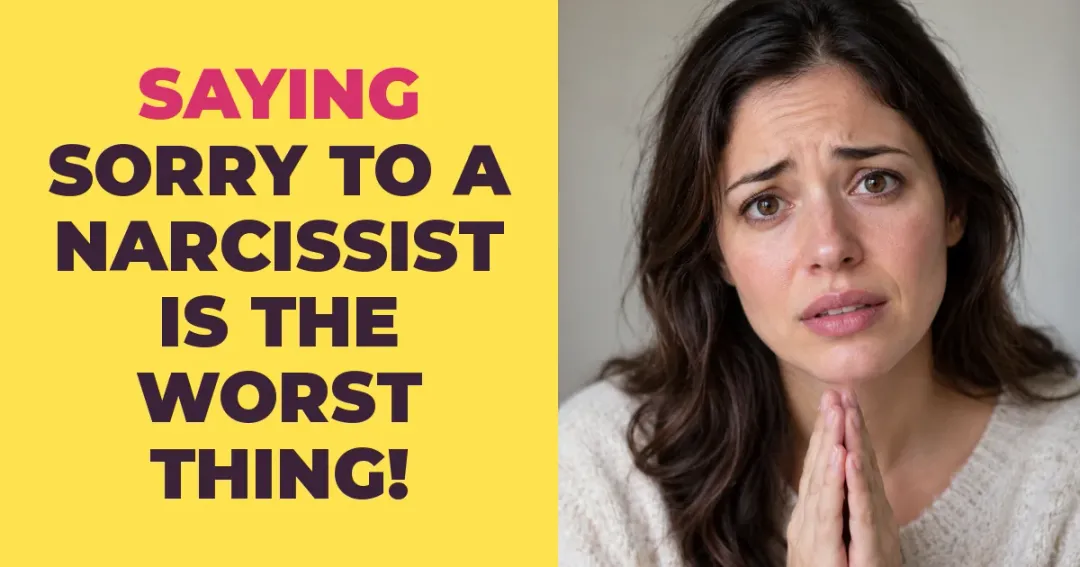
A narcissist may not hear ‘sorry’ like you mean it.
You mean let’s fix this. They may hear something else.
Here are 7 reasons why saying sorry to a narcissist is the worst thing you can do, and what to try instead.
Why sorry works differently here
In a healthy relationship, an apology is a bridge. One person owns their part, the other meets them halfway, and you both move on.
With a narcissist, there’s often no halfway. Their sense of worth leans on outside confirmation, so other people tend to be either sources of praise or threats to it.
That can change what your apology does. Instead of opening a door to repair, it can feed their need to be proven right.
One bad night proves nothing. Watch the pattern over months.
#1 Your sorry flips who the victim is
The moment you say sorry, the fight stops being about what they did.
You bring up the comment they made at dinner. Calmly, even. Within two minutes, you’re hearing about the time you forgot to call their mother.
“I never said that, and I can’t believe you’d accuse me.” Then the sulking starts, and somehow you’re the one comforting them.
Psychologists call this DARVO: deny, attack, then reverse victim and offender. Research found it makes the one who raised the problem blame herself more.
So you apologise. And that sorry seals the swap. Their comment from dinner? Never mentioned again.
Next time, keep it short and factual: name the original issue and return to it. Skip the counter-attacks. And if raising it doesn’t feel safe, you don’t have to raise it at all.
The dinner comment still happened. Sorry doesn’t erase it.
#2 They hear sorry as a confession
To a narcissist, your apology is evidence that their version of events was true.
See also 10 Painful Ways Narcissists Treat Their Kids
“That never happened.” “You’re too sensitive.” You heard them shout. You know you did. But after an hour of this, you say sorry just so it stops.
Then doubt creeps in. Did you overreact?
Gaslighting means making you doubt your own memory so their story wins. It works best when one person holds more power and controls the story.
Each sorry for something that didn’t happen makes their story a little firmer and yours a little shakier. That’s how you end up apologising when you were the one who got hurt.
Write things down when they happen. Check them with someone outside the relationship.
A dated note on your phone can outlast an hour of “that never happened.”
#3 Silence teaches you to say sorry
The silent treatment is built to make you apologise first.
Three days of nothing. They laugh on the phone with their sister, chat to the neighbour, and look straight through you in the kitchen.
Research on being ignored says it threatens the basic need to belong and to matter. That’s why it can hurt like physical pain, and why it pushes you to give in.
So you say sorry. For what? You’re not even sure.
Then they come back as if nothing happened. The lesson sticks for both of you: silence works.
Soon you’re steering clear of any topic that might start the next round.
Try saying once that you’re open to talking, then get on with your day. No chasing. No begging. Let the silence be theirs to carry.
#4 Your sorry doesn’t wipe the slate clean
With a narcissist who keeps score, an apology doesn’t settle the account.
You said sorry for being short with them on Tuesday. They nodded. Then on Saturday, in front of friends: “Well, she can be pretty nasty when she wants.”
Research on narcissism describes a quiet, touchy side that keeps score of slights and plays the victim when challenged.
See also 11 Odd Answers Narcissists Give to Dodge a Simple Question
Then there’s what psychologists call threatened egotism: when their image is bruised, they’re more likely to lash out at whoever they blame, sometimes days later.
So don’t expect the slate to be clean. A slight you’ve long forgotten can come back days later, in front of an audience, with interest added.
One way to tell: watch whether their apologies ever come without a condition attached. “I’m sorry you feel that way” doesn’t count.
Has theirs ever been free?
#5 Soft spots become their ammunition
A heartfelt apology shows a narcissist exactly where you’re soft.
You don’t just say sorry. You explain. You were stressed, your dad’s been ill, and lately you’ve felt like a failure at work.
Two weeks later, mid-argument: “No wonder you’re failing at work.”
Studies on narcissism found empathy is low by default but rises when they’re prompted to take your view. That points to a choice more than an inability.
They often understand what you feel. They just don’t act on it, unless it serves them.
The details you offered to explain yourself become the details they aim at. Soon you stop sharing feelings at all, and start doubting the ones you have.
Stop explaining your pain to the person who uses it. Save it for people who hold it gently.
#6 Sorry becomes your automatic setting
After enough time with a narcissist, sorry stops being a choice and becomes a reflex.
You apologise to the waiter for his mistake. You say sorry to a chair you bumped into. You hear keys in the door and your shoulders rise.
Psychologists describe this as fawning and hypervigilance. Living with unpredictable anger trains your body to stay on alert and to calm the threat by agreeing.
That reflex was protecting you.
It’s also exhausting. It buries what you actually want, until you lose track of it completely.
Start small. When the sorry rises in your throat, notice the alarm and slow down. Try a tiny no somewhere safe, like turning down a coffee you didn’t want.
See also You Can Spot a Narcissist on Social Media in Less Than 60 Seconds, Here’s How
The chair you bumped into will be fine without one.
#7 You end up apologising for having needs
With a narcissist, even asking for something basic can end with you saying sorry.
You ask them to text if they’ll be late. Or to pay back the money from last month. Suddenly you’re “nagging” and “making everything about you.”
“Fine. I guess my life revolves around you now.”
There’s a name for this: entitlement, the steady belief that rules are for everyone else. It makes ordinary limits feel like insults, so your normal request lands like an attack.
So you apologise for asking. And they learn that your needs can be talked down, one sorry at a time.
Over time, you give more and get less. Asking for fairness starts to feel like starting a war.
Stop pre-forgiving, pre-agreeing and pre-paying. Keep track of what you give. Your request was fair the first time.
Saying sorry was never the problem. It’s a good instinct, and it shows you care about the people in your life.
It just belongs with people who can say it back.
So the next time the word jumps out before you’ve even thought, pause. Ask yourself one quiet question: did I actually do something wrong?
If you feel unsafe: in the US, call the National Domestic Violence Hotline at 1-800-799-7233 (thehotline.org). In the UK, call the National Domestic Abuse Helpline on 0808 2000 247. If you are in immediate danger, call your local emergency number.
Sources
- American Psychiatric Association. (2022). Diagnostic and Statistical Manual of Mental Disorders (5th ed., text rev.).
- Pincus, A. L., & Lukowitsky, M. R. (2010). Pathological narcissism and narcissistic personality disorder. Annual Review of Clinical Psychology, 6, 421-446.
- Freyd, J. J. (1997). Violations of power, adaptive blindness, and betrayal trauma theory. Feminism & Psychology, 7(1), 22-32.
- Harsey, S. J., Zurbriggen, E. L., & Freyd, J. J. (2017). Perpetrator responses to victim confrontation: DARVO and victim self-blame. Journal of Aggression, Maltreatment & Trauma, 26(6), 644-663.
- Bushman, B. J., & Baumeister, R. F. (1998). Threatened egotism, narcissism, self-esteem, and direct and displaced aggression. Journal of Personality and Social Psychology, 75(1), 219-229.
- Sweet, P. L. (2019). The sociology of gaslighting. American Sociological Review, 84(5), 851-875.
- Stern, R. (2007). The Gaslight Effect. Morgan Road Books.
- Williams, K. D. (2009). Ostracism: A temporal need-threat model. Advances in Experimental Social Psychology, 41, 275-314.
- Wink, P. (1991). Two faces of narcissism. Journal of Personality and Social Psychology, 61(4), 590-597.
- Miller, J. D., Lynam, D. R., Hyatt, C. S., & Campbell, W. K. (2017). Controversies in narcissism. Annual Review of Clinical Psychology, 13, 291-315.
- Hepper, E. G., Hart, C. M., & Sedikides, C. (2014). Moving Narcissus: Can narcissists be empathic? Personality and Social Psychology Bulletin, 40(9), 1079-1091.
- Walker, P. (2013). Complex PTSD: From Surviving to Thriving. Azure Coyote.
- Herman, J. L. (1992). Trauma and Recovery. Basic Books.
- Campbell, W. K., Bonacci, A. M., Shelton, J., Exline, J. J., & Bushman, B. J. (2004). Psychological entitlement: Interpersonal consequences and validation of a self-report measure. Journal of Personality Assessment, 83(1), 29-45.
Belle Souls articles explain patterns described in psychology research and recovery writing. They are not a diagnosis and not a substitute for help from a qualified professional.