Narcissists rarely marry for the reasons you did.
You married for love, for a future, for the person who made you feel chosen above everyone else. Then the ring went on, and something shifted.
The charm started going to everyone else. The chores, the bills and the blame started landing on you.
That shift is not in your head.
Marriage makes a narcissist’s life easier in some very specific ways. Here are 6 reasons why narcissists marry you so their lives are easier.
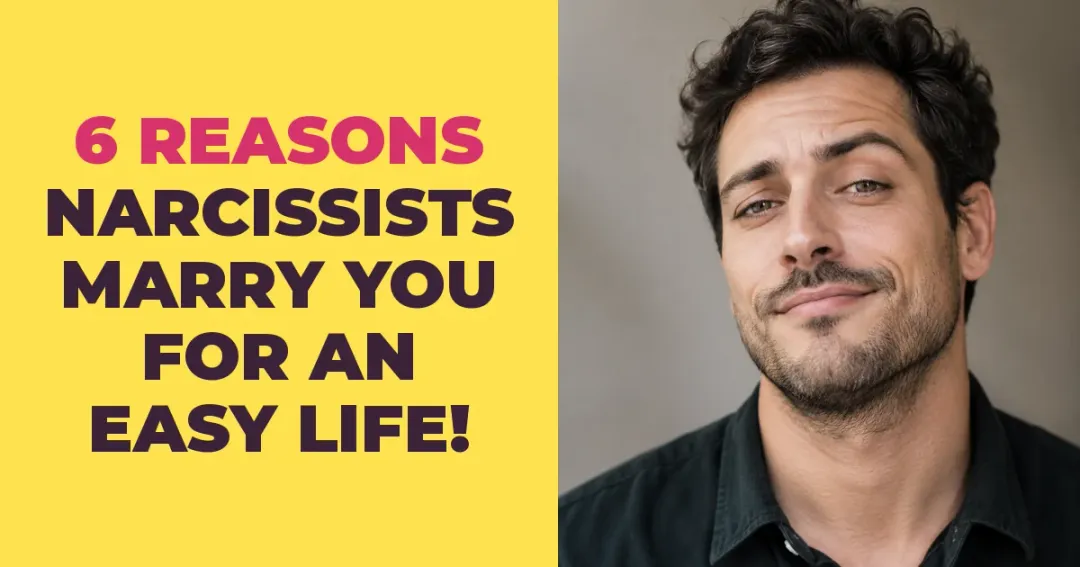
Why the effort stops after the wedding
Research on narcissism describes two drives. One wins people over with charm and showing off. The other guards their rank by cutting others down.
At the start, the charming side is in charge. Later, the competitive, cutting side gets louder. That’s why the beginning felt so different from now.
Psychologists also connect narcissism with treating love like a game, with less commitment. Once the game feels won, interest often drops.
A wedding can feel like the win. After that, you’re less a prize to chase and more a resource to use.
#1 A spouse makes them look like a good person
A loving spouse at their side is the best mask a narcissist can wear.
Picture them at your sister’s birthday. Warm. Attentive. A hand on your back, a story that gets the whole table laughing.
Then the car ride home, and silence.
Psychologists call this impression management. We all tidy up how we come across. Narcissists put huge effort into it, because being admired is what keeps their self-worth afloat.
Marriage helps that image enormously. It says trustworthy, loyal, loved and loving. It looks like someone who puts others first.
So your friends tell you, “You’re so lucky.” Hint at the coldness, and nobody quite believes you. After a while, you start second-guessing what you lived through.
One way to tell: most of us are a little nicer in public. Here, the difference is between warm and cruel.
See also 8 Things You Should do Right Away if You’re Finished With The Narcissist
What happens at home is the real version.
#2 You carry the load so they don’t have to
To a narcissist, a spouse often means someone whose plans can always be moved.
Your Saturday was booked weeks ago. Then they announce a work dinner or a weekend away and expect you to cover the kids, the dog, the dentist. All yours, again!
“You weren’t doing anything important anyway.”
Research on entitlement describes people who feel they’re owed more than the rest of us, and who think the rules are for other people.
That’s why normal limits sting them. Your simple “I can’t this time” lands like a personal attack.
Over the years, the maths stops adding up. You give more and get less. Even asking for an even split feels like picking a fight.
It helps to jot down, quietly, what you’re giving. Not as ammunition. Just so you can see it in black and white.
What would your week look like without pre-agreeing?
#3 Your money becomes their safety net

For some narcissists, marriage is the easiest route to your money.
It can start small. A loan for their car that never gets paid back. Your card “borrowed” for a weekend away with friends.
Then it grows. They live in your home and never chip in. They offer to “handle” the accounts, and ask a lot about what your parents might leave you.
“Don’t you trust me?”
Researchers call this economic abuse. It covers taking over, using up or wrecking your money, your pay or your ability to stand on your own feet.
The logic is cold. If you have no money of your own, walking away is much harder. That suits them.
So the receipts get tucked away. Something as ordinary as a bank balance starts to feel like a cage.
Having your own account and your own records is allowed. That money is part of your life too.
See also 8 Things You Do for The Narcissist That They’ll Never Be Grateful For
#4 They always have someone to blame
When life goes wrong for a narcissist, a spouse makes a very handy target.
They forget the bill, and you get the lecture. They’re late, and somehow it’s because you took too long finding your keys. Then they shout across the kitchen:
“Why are you always so angry?”
Psychologists call this projection. They pin on you exactly what they’re doing or feeling themselves.
If the ugly trait is spotted in you, they never have to spot it in the mirror. Marriage gives them someone to pin it on, every single day.
So after taking the lion’s share, they call you selfish. Catch them in a lie, and suddenly you’re the liar.
You end up arguing against things you never did. Halfway through, the original problem has vanished.
When the same accusation keeps coming, read it as a clue about them. Say the facts once. Then stop.
#5 They get an audience that never leaves
Marriage gives a narcissist an audience that’s home every single night.
They walk in with a story about work. They’re the hero again, the boss is useless, and you’re expected to nod along on cue.
“Honestly, nobody there has a clue without me.”
Clinicians describe a pattern in narcissistic personality disorder: an inflated sense of self, an endless hunger for praise and little real empathy, showing up everywhere.
Their self-worth needs constant topping up from outside. So the people closest to them become either mirrors or threats.
You mention the hard week you’ve had, and within a minute the subject is back on them. Your needs get treated like a nuisance.
Slowly, it can feel like your whole job is to show them their own reflection.
Look at months of behaviour, not one sweet evening. You were never meant to be a mirror.
#6 Marriage makes you easier to keep
Once you’re married, the years you’ve given start doing the narcissist’s work for them.
See also 11 Things No Narcissist Can Cope With Emotionally
They don’t have to win you anymore. The house, the shared friends, the photos, the anniversaries quietly hold you in place.
Research on sunk cost describes this pull. The more you’ve put in, the more leaving feels like throwing it all away.
Then there’s the clash in your head. “They love me” and “they hurt me” can’t both feel true, so your mind tries to settle it.
Psychologists call that cognitive dissonance. The easiest fix is usually to find excuses for the bad parts.
“They had a hard childhood.” “Work’s been brutal.”
No wonder decisions feel impossible.
Try noting the facts of what happened, minus the explanations. Then ask what the coming years would cost, rather than what the past already took. Those years were real. So is what comes next.
None of this means you were foolish. You married the person they showed you.
Seeing the pattern doesn’t mean you have to do anything today. It just means the fog lifts a little, and your own memory starts to make sense again.
If you want one small step, share the whole story with one person you trust. Manipulation tends to work by cutting you off, so getting back in touch with your people is part of finding your footing.