Narcissists look untouchable. Up close, they’re anything but.
You’ve seen them own the room at dinner, steamroll every argument and stroll off from fights you’re still replaying at 2 a.m.
So it feels like they hold all the cards.
They don’t. Behind the swagger sits an ego so thin that a sigh, a raised eyebrow or a calm ‘no’ can put a crack in it.
Below are the 7 soft spots hiding under that act, and what each one looks like from where you’re standing.
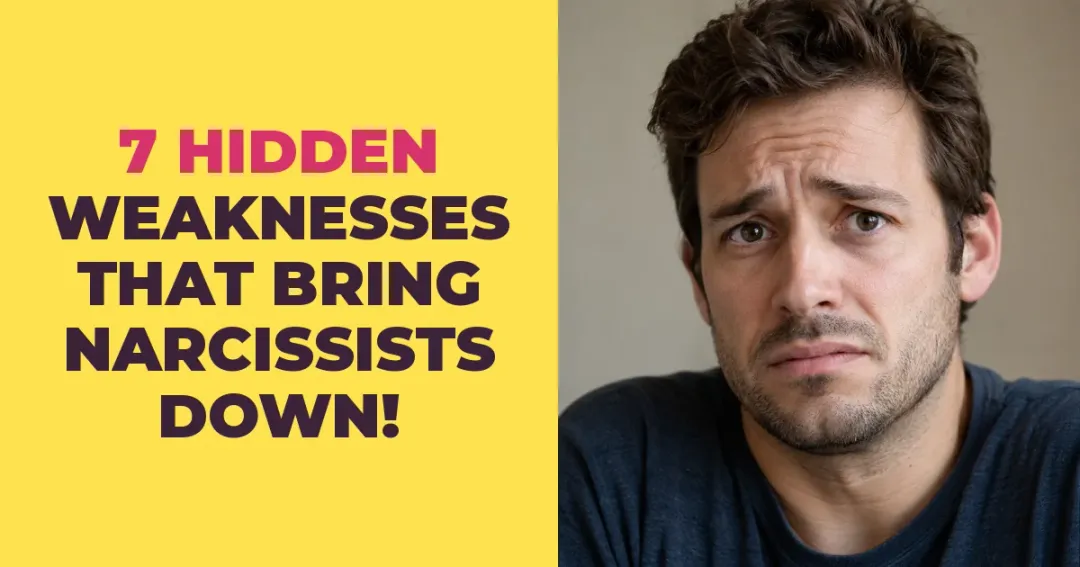
The fragile core
Researchers see two faces of narcissism. One is loud: bold, charming, in charge. The other is quiet: prickly, bitter, sorry for itself. Plenty of narcissists flip between the two.
Different outfits. Same purpose.
Each one shields an ego that bruises easily. The loud version puffs itself up. The quiet version pulls back and nurses a grudge.
That’s why the weak spots below are so precise. Poke the image, and to them it can feel like their whole self is under fire.
#1 Your attention is their oxygen

A narcissist’s sense of worth isn’t stored inside them. It’s borrowed from your reaction.
It shows up in small ways. The same story told three times at the barbecue. The promotion that gets bigger with each retelling. ‘Did you see their faces?’ as you buckle your seatbelt.
Why? Their value only feels real when someone else confirms it. So everyone nearby ends up as either an audience to impress or a danger to the act.
Guess where your needs end up.
Slowly you can feel like a mirror on legs. Polish them, reflect them, look impressed. Your bad days, your worries and your plans get treated as a nuisance.
Look at months, not one awkward night. One vain moment proves nothing. A steady hunger does.
And nobody can fill that tank for them.
#2 The smallest criticism feels like an attack
A narcissist can hear one gentle comment as a full-scale attack.
See also 10 Weird Habits Only Narcissists Have
The milk didn’t get picked up, and you mention it lightly. Ten seconds later it’s a war. ‘Oh, so I’m useless now? Brilliant. Thanks.’
Other times the air just freezes for the evening. Then, days later, a jab about a remark you’d long forgotten.
Psychologists call this threatened egotism. In the research, narcissists answered an insult with more aggression, aimed right at the person they blamed for it.
Criticism, rejection, being ignored. Any of it can bruise the image.
Living with that, your words start passing through an inner editor first. Apologies slip out for things that were never yours.
If you do raise something, keep it short and factual. If it doesn’t feel safe, let it go. And if the anger turns into threats, leave the room.
Your safety beats winning the point.
#3 They need the world to believe the mask
A narcissist protects their public image like it’s the family silver.
At the party, they refill glasses and ask about everyone’s kids. On the drive home? Nothing. Or a rundown of every mistake you made.
Your friends tell you how lucky you are. You smile and let it go.
The reason is simple. Being admired is what props up their self-worth, so they pour serious effort into how outsiders see them.
That gap is the weak spot. It’s also why your story gets doubted, and why you begin doubting it too.
Sure, everyone’s a bit nicer at parties. This is different. This is warm versus cruel. If one person has seen both versions, lean on them.
What happens behind closed doors is the real record.
#4 Good news makes them go sour

Your happiness can land like an insult to a narcissist.
You get the job. You tell them, buzzing. ‘Huh. And the pay’s decent, is it?’ Then the topic moves on.
Or your birthday dinner ends in a fight. Again.
Research ties envy to narcissism, most of all the quiet kind. Your wins rattle their need to sit above you, so they make your news smaller, take credit for it, or ruin the moment.
See also What Really Turns Someone Into a Narcissist
Studies on narcissistic rivalry describe the same thing. Anything you gain counts as something they lost.
So you start keeping good news to yourself. Happy days begin to feel dangerous.
Pay attention to whose face falls when things go well for you. Then bring your wins to the people who cheer.
Your joy was never the problem.
#5 Fair rules feel like an insult
To a narcissist, an ordinary limit can feel like a slap in the face.
You ask about the money they borrowed in March. You say you can’t skip your sister’s thing for their work dinner. Cue the outrage. ‘Wow. After all I do around here?’
Psychologists call this entitlement: a fixed sense that they’re owed extra, and that rules exist for other people.
So your normal request sounds like an attack to them. Even a queue at the bakery becomes a personal insult.
Meanwhile the scales tip. You put in more, you get back less, and wanting anything at all starts to feel like picking a fight.
Wanting your needs met is not the same thing. Quietly note what you hand over. And quit handing out money, forgiveness and yeses before anyone’s even asked.
Fair isn’t a fight, whatever they call it.
#6 They can’t admit they were wrong
Point out a narcissist’s mistake and somehow you walk away as the guilty one.
You mention the dig about your weight in front of your mum. Within a minute: ‘I never said that. How dare you? You always do this.’
Then come the tears, or the sulk. Somehow you’re the one patting their back.
Researchers named it DARVO. First comes denial, then an attack on you, then a role swap where they suddenly become the wounded party.
Studies found it makes the person speaking up blame herself more. No wonder the talk ends so fast.
After enough rounds, problems stop getting mentioned at all.
Don’t chase each counter-accusation down its rabbit hole. State the original issue once and keep circling back to it.
See also 12 Things Narcissists Do in Public That Give Them Away
What did they actually do? Start there.
#7 Your calm leaves them with nothing
A narcissist can’t do much with a reaction that never comes.
They text something built to sting. Normally you’d fire back three paragraphs. This time: ‘Noted. I’ll drop the kids’ coats off Saturday at 10.’
Then silence.
Online, this gets called grey rock: being flat and boring when you can’t avoid contact. Its bigger cousin, no contact, means stepping away completely. Both are popular labels, not clinical treatments.
The logic is simple. Less emotion from you means less material for them, and the trauma bond gets space to loosen. The first weeks can bring cravings. Calm tends to follow.
It isn’t a contest you win, and it isn’t always safe. If they might escalate, a domestic violence service can help you plan.
That steadiness you feel? That’s you, coming back.
A narcissist can still do real harm. But the weight pressing on you was never as solid as it seemed.
You weren’t imagining the eggshells. You were reading a fragile person correctly. Pick one point from this list and just watch for it this week.
That’s plenty for now.