Narcissists rarely get caught without a story ready.
The phone goes face down when you walk in. The late nights stretch longer. And every question you ask somehow ends with you feeling like the problem.
That’s no accident.
Studies tie narcissism to a casual, low-commitment view of love, where other doors never quite close. Hiding that takes a steady supply of lies, and many of them sound painfully familiar.
Once you hear the lies clearly, they lose their grip.
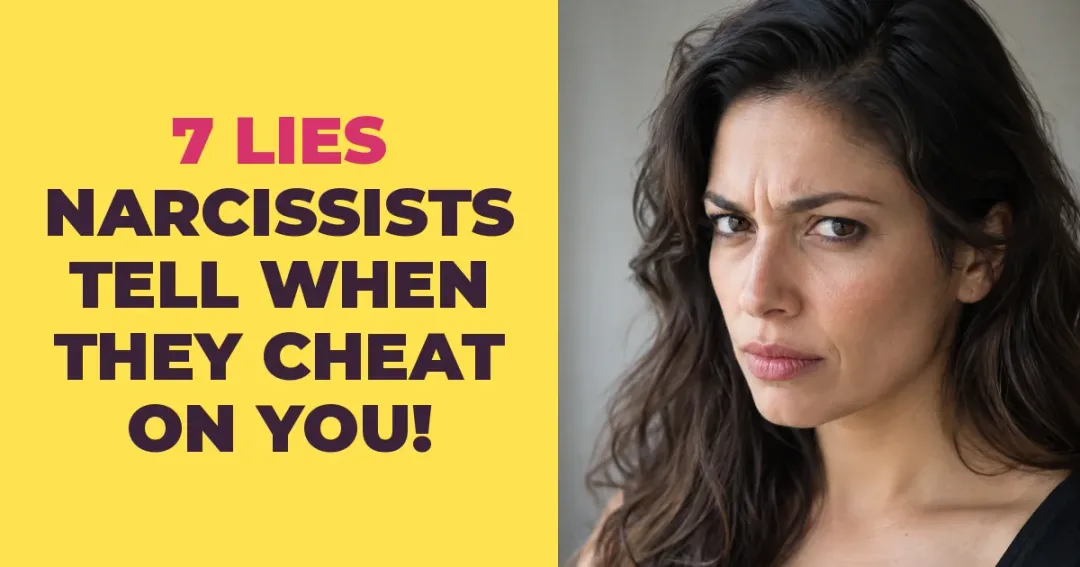
Here are 7 lies narcissists tell when they are cheating on you, and what each one is really doing.
Why the lies land so well
If you’re kicking yourself for not seeing it sooner, stop for a second.
Psychologists call this betrayal blindness. When you rely on a partner, part of your mind can quietly screen out proof that they’re betraying you, because seeing it would put the attachment at risk.
It isn’t stupidity.
It’s protection.
So when a lie offers an easy way out, part of you grabs it. That says you were attached. Nothing worse.
#1 That new friend gets a lot of texts
The ‘friend’ they keep mentioning is often there to keep you off balance.
Her name comes up at dinner, then again in the car. Their phone lights up during a movie, and they grin and tilt the screen away. Saturday’s quick coffee somehow runs three hours.
“Relax, she’s just a friend. Why are you being so weird?”
Psychologists call this triangulation. A third person gets dragged into what should stay between the two of you, and jealousy does the rest of the work.
Research also ties narcissism to a casual, keep-the-door-ajar approach to love. Exes and admirers tend to hover nearby, just in case.
So you start to feel replaceable.
You never agreed to this contest. So who’s keeping score?
#2 Your memory gets rewritten
When the evidence is right in front of you, a narcissist may simply deny it.
See also 8 Truths Narcissists Face Once You Walk Away
You saw the message on the lock screen. You read the name. You know what time they actually came home, because you were lying awake watching the clock.
“That never happened. You’re making things up again.”
This is gaslighting. They chip away at your trust in what you saw, so their story is the one left standing. It works best on a partner who trusts them.
Soon you’re saving screenshots like you’re building a court case. You may even say sorry, after being the one who got hurt.
Jot down what happened on the same day. Then run it past a friend who has nothing riding on the story.
Your eyes were working fine.
#3 Your pain gets called insecurity

Your hurt is real, even when they insist it’s only insecurity talking.
You finally say it, quietly, in the kitchen. Something feels off, and it’s been eating at you for weeks.
They sigh. “You’re so insecure. You’re too sensitive about everything.” Then they reach for the remote and turn the volume up.
Here’s what stings.
Studies found narcissists tend to tune out other people’s feelings, yet show more empathy when nudged to imagine your side. That looks more like a choice than a missing ability.
Over time, you stop opening up and start second-guessing every reaction. Your feelings belong with people who actually answer them.
Insecure? You noticed.
#4 It meant nothing, they swear
When a narcissist swears it meant nothing, that may be the most unsettling part.
The tears, the flowers, the long talk on the sofa at two in the morning. “She was nobody. One stupid mistake. It meant nothing, I promise.”
You want to believe it. Who wouldn’t?
Research ties narcissism to treating romance like a contest. They hold back from true intimacy, and once the prize feels won, the spark often fades fast.
Seen that way, the affair may really have meant little to them.
So might the apology.
See also 8 Signs A Narcissist Knows Their Time With You Is Up
Watch the ordinary weeks that follow, not the big scene. Real change doesn’t need a speech.
#5 Somehow the affair becomes your fault
Raise the affair, and a narcissist may put you on trial instead.
You bring up the hotel receipt. Ten minutes later, you’re hearing about your weight, your mother, and how you never make time for them anymore.
“You were so cold. What did you expect?” Then the tears start, and somehow you’re the one doing the comforting.
Researchers have a name for this: DARVO. They deny it, go on the attack, then swap places with you and play the injured one.
Studies found this leaves the partner who spoke up blaming herself more. No wonder these talks so often end with your apology.
Skip the side arguments. Bring it back, calmly, to what they did.
The receipt is still the receipt.
#6 They promise a fresh start

A shiny promise about tomorrow can stop you looking hard at today.
Suddenly there’s talk of the trip you always wanted. The new house. Maybe even a ring. “Once work calms down, it’s just us. I swear.”
Future faking is a popular label, not a formal term, for big promises made to keep you hooked, with no plan to keep them.
It works because the more you’ve pictured that future, the more it hurts to give it up.
It also fits research showing narcissists often rush into commitment, then cool off once the chase is over.
So you wait. And asking ‘when?’ feels like nagging.
Look at what has really happened. How many of those plans ever got booked?
#7 They accuse you of cheating
The partner shouting about your loyalty is often the one being disloyal.
You smile at a waiter. Your brother texts about Sunday lunch. You stay twenty minutes late at work.
“Who were you really with? Don’t lie to me.”
Meanwhile, their phone never leaves their pocket.
See also 9 Things You Can Say That Infuriate a Narcissist
Psychologists call this projection. Pinning their own guilty behaviour on you means they never have to face it in the mirror.
So you wear yourself out answering charges you didn’t earn, while the real issue slips quietly out of view.
Say what’s true one time. The constant accusations tell you about them.
If you believed the lies, it’s because you trusted someone you loved.
Trust was never the flaw.
Talk to yourself the way you’d talk to a friend who just found out. Note what you know. Find one person who believes you. You saw more than they ever wanted you to.
Sources
- Campbell, W. K., Foster, C. A., & Finkel, E. J. (2002). Does self-love lead to love for others? A story of narcissistic game playing. Journal of Personality and Social Psychology, 83(2), 340-354.
- Neff, K. D. (2003). Self-compassion: An alternative conceptualization of a healthy attitude toward oneself. Self and Identity, 2(2), 85-101.
- Freyd, J. J. (1996). Betrayal Trauma: The Logic of Forgetting Childhood Abuse. Harvard University Press.
- Bowen, M. (1978). Family Therapy in Clinical Practice. Jason Aronson.
- Sweet, P. L. (2019). The sociology of gaslighting. American Sociological Review, 84(5), 851-875.
- Stern, R. (2007). The Gaslight Effect. Morgan Road Books.
- Hepper, E. G., Hart, C. M., & Sedikides, C. (2014). Moving Narcissus: Can narcissists be empathic? Personality and Social Psychology Bulletin, 40(9), 1079-1091.
- Freyd, J. J. (1997). Violations of power, adaptive blindness, and betrayal trauma theory. Feminism & Psychology, 7(1), 22-32.
- Harsey, S. J., Zurbriggen, E. L., & Freyd, J. J. (2017). Perpetrator responses to victim confrontation: DARVO and victim self-blame. Journal of Aggression, Maltreatment & Trauma, 26(6), 644-663.
- Arkes, H. R., & Blumer, C. (1985). The psychology of sunk cost. Organizational Behavior and Human Decision Processes, 35(1), 124-140.
- Baumeister, R. F., Dale, K., & Sommer, K. L. (1998). Freudian defense mechanisms and empirical findings in modern social psychology. Journal of Personality, 66(6), 1081-1124.
Belle Souls articles explain patterns described in psychology research and recovery writing. They are not a diagnosis and not a substitute for help from a qualified professional.