You said one calm, true sentence. And the air in the room changed.
Their jaw went tight. The sulk lasted three days. Or the shouting started before you’d even finished.
Being seen clearly can feel like a threat to a narcissist’s self-image.
Plain, honest words can hit harder than any insult, because they poke at the fragile self-image they work so hard to protect.
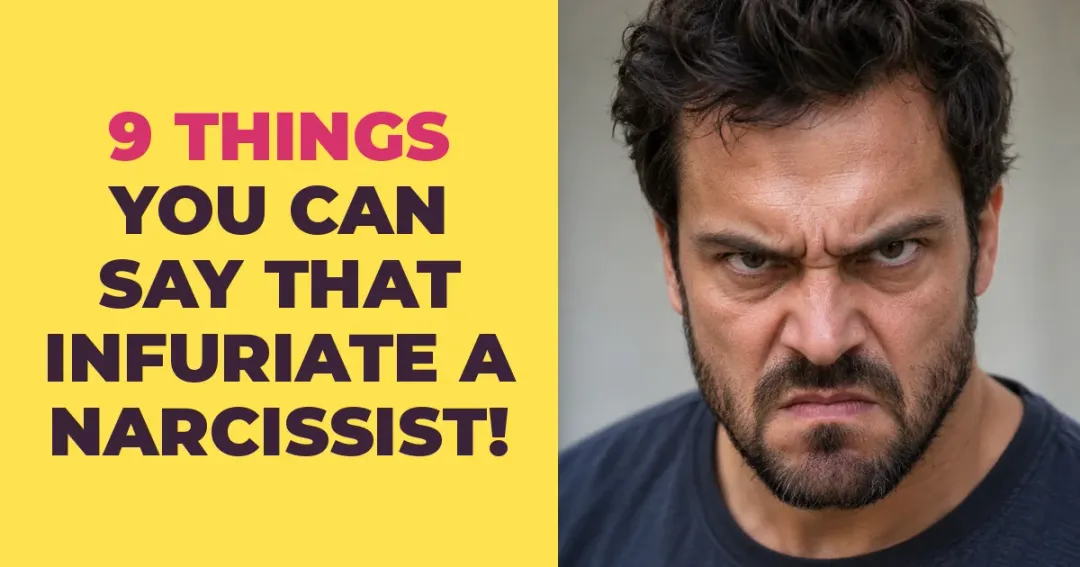
Here are 9 things you can say that infuriate a narcissist, and why each one stings so much.
Why plain truth feels like an attack
A narcissist’s sense of worth leans on outside confirmation. Your admiration. Your agreement. Your silence.
So when you correct them, refuse them or simply stop clapping, it can register as an attack. Research on threatened egotism found narcissists respond to insults with more aggression, aimed at whoever caused the sting.
That’s why this list is no dare. If their anger has ever turned into threats or breaking things, the safest truth might be the one you keep to yourself. Leave the room when you need to.
Your safety comes first. Always.
#1 You’re no more special than anyone
Nothing stings a narcissist like being treated as one of the crowd.
The waiter got their order wrong. The promotion went to someone else. Your sister’s news got more attention at Sunday dinner. And suddenly, a storm.
“Do they know who I am?” Many narcissists expect special treatment and get angry when it doesn’t come.
Why? Their sense of worth leans on outside confirmation. Being ordinary feels like vanishing.
So a calm “Everyone has to wait, not just you” can land like a slap.
Meanwhile, your own needs get treated as an inconvenience.
One tantrum proves little. Months of them tell you plenty.
#2 I’m done hearing about your wins
Refusing to be the audience is one of the fastest ways to bruise a narcissist.
You mentioned your day. Twenty minutes later you’ve heard about their deal, their gym record and how impressed everybody was.
See also 6 Reasons Narcissists Are Nicer To Everyone Else Than To You
Psychologists describe a loud form of narcissism that needs the spotlight and dominates conversations. Many also exaggerate what they’ve achieved.
The bragging is fuel.
So when you say, “Can we talk about something else?”, the fuel stops. They may shrug like they don’t care. Watch closely anyway.
Notice how they act when they’re not the centre of attention. A sulk, a dig, a sudden cold shoulder.
You’re a person with your own day. Not their mirror.
#3 Other people have feelings too
Narcissists often understand exactly how you feel. Acting on it is another matter.
You’re crying at the kitchen table. They ask what’s for dinner. Or they sigh, “You’re too sensitive,” and change the subject.
Studies found narcissists show less empathy by default, but more when prompted to take the other person’s view. That suggests a choice more than an inability.
So “Think about how that felt for her” lands badly. It points at something that looks more like a choice than a blind spot.
Over time, you stop sharing. You start doubting your own reactions.
Stop explaining your pain to someone who uses it.
Take it to people who actually listen.
#4 No more loans until you pay me back
Entitlement makes ordinary limits feel like personal insults.
They borrowed money in March and never paid it back. Now they want more, and they’re annoyed you hesitated.
“Seriously? After all this time, you’re keeping score?”
Many narcissists carry a steady belief that rules apply to everyone else. So a normal request from you feels like an attack to them.
That’s why “I’m not lending again until the last loan is back” can feel like starting a war. Asking for fairness often does.
Keep track of what you give. Stop pre-paying, pre-forgiving and pre-agreeing.
You’ve been giving more and getting less. Let the numbers show it.
#5 This need for attention wears me out
Not every narcissist is loud. The quiet ones sulk when they aren’t noticed.
See also A Narcissist Loses Their Grip On You Once You Learn This One Skill
You spent the evening catching up with an old friend. On the drive home, the silence is thick. “No, I’m fine. Clearly I’m invisible.”
Psychologists describe a quiet form of narcissism: touchy, resentful, self-pitying. It keeps score of slights. Many switch between quiet and loud.
Both forms protect a fragile self-image.
You end up walking on eggshells, managing their moods like a second job. And you get blamed for their disappointment.
They’re often hypersensitive to criticism while acting indifferent. So even a gentle “this wears me out” can sting.
Watch for an apology with no “but” attached. Does one ever come?
#6 Your charm doesn’t work on me now
The charm that won you over was never the whole story.
At parties they’re funny, warm, the one everybody adores. In the car home, silence. Your friends still tell you how lucky you are.
Research on narcissistic admiration and rivalry explains the switch. Charm wins people over early. Over time, putting others down takes over.
So first impressions shine, and later ones sour.
Then the sweet voice comes out: “Come on, you can’t stay mad at me.” And you don’t melt. Their best tool just stopped working.
Meanwhile, part of you may still be chasing the person you met at the start.
Trust what happens behind closed doors. That’s the real one.
#7 No is a full answer
A boundary doesn’t need their permission, and that is exactly what bothers them.
They want you at their work dinner. You’ve got plans. Cue the debate, the sighing, the “Wow. Fine. I’ll just go alone, like always.”
Boundary is a popular word without a strict definition. Put simply, it’s about what you’ll do to protect yourself, rather than a rule for what they must do.
That idea matters most with someone who tries to control your days, your money or your friends.
“No, I’m not coming” needs no essay attached.
Expect pushback at first. State it once, act on it every time.
See also Hand A Narcissist Any Of These 11 Things And You Will Regret It
The guilt comes first. Self-respect follows.
#8 Guilt won’t move me anymore
Guilt is the leash a narcissist may pull hardest when you start saying no.
“After everything I’ve done for you.” “If you leave, I don’t know what I’ll do.”
There’s a popular name for this: FOG, short for fear, obligation and guilt. It isn’t a formal diagnosis. It describes emotional blackmail that makes no feel costlier than giving in.
Research on coercive control describes how many small pressures like these add up, until your world gets smaller.
Yes becomes automatic. Their moods start to feel like your job.
So a calm “I hear you, and my answer is still no” snaps the lever.
Pause before you answer. Their feelings belong to them.
#9 I know what I saw
Gaslighting only works while you doubt yourself, so your certainty is a real problem for them.
“That never happened.” “You’re imagining things again.” You saw the message. You heard the words. Ten minutes later, you’re the one apologising.
Gaslighting means making you doubt your own memory and perception so their version of events wins. It works best where power is unequal and they control the story.
You might start keeping notes just to prove what happened.
Two people recalling the same night differently is normal. Being told you didn’t see what you saw is not.
Write things down when they happen. Check in with someone outside the relationship.
Your memory is yours. Keep it.
You never have to say a single one of these out loud. Knowing why they sting already changes how the storm feels.
That fury over one small, true sentence was never proof you did something wrong.
Keep your notes honest and your people close. Isolation is part of how manipulation works. Reconnection is how you climb back.
If you feel unsafe: in the US, call the National Domestic Violence Hotline at 1-800-799-7233 (thehotline.org). In the UK, call the National Domestic Abuse Helpline on 0808 2000 247. If you are in immediate danger, call your local emergency number.
Sources
- American Psychiatric Association. (2022). Diagnostic and Statistical Manual of Mental Disorders (5th ed., text rev.).
- Pincus, A. L., & Lukowitsky, M. R. (2010). Pathological narcissism and narcissistic personality disorder. Annual Review of Clinical Psychology, 6, 421-446.
- Wink, P. (1991). Two faces of narcissism. Journal of Personality and Social Psychology, 61(4), 590-597.
- Miller, J. D., Lynam, D. R., Hyatt, C. S., & Campbell, W. K. (2017). Controversies in narcissism. Annual Review of Clinical Psychology, 13, 291-315.
- Herman, J. L. (1992). Trauma and Recovery. Basic Books.
- Bancroft, L. (2002). Why Does He Do That? Inside the Minds of Angry and Controlling Men. Berkley.
- Bushman, B. J., & Baumeister, R. F. (1998). Threatened egotism, narcissism, self-esteem, and direct and displaced aggression. Journal of Personality and Social Psychology, 75(1), 219-229.
- Hepper, E. G., Hart, C. M., & Sedikides, C. (2014). Moving Narcissus: Can narcissists be empathic? Personality and Social Psychology Bulletin, 40(9), 1079-1091.
- Campbell, W. K., Bonacci, A. M., Shelton, J., Exline, J. J., & Bushman, B. J. (2004). Psychological entitlement: Interpersonal consequences and validation of a self-report measure. Journal of Personality Assessment, 83(1), 29-45.
- Back, M. D., Kufner, A. C. P., Dufner, M., Gerlach, T. M., Rauthmann, J. F., & Denissen, J. J. A. (2013). Narcissistic admiration and rivalry. Journal of Personality and Social Psychology, 105(6), 1013-1037.
- Goffman, E. (1959). The Presentation of Self in Everyday Life. Doubleday.
- Cloud, H., & Townsend, J. (1992). Boundaries. Zondervan.
- Stark, E. (2007). Coercive Control: How Men Entrap Women in Personal Life. Oxford University Press.
- Forward, S., & Frazier, D. (1997). Emotional Blackmail. HarperCollins.
- Sweet, P. L. (2019). The sociology of gaslighting. American Sociological Review, 84(5), 851-875.
- Stern, R. (2007). The Gaslight Effect. Morgan Road Books.
Belle Souls articles explain patterns described in psychology research and recovery writing. They are not a diagnosis and not a substitute for help from a qualified professional.