A narcissist can look straight at you and say, “That never happened.”
You ask something simple. Where were you? Why did you say that? What comes back is a speech, a joke, a fight or a long, cold silence.
You still don’t know where they were.
So you ask again. And again. Slowly, you start to wonder if the problem is the way you ask. Or you.
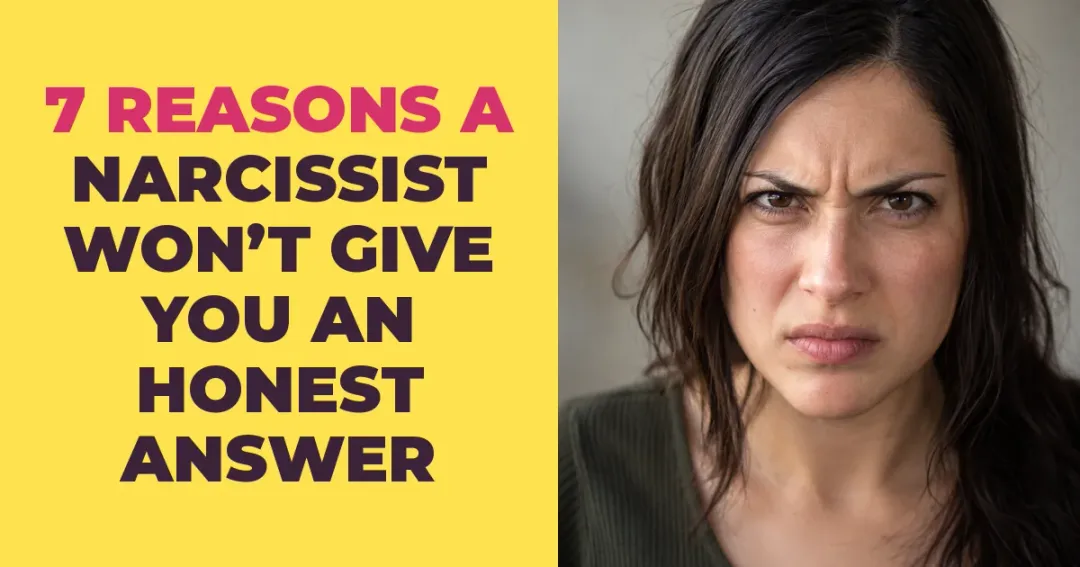
It isn’t. Here are 7 reasons you’ll never get an honest answer from a narcissist, and what is really going on each time you try.
What sits under every dodge
Many narcissists need other people to keep confirming how great they are. Praise holds them up. Whatever wobbles that picture feels like danger, and that includes your questions.
They may puff up what they’ve done and expect special treatment. Your needs, including your need for a straight answer, get treated as an inconvenience.
We’re talking about a pattern here, not a diagnosis.
And an honest answer would crack the picture.
#1 Their version has to win
A narcissist may rewrite what happened until their version is the only one left.
You bring up the comment they made at dinner. They frown. “I never said that. You’re too sensitive.” Ten minutes later, you’re the one apologising.
Psychologists call this gaslighting. It thrives when one person holds more power. Your trust hands them the pen, and they redraw the scene.
Their version is the answer.
What it does to you is quiet and heavy. You start saving screenshots and keeping notes on your phone, just to prove to yourself that you’re not imagining things.
Jotting down what happened on the day helps. So does a reality check with a friend outside the relationship, someone who can say, “No, that really happened.”
You weren’t imagining it.
#2 Their image matters more than the truth
A narcissist may invest heavily in the version of themselves everyone else sees.
See also 10 Reasons Your Entire Life With The Narcissist is a Lie
At the party, they’re charming. They top up drinks, tell the funny story, hug your mum. In the car home, they don’t say a single word to you.
Your friends tell you how lucky you are.
We all polish how we come across a little. For a narcissist it’s a big project, because being admired keeps their self-worth topped up. An honest answer that makes them look bad? Far too expensive.
So the truth gets edited for the audience. Even when the audience is just you.
That gap does real damage. When nobody else sees the cold side, nobody believes you, and you start doubting what you lived through.
Believe what happens once the front door closes. Lean on anyone who has watched both versions of them. That’s the real one.
#3 A simple question feels like an attack
To a narcissist, even a basic question can feel like an insult to their image.
“Did you pay the electric bill?” Simple. Then the cupboard door slams. “Oh, so now I’m useless? Great. Thanks a lot!”
Why so big, over something so small?
Research on threatened egotism points to this. Narcissists who feel insulted tend to hit back harder, and they aim it at whoever they think caused the sting. Tonight, that’s you.
Sometimes the punishment comes days later, over a remark you’d already forgotten.
So you learn. You rehearse every sentence before it leaves your mouth. You apologise for things that were never yours, just to keep the house calm.
Keeping criticism short and factual is the safer way to raise something. When it feels unsafe, you can skip asking altogether. If the anger tips into threats, get out of the room. Your safety matters more than any answer.
#4 Admitting fault feels too dangerous
Behind the bravado, many narcissists are guarding a self-image that bruises easily.
Criticism lands hard on them. Even when they shrug like they couldn’t care less.
See also Strange Ways Narcissists Watch You Without Saying a Word
So honesty never stays simple. You ask why they forgot your birthday, and suddenly they’re the wounded one. “I can never do anything right with you. Do you know how hard my week was?”
A plain “I forgot, I’m sorry” would mean being seen as flawed. Playing the hurt one keeps the fault off them.
You end up consoling them over your birthday.
And somehow their disappointment becomes your fault. You tiptoe around whatever mood walks in the door.
One way to tell: has an apology of theirs ever come with no but attached?
#5 Everyone gets a different story
Some narcissists feed each person the story that pleases them most.
Their mum hears one story. Your sister hears another. Their boss hears a third. You get a fourth, delivered calmly, with a reasonable smile.
Psychologists call this calculating style Machiavellianism. It’s patient. Charm here, a half-truth there, a spotless reputation out front, and quiet moves against you in the back.
With a different story for each person, a plain answer to you is hard to keep consistent.
That’s why the scheme often only becomes visible once it’s done. And when you try to explain, people don’t believe you, because what they see is someone calm and sensible.
Keep your private details to yourself. Get agreements in a text or email, even tiny ones.
A text can’t be retold.
#6 They accuse you of lying

Catch a narcissist in a lie, and you may suddenly be the liar.
The receipt was sitting in the car. You ask about it, calmly. “Why are you always checking up on me? You’re the one who lies.”
Psychologists call this projection. Pinning a trait they dislike on you means they never have to spot it in the mirror. That’s how someone mid-shout can tell you to calm down.
So your honest question turns into your trial.
Soon you’re defending charges you never earned. And the original issue, that receipt, has vanished from the conversation.
See also Strange Things Narcissists Do When They Believe You’re Asleep
When the same accusation keeps coming back, read it as a hint about the one making it. Say what’s true one time. Then stop explaining.
So what do they keep accusing you of?
#7 Asking makes you the problem
Confront a narcissist with the truth, and you may end the night apologising to them.
Psychologists call the pattern DARVO: deny, attack, reverse victim and offender.
It goes like this. “I never did that. How dare you accuse me?” Then comes a list of everything you’ve done wrong since the day you met. Then tears, or a sulk, until you’re comforting them.
Research found this move leaves the person who spoke up feeling more to blame. That’s the point: it shuts the talk down fast. It’s also why you’ve slowly stopped bringing things up.
You don’t owe a reply to each jab they throw back. Steer back, calmly, to what you first asked. One sentence is enough.
If their reaction turns frightening, you can drop the topic and leave the room.
Your question was fair. It still is.
Not getting an honest answer was never about how you asked.
You can trust what you saw. Write it down, tell one person who listens, and let that be enough for today.
The dinner comment happened. The forgotten birthday happened. You saw what you saw.