Few things threaten a narcissist like being seen clearly.
And lately, something has shifted. You caught the lie. You noticed the pattern. Maybe you said it out loud, or maybe you just stopped laughing at the jokes.
They noticed too.
Now the ground keeps moving under your feet, and you’ve begun to question whether any of it was real.
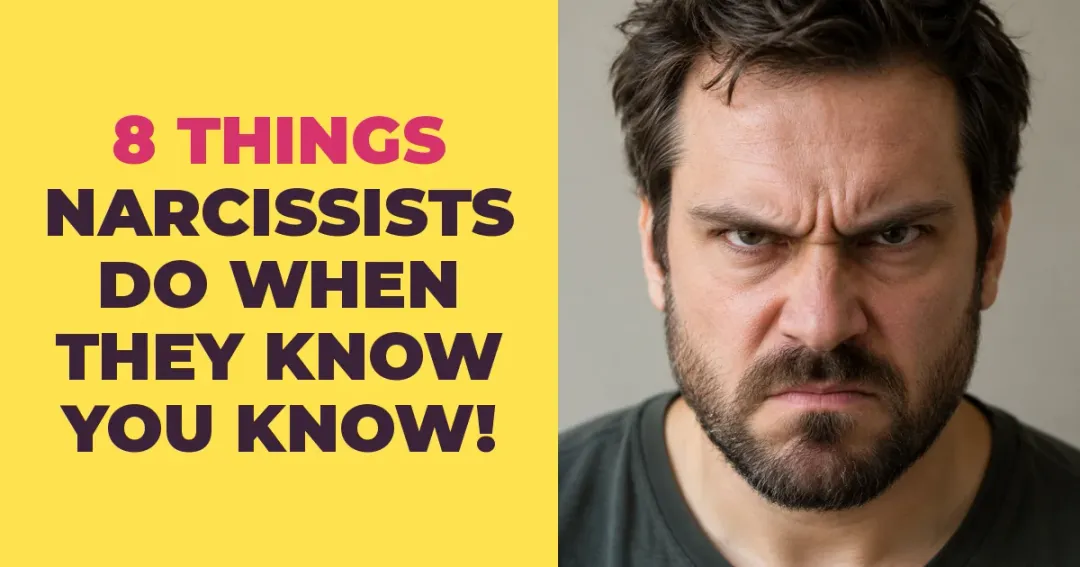
It was. Here are 8 things a narcissist does when they know you know.
Why being seen scares them
Under all the show, a narcissist’s self-worth tends to be on loan. It leans on other people handing back a polished image.
Think about it. You were the mirror. The moment you see through them, the mirror turns into a threat.
Psychologists describe two faces of narcissism, one loud and one quiet, and plenty of narcissists flip between them. Each guards the same brittle self-image. The loud face shows off. The quiet one sulks and nurses its grievances.
Expect to meet both.
#1 They deny it ever happened

Flat denial tends to come first, usually without a flicker.
You mention the message you saw, the dig at dinner, the missing cash. They meet your eyes, totally calm. “That never happened. You’re too sensitive.”
Psychologists call this gaslighting. It lands because you trust them, and because the story of your shared life has been theirs to tell for years.
So your own eyes start to feel unreliable.
Soon your phone fills with screenshots and notes, saved just to prove you’re not losing it. You find yourself saying sorry after being the one who got hurt.
Couples recall the same evening in different ways all the time. Gaslighting is something else: insisting you didn’t see what you saw, until you stop trusting yourself.
Jot it down the same day. A notebook can’t be talked out of anything.
#2 Suddenly you’re the one with the problem

Catch them lying, and the word “liar” often lands on you instead.
See also What Is the Real Root of Narcissism?
You ask about the woman in the group chat. Within ten minutes it’s “What about your ex? You’re the one hiding things.”
Psychologists call this projection. Pinning the ugly trait on you means they never have to look at it in themselves.
The one who takes everything calls you selfish. The one yelling tells you to calm down.
It’s exhausting. You spend all evening answering charges you never earned, and by bedtime the original question is gone.
Not every jab is projection. Honest criticism hurts sometimes too. But an accusation that keeps circling back says more about them than about you.
Say what’s true once. Then stop explaining.
#3 Now they’re the wounded one

When the facts stop working, a narcissist may flip the script and play the victim.
You finally bring up what hurt you. First it didn’t happen, then you’re cruel for asking, then come the tears. “I can’t believe you’d think that of me. After the week I’ve had?”
Psychologists have a name for this: DARVO. Deny, attack, then reverse who’s the victim and who’s the offender.
Studies show it leaves the person who raised the issue feeling more to blame. No wonder the talk ends so quickly.
Before long you’re the one doing the comforting. You say sorry for speaking up. Next time, you keep quiet.
If you can, steer back to the first issue and let the counter-attack go.
And notice this: do their apologies ever come without a “but”?
#4 The anger comes out of nowhere

A narcissist whose ego gets bruised by being seen often answers with rage.
In the car you ask something simple. “Why did you tell your mum we cancelled?” Now they’re yelling, knuckles white on the wheel, and you’re watching the road go by.
Psychologists studying threatened egotism saw narcissists turn more aggressive after an insult, and they aimed it at the person they held responsible.
Right now, that’s you.
See also What Happens To Narcissists In The End?
Other times it’s icy silence, or payback days later for a comment you’d long forgotten. So every sentence gets edited before you say it, and you apologise for things you never did.
Anger is human. This kind is far bigger than the moment, pointed at whoever dented the image.
If it ever tips into threats, get out of the room. Being safe matters more than finishing any talk.
#5 Your name gets dragged behind your back

Once you know, a narcissist often hurries to get their story out first.
A mutual friend stops replying. Your sister-in-law asks, softly, if you’re “doing okay.” Somebody mentions you’ve seemed “really unstable lately.”
Psychologists call this relational aggression, and a smear campaign is one form of it. It goes after your standing with people, not your body, so there’s nothing anyone can see.
And people buy it. All they’ve met is the charmer. Life of the party, then stone silent on the drive home.
You feel on trial everywhere. And you lose support at the exact moment you need it most.
Believe what goes on at home. Stay the same steady person, and give time a chance to show who’s consistent.
You’ve seen the private version. That counts.
#6 The future gets painted bright again
Shiny promises about later can keep you hooked in the now.
The moment you start drifting, plans appear. Italy. A house with a garden. “Once this busy stretch at work is over, I promise.”
Many call this future faking. It’s a popular label, not a formal term, for detailed plans offered with no intention of keeping them. It links to research showing that hope rewarded at random is harder to walk away from.
Why does it work? A future you’ve already put yourself into feels too costly to lose.
So you wait.
The date slides and nothing gets rebooked. Bring it up later and it’s “I never said that.” Genuine plans fall through too, but those get a new date.
See also 10 Morning Habits That Reveal You Live With a Narcissist
Look at what’s really happened. How many of those trips have you taken?
#7 They drop you like you never mattered
Stop playing the adoring audience, and a narcissist may just walk away.
No big talk. No closure. Only a flat “I think we want different things,” and within a week a new face shows up in their photos.
Many call this the discard. It’s a popular name for a familiar arc: pedestal, criticism, exit.
Research offers a reason. Narcissism goes along with a game-playing approach to love. The charming side reels you in, and later competition and boredom win out. After they feel they’ve won, the interest drains away.
You feel replaceable.
Somehow the ending feels like your fault, too. Every couple cools down after the early rush. This is different: contempt, then a replacement.
How fast they dropped you says something about them. Not about your worth.
#8 Then the door swings back open

Just as life gets quieter, a narcissist will often reappear.
Maybe it’s your birthday, or three silent months have passed. Your phone lights up. “I miss you. I’ve been doing a lot of thinking.”
Many call this hoovering, a popular word for trying to reel you back in. It tends to turn up when they need something or feel replaced.
The bond is what makes it work. Psychologists call it trauma bonding: when hurt and tenderness keep taking turns, the attachment can grow stronger than in a calm relationship.
So hope floods back. One message, and weeks of progress seem to vanish.
Feeling that pull isn’t weakness. It’s a recognised reaction.
Pick your response ahead of time. Then weigh the history, not the new promise.
Seeing yourself in these pages doesn’t mean you’re imagining things. It means you’re spotting a pattern.
Denial, blame, tears, rage, smears, the vanishing act, the comeback. Once you can name each move, you’ll spot it sooner the next time it starts.
If any of it frightens you, start with one trusted person and tell them everything. Isolation is how manipulation gets its grip, so letting people back in helps you find your footing again.
If you feel unsafe: in the US, call the National Domestic Violence Hotline at 1-800-799-7233 (thehotline.org). In the UK, call the National Domestic Abuse Helpline on 0808 2000 247. If you are in immediate danger, call your local emergency number.
Sources
- American Psychiatric Association. (2022). Diagnostic and Statistical Manual of Mental Disorders (5th ed., text rev.).
- Pincus, A. L., & Lukowitsky, M. R. (2010). Pathological narcissism and narcissistic personality disorder. Annual Review of Clinical Psychology, 6, 421-446.
- Wink, P. (1991). Two faces of narcissism. Journal of Personality and Social Psychology, 61(4), 590-597.
- Miller, J. D., Lynam, D. R., Hyatt, C. S., & Campbell, W. K. (2017). Controversies in narcissism. Annual Review of Clinical Psychology, 13, 291-315.
- Herman, J. L. (1992). Trauma and Recovery. Basic Books.
- Bancroft, L. (2002). Why Does He Do That? Inside the Minds of Angry and Controlling Men. Berkley.
- Sweet, P. L. (2019). The sociology of gaslighting. American Sociological Review, 84(5), 851-875.
- Stern, R. (2007). The Gaslight Effect. Morgan Road Books.
- Baumeister, R. F., Dale, K., & Sommer, K. L. (1998). Freudian defense mechanisms and empirical findings in modern social psychology. Journal of Personality, 66(6), 1081-1124.
- Freyd, J. J. (1997). Violations of power, adaptive blindness, and betrayal trauma theory. Feminism & Psychology, 7(1), 22-32.
- Harsey, S. J., Zurbriggen, E. L., & Freyd, J. J. (2017). Perpetrator responses to victim confrontation: DARVO and victim self-blame. Journal of Aggression, Maltreatment & Trauma, 26(6), 644-663.
- Bushman, B. J., & Baumeister, R. F. (1998). Threatened egotism, narcissism, self-esteem, and direct and displaced aggression. Journal of Personality and Social Psychology, 75(1), 219-229.
- Crick, N. R., & Grotpeter, J. K. (1995). Relational aggression, gender, and social-psychological adjustment. Child Development, 66(3), 710-722.
- Goffman, E. (1959). The Presentation of Self in Everyday Life. Doubleday.
- Arkes, H. R., & Blumer, C. (1985). The psychology of sunk cost. Organizational Behavior and Human Decision Processes, 35(1), 124-140.
- Ferster, C. B., & Skinner, B. F. (1957). Schedules of Reinforcement. Appleton-Century-Crofts.
- Dutton, D. G., & Painter, S. (1993). Emotional attachments in abusive relationships: A test of traumatic bonding theory. Violence and Victims, 8(2), 105-120.
- Back, M. D., et al. (2013). Narcissistic admiration and rivalry. Journal of Personality and Social Psychology, 105(6), 1013-1037.
- Campbell, W. K., Foster, C. A., & Finkel, E. J. (2002). Journal of Personality and Social Psychology, 83(2), 340-354.
- Campbell, W. K., Foster, C. A., & Finkel, E. J. (2002). Does self-love lead to love for others? A story of narcissistic game playing. Journal of Personality and Social Psychology, 83(2), 340-354.
Belle Souls articles explain patterns described in psychology research and recovery writing. They are not a diagnosis and not a substitute for help from a qualified professional.