Loving a narcissist can feel like pouring water into a glass with no bottom.
You give. You wait. You hope the next good day is the one that finally lasts.
And somehow you’re still the one saying sorry.
You’re not imagining it.
Here are 7 painful realities of loving a narcissist, why they happen, and one thing that helps with each.
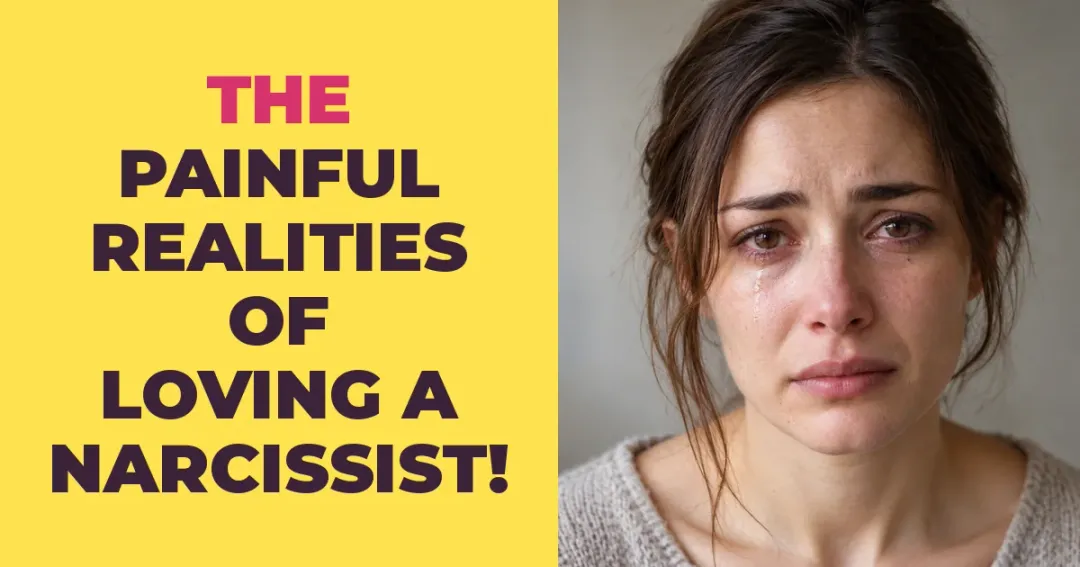
#1 You’ll love harder than they ever will

You will often love them far more than they choose to love you.
You cry in the kitchen after a brutal day at work. They glance up from their phone, then ask what’s for dinner.
Or worse: “You’re too sensitive.”
Your needs land like an inconvenience. Theirs land like emergencies.
Studies on empathy point to something hard to hear. A narcissist may grasp exactly how you feel. Whether they do anything with that depends on what’s in it for them.
So you keep explaining your hurt louder and clearer, as if the problem were your wording. It isn’t.
Over time, you stop sharing at all and start second-guessing every reaction. Your hurt deserves someone who answers it. Who in your life actually does?
#2 Hope becomes the whole relationship
Hope is the hook that keeps you holding on through the worst days.
Monday they’re cold. Wednesday they bring your favourite coffee and say, “Let’s book that trip this summer.” By Friday the trip has quietly vanished.
Why does this grip so hard?
Psychologists call it intermittent reinforcement. When warmth arrives at random, between stretches of coldness, it grips tighter than warmth you can count on. Slot machines run on the same trick.
Then there’s what many call future faking: the house, the wedding, the trip, promised in detail and never quite arriving. It’s a popular term, not a diagnosis, but it feeds that same unpredictable reward.
You end up working harder for less, waiting for a life that keeps sliding out of reach. Try rating the ordinary Tuesdays, not the rare perfect Saturday.
See also Stop Believing You Expect Too Much From The Narcissist. You’re Asking The Wrong Person
So what do the Tuesdays look like?
#3 Your own memory stops feeling safe
A narcissist can make you doubt things you saw with your own eyes.
You bring up the comment they made at dinner with your sister. “That never happened. You’re imagining things again.”
You were there. Still, a small voice wonders.
Psychologists call this gaslighting: chipping away at your trust in what you saw until their account is the only one left standing. It thrives when one person holds more power, since your faith in them hands them the pen.
So you start keeping notes on your phone, just to prove to yourself what happened. You apologise for being hurt.
Two people recalling an evening a little differently is normal. Being told, again and again, that you didn’t see what you saw is something else entirely.
Jot it down the same day. Run it past a friend who isn’t inside it. Your memory isn’t the broken part.
#4 Peace lasts only as long as you obey
Peace in the house often depends on you doing exactly what they want.
You hear the keys in the door and your shoulders rise. You check the sink, rehearse your words, and read the mood from how the door shuts.
One small question, “Did you call the plumber?”, and the whole evening explodes.
Researchers studying what they call threatened egotism saw that when a narcissist feels insulted, the anger runs hotter and lands on whoever bruised them. Even a plain question can register as an attack.
So your body learns to stay on alert. You agree before you think. You pre-edit each sentence and apologise for things you didn’t do.
That’s how people survive anger they can’t predict.
And if the anger turns into threats, you’re allowed to leave the room. Your safety comes first.
#5 They take, and you keep giving
You give your time, money and energy, and they treat it as owed.
See also Most Parents Would Be Shocked If They Found Out Narcissists Do This To Their Children
You cancel your plans because theirs suddenly matter more. You lend money that never comes back. They tell friends the kitchen renovation was all their idea.
Ask for fairness? “Wow. After everything I do around here?”
Psychologists call this entitlement. Deep down, they feel owed extra, and rules are something other folks follow. So a normal limit from you reads to them as a personal snub.
Which is why your perfectly reasonable request lands like a declaration of war.
You give more. You get less.
One quiet step: jot down what goes out from your side, and notice how often you say yes, forgive or pay before anyone even asks. Numbers don’t argue back.
#6 The bond pulls harder than logic
You can know they hurt you and still ache to go back.
Your friend asks why you stay. You hear yourself say, “They had a hard childhood,” or “We’ve been through so much together.”
And part of you believes it.
Psychologists call this trauma bonding. When hurt and tenderness keep taking turns, and one person holds more power, the attachment can grow tighter than anything a calm relationship builds.
Add cognitive dissonance: two beliefs that can’t sit comfortably together, “they love me” and “they hurt me.” To quiet that discomfort, you find reasons for the bad parts. All those invested years make leaving feel like throwing them away.
So logic says one thing and your heart says another. You argue with yourself half the night.
This is a known human reaction. It says nothing bad about you. The real question is what the future will cost, not what the past already took.
#7 You’ll grieve the person they promised to be
The hardest loss is the person they seemed to be at the very start.
The texts all day. The talk of soulmates in week three. The way they looked at you across the table as if nobody else existed.
See also Nothing Hurts Like Watching A Narcissist Harm Your Child
Then, slowly, the cutting comments. The coldness. The competing.
Research on narcissistic admiration and rivalry helps explain the shift. At first, they lead with charm and shine. Later, the drive to cut others down wins out. It’s why meeting them felt like magic and living with them feels like a slow chill.
Love bombing speeds it up: a flood of messages, gifts and big plans that ties you in before you’ve watched them handle a hard week. Later, that flood is what you keep trying to get back.
So you grieve twice. Once for the relationship, and once for someone who was mostly a first impression.
You weren’t foolish for believing it. It was built to be believed.
If you saw yourself in this list, go gently with yourself tonight. Being kind to yourself eases the shame and self-blame that weigh so much after manipulation. Those belong to the pattern, not to you.
Start small. Pick one person you trust and tell them everything, or ring a helpline simply to talk. Getting support doesn’t mean anything has to change today.
You read this far. That counts.