A narcissist can hear a question and feel an accusation.
You asked what time they’d be home. Or where the money from the joint account went. Something small and normal.
Ten minutes later there’s shouting, a slammed door, and somehow you’re the one saying sorry.
And you lie awake replaying it, wondering what you did wrong.
Nothing.
Here are 6 real reasons a simple question turns into World War III, and what’s going on underneath it.
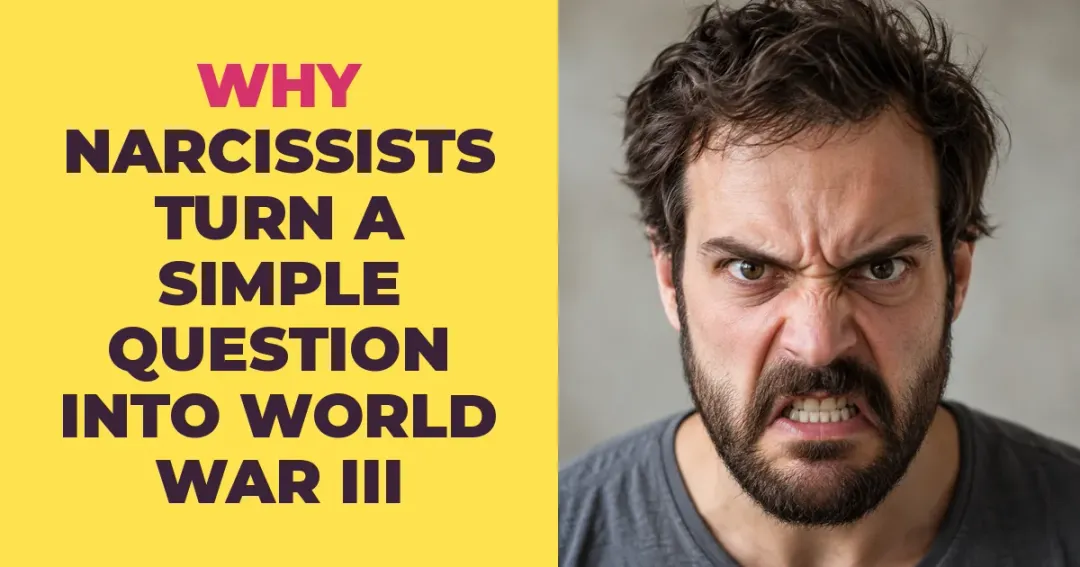
What’s behind the explosion
Psychologists describe two faces of narcissism. A loud one that’s bold and charming, and a quiet one that’s touchy and resentful. Many switch between both.
Both guard the same thing: a fragile self-image.
That’s why they can act like nothing touches them, then rage at the smallest hint of criticism. And to that fragile image, a question can sound a lot like criticism.
#1 Your question lands like an insult
To a narcissist, a simple question can feel like a slap across the face.
You ask, “Did you call the plumber?” over breakfast. They put the mug down hard. “Oh, so now I’m useless? Great. Thanks for that.”
You didn’t say useless. You said plumber. Now you’re somehow arguing about whether you’ve ever respected them.
Research on what psychologists call threatened egotism found that narcissists respond to insults with more aggression, aimed straight at the person they blame.
Their self-image heard an insult anyway. And you happened to be the one holding the coffee.
So you start pre-editing. You rehearse that one little question six different ways in your head before you dare say it. Your whole body braces.
If it does come out, keep it short and factual. And if anger ever tips into threats, leaving the room is a perfectly good answer.
Your question doesn’t need an apology attached.
#2 Rules are for you, not them
Entitlement turns your normal, fair requests into personal attacks in a narcissist’s mind.
See also What Narcissists Keep in Their Home That Nobody Is Meant to See
You ask them to pay back the money they borrowed in March. Or to text if they’ll be late for dinner.
Basic stuff. The stuff any couple sorts out.
But they look at you like you’ve demanded a kidney. “Why are you keeping score? I can’t believe you’d even bring that up.”
Research on entitlement describes a steady belief that they deserve more than others, and that rules apply to everyone else. So an ordinary limit feels like an insult.
Over time you give more and get less. You start rounding everything in their favour just to skip the fight. Asking for fairness feels like declaring war.
One quiet fix: keep track of what you give. Stop pre-agreeing, pre-paying and pre-forgiving before they’ve even asked.
Asking for what’s fair isn’t greedy.
#3 Suddenly you’re the one on trial
Ask one fair question and the whole conversation ends up being about your faults.
You start with, “Why did you tell your mum I was being difficult?” Five minutes later you’re hearing about your tone, your friends, and something you said two Christmases ago.
Then the tears come. Theirs.
Psychologists call this DARVO: deny, attack, then reverse victim and offender. “I never said that. How dare you accuse me? You always do this to me.”
Research found it makes the person who raised the issue blame themselves more. That’s why it shuts conversations down so well.
And it works. You end up comforting them and apologising for bringing it up. Next time, you don’t.
When it starts, name your original question and go back to it. “I’m asking about what you told your mum.” Calm, and on repeat. You don’t need to fight every counter-attack point by point.
Your question still deserves an answer.
#4 They accuse you of what they do
Often, the thing a narcissist accuses you of is the very thing they’re doing.
You ask, quietly, why they’re yelling. “I’M not yelling! You’re the one who’s always angry!”
See also Think It’s Love? That Is Exactly How a Narcissist Manipulates You
You ask who they were texting at midnight. Suddenly you’re the jealous, controlling one.
Psychologists call this projection. Seeing an unwanted trait in someone else lets a person avoid seeing it in themselves.
Your question shines a light on something they don’t want to look at. So they swing the light round onto you.
The cost is real. You spend the whole night defending yourself against things you never did, and the thing you actually asked about quietly vanishes.
One way to tell: when the same accusation keeps coming back, treat it as information about them. State the facts once.
Don’t over-defend.
#5 Your pain is noticed, then ignored
Many narcissists can see exactly how you feel. They just don’t act on it.
You ask, voice shaking, “Why would you say that in front of everyone?” They sigh and check their phone.
“God, you’re so sensitive. It was a joke.” Then the subject changes to dinner.
Research on empathy in narcissism found they show less of it by default, but more when prompted to take the other person’s view.
That suggests empathy is often a choice for them, more than something they can’t do.
So you stop sharing your feelings. Then you start doubting your own reactions. Was it really that bad?
Take your feelings to people who respond.
And stop explaining your pain to someone who uses it.
#6 You learn to stop asking
Each blow-up quietly teaches you that asking questions costs too much.
So you stop asking where the money went. You stop asking who they’re seeing on Friday. You just check their face first.
You read the mood from their keys.
Psychologists call the wider pattern coercive control. Lots of small rules and punishments add up until your independence is gone, which is why it’s so hard to point to one big incident.
Living with unpredictable anger also trains your body to stay on alert, and to calm things down by agreeing.
See also What You Never See in Public: 12 Disturbing Things Narcissistic Parents Do
Your world gets smaller. You ask permission for ordinary things, and lose track of what you even want.
If this is your home, keep some money and contacts of your own. A domestic abuse service can help you think through safety.
You were always allowed to ask.
A question about money, time or a text message is a normal part of sharing a life.
If asking one feels like pulling the pin on a grenade, that tells you something about the room, not about you.
Trust what you saw. Wanting answers was never the problem.
If you feel unsafe: in the US, call the National Domestic Violence Hotline at 1-800-799-7233 (thehotline.org). In the UK, call the National Domestic Abuse Helpline on 0808 2000 247. If you are in immediate danger, call your local emergency number.
Sources
- Bushman, B. J., & Baumeister, R. F. (1998). Threatened egotism, narcissism, self-esteem, and direct and displaced aggression. Journal of Personality and Social Psychology, 75(1), 219-229.
- Wink, P. (1991). Two faces of narcissism. Journal of Personality and Social Psychology, 61(4), 590-597.
- Miller, J. D., Lynam, D. R., Hyatt, C. S., & Campbell, W. K. (2017). Controversies in narcissism. Annual Review of Clinical Psychology, 13, 291-315.
- Campbell, W. K., Bonacci, A. M., Shelton, J., Exline, J. J., & Bushman, B. J. (2004). Psychological entitlement: Interpersonal consequences and validation of a self-report measure. Journal of Personality Assessment, 83(1), 29-45.
- Freyd, J. J. (1997). Violations of power, adaptive blindness, and betrayal trauma theory. Feminism & Psychology, 7(1), 22-32.
- Harsey, S. J., Zurbriggen, E. L., & Freyd, J. J. (2017). Perpetrator responses to victim confrontation: DARVO and victim self-blame. Journal of Aggression, Maltreatment & Trauma, 26(6), 644-663.
- Baumeister, R. F., Dale, K., & Sommer, K. L. (1998). Freudian defense mechanisms and empirical findings in modern social psychology. Journal of Personality, 66(6), 1081-1124.
- Hepper, E. G., Hart, C. M., & Sedikides, C. (2014). Moving Narcissus: Can narcissists be empathic? Personality and Social Psychology Bulletin, 40(9), 1079-1091.
- Stark, E. (2007). Coercive Control: How Men Entrap Women in Personal Life. Oxford University Press.
- Walker, P. (2013). Complex PTSD: From Surviving to Thriving. Azure Coyote.
- Herman, J. L. (1992). Trauma and Recovery. Basic Books.
Belle Souls articles explain patterns described in psychology research and recovery writing. They are not a diagnosis and not a substitute for help from a qualified professional.