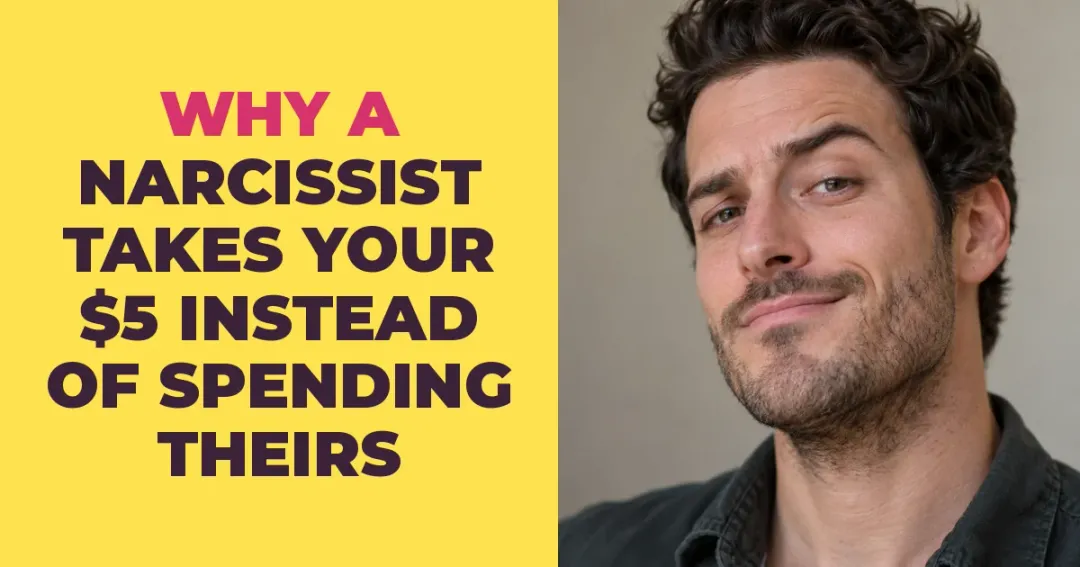
A narcissist may watch you pay for their coffee and rarely reach for a wallet.
It’s often small. Five dollars for lunch. Ten for petrol. Twenty you’ll “get back Friday.”
Friday never comes.
And the moment you mention it, somehow you’re the petty one. You start wondering if you’re the problem.
You’re not imagining it. The amount was never the point.
Here are 6 reasons a narcissist reaches for your wallet before their own, and what each one tells you.
What the $5 really means
Entitlement is a steady belief that they deserve more than others, and that the rules apply to everyone else.
Research on entitlement describes how it makes ordinary limits feel like insults. So your simple “Can you pay me back?” lands like an attack.
Underneath, a narcissistic pattern often runs on outside confirmation. Other people get treated as sources of what they want, or as threats to it.
Your wallet is just one more source.
#1 Your money feels like theirs
To a narcissist, what’s yours is often quietly up for grabs.
You’re at the till. They pat their pockets, flash that easy smile and say, “Can you grab this? I’ll get you next time.”
Next time never comes.
It’s a sandwich here, a parking fee there, a top-up on the streaming account. Each one too small to make a fuss about, which is exactly how it piles up.
Research on entitlement links it with not paying back money or favours. Settling up is a rule, and in their eyes rules are mostly for other people.
So you give more and receive less. Then one evening you add it up and feel a bit sick.
One quiet habit helps: keep track of what you give. Not to win a fight. Just so your memory has something solid to stand on when you start doubting it.
On paper, the sandwiches and parking fees stop looking like nothing.
See also 11 Things Narcissists Do That Leave You Awake at Night
#2 Asking for it back starts a war
Asking for your own money back can turn you into the villain in seconds.
You mention, lightly, that they still owe you for Friday’s takeaway. Their face changes.
“Are you seriously keeping score over five dollars? Wow. I didn’t know you were this tight.”
Then come the tears, or the sulk, or the long speech about how hard their week has been and how little you appreciate them.
Psychologists call this DARVO: deny, attack, then reverse victim and offender. Research found it makes the person who raised the problem blame themselves more, which is why it ends the conversation so well.
And it works. You apologise for bringing it up. Next time, you just let it go.
One thing helps. You don’t have to answer every jab they throw back. Name the original issue once, calmly, and come back to it. If they meet it with anger or threats, you can skip it entirely.
Five dollars. That’s all you asked about.
#3 Saying yes becomes automatic
Small asks wrapped in guilt make saying no feel far too expensive.
“Can you just cover me till payday? After everything I’ve done for you?”
There it is.
FOG is a popular name for fear, obligation and guilt used as emotional blackmail. It isn’t a diagnosis. It sits close to what researchers call coercive control, where many small pressures add up over time.
Reminders of old favours. A long, disappointed silence until you hand over your card. Each one makes no feel heavier than yes.
So yes starts coming out before you’ve even thought. You feel responsible for their moods, their bills, their bad week.
Try a pause before you answer. “Let me check and get back to you” is a full sentence.
Their feelings are theirs. Your money is yours.
#4 They’re generous where people can see
A narcissist can be wildly generous, as long as there’s an audience watching.
See also 11 Odd Answers Narcissists Give to Dodge a Simple Question
At the work drinks they buy a round for the whole table. Everyone cheers! Later, in the car home, they ask you to transfer half.
Half of a round you didn’t even order.
Everyone manages the impression they give. Psychologists who study this describe narcissists investing heavily in their public image, because admiration feeds their self-worth.
Spending in front of friends earns applause. Spending quietly on you earns nothing anyone can see.
That gap is what makes it so lonely. Friends tell you how lucky you are. When you try to explain, nobody quite believes you, and you start doubting your own experience.
Trust what happens behind closed doors. That’s the version you actually live with.
Some of that applause was bought with your money.
#5 Your good news makes them sour
Your good fortune can feel like a threat to a narcissist.
You get the raise. You mention it over dinner, glowing. They shrug, “Must be nice,” and then ask if you can cover the electric bill now.
Notice the order. First they shrink it. Then they spend it.
Research links narcissism with envy, especially in its quieter, more vulnerable form. Your success threatens their need to feel superior, so they may shrink it, steal it or spoil it.
A fight picked on your birthday. A sneer at the course you worked so hard to finish.
Slowly, you learn to hide good news. You downplay the bonus. Happy moments start to feel risky.
One way to tell: watch who goes quiet when you win. Then take your wins to the people who are actually glad for you.
That raise was yours before it ever paid their electric bill.
#6 Money turns into a leash
When a narcissist controls the money, they control how far you can go.
It may start with “Let me hold your card, you’re hopeless with money.” Then it’s debt in your name. Loans that never come back.
See also You Can Spot a Narcissist on Social Media in Less Than 60 Seconds, Here’s How
Researchers call this financial or economic abuse: controlling, exploiting or sabotaging your money and your independence.
Why? Without money of your own, leaving gets harder. That keeps you dependent.
It rarely arrives as one big moment. Many small rules about spending pile up, which is why it’s so hard to point to the day it began.
You hide small purchases. You ask permission for a coffee. Your world gets smaller.
Keeping some money, contacts and records of your own can help. A domestic abuse service can also talk you through money and safety planning.
A coffee shouldn’t need permission.
If this read like your own bank statement, that isn’t stupidity or weakness. You were being fair with someone who wasn’t playing fair.
Start small. Write down one thing you gave this week. Tell one person you trust what you’ve been noticing.
Next time they pat their pockets at the till, you’re allowed to just wait.
If you feel unsafe: in the US, call the National Domestic Violence Hotline at 1-800-799-7233 (thehotline.org). In the UK, call the National Domestic Abuse Helpline on 0808 2000 247. If you are in immediate danger, call your local emergency number.
Sources
- Campbell, W. K., Bonacci, A. M., Shelton, J., Exline, J. J., & Bushman, B. J. (2004). Psychological entitlement: Interpersonal consequences and validation of a self-report measure. Journal of Personality Assessment, 83(1), 29-45.
- American Psychiatric Association. (2022). Diagnostic and Statistical Manual of Mental Disorders (5th ed., text rev.).
- Pincus, A. L., & Lukowitsky, M. R. (2010). Pathological narcissism and narcissistic personality disorder. Annual Review of Clinical Psychology, 6, 421-446.
- Herman, J. L. (1992). Trauma and Recovery. Basic Books.
- Bancroft, L. (2002). Why Does He Do That? Inside the Minds of Angry and Controlling Men. Berkley.
- Freyd, J. J. (1997). Violations of power, adaptive blindness, and betrayal trauma theory. Feminism & Psychology, 7(1), 22-32.
- Harsey, S. J., Zurbriggen, E. L., & Freyd, J. J. (2017). Perpetrator responses to victim confrontation: DARVO and victim self-blame. Journal of Aggression, Maltreatment & Trauma, 26(6), 644-663.
- Bushman, B. J., & Baumeister, R. F. (1998). Threatened egotism, narcissism, self-esteem, and direct and displaced aggression. Journal of Personality and Social Psychology, 75(1), 219-229.
- Forward, S., & Frazier, D. (1997). Emotional Blackmail. HarperCollins.
- Stark, E. (2007). Coercive Control: How Men Entrap Women in Personal Life. Oxford University Press.
- Goffman, E. (1959). The Presentation of Self in Everyday Life. Doubleday.
- Krizan, Z., & Johar, O. (2012). Envy divides the two faces of narcissism. Journal of Personality, 80(5), 1415-1451.
- Postmus, J. L., Plummer, S.-B., McMahon, S., Murshid, N. S., & Kim, M. S. (2012). Understanding economic abuse in the lives of survivors. Journal of Interpersonal Violence, 27(3), 411-430.
Belle Souls articles explain patterns described in psychology research and recovery writing. They are not a diagnosis and not a substitute for help from a qualified professional.