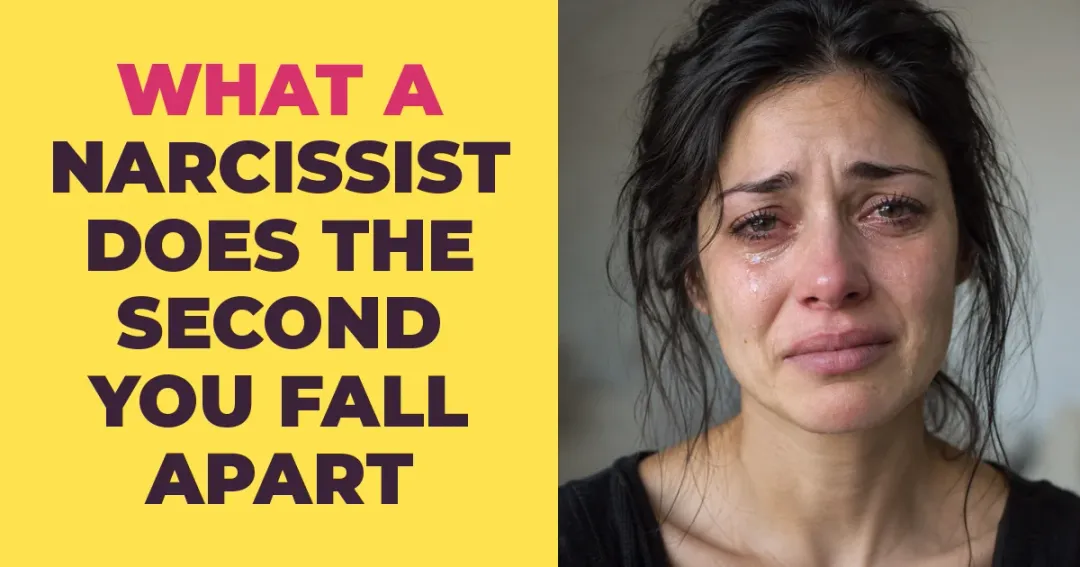
You finally cracked. Maybe it was the bills, the job, the long week, or one more cold word. The tears came and wouldn’t stop.
And the person beside you looked at you like you were an interruption.
Narcissists rarely rush to comfort.
Often they rush away from your pain, or turn it into something about themselves. If you’ve ever felt more alone with them than without them, that’s why.
Here’s what a narcissist does the second you fall apart, and what a loving partner would do instead.
Why your pain is inconvenient
To someone with strong narcissistic traits, the people close to them often have one job: mirror them, looking good.
Their self-worth isn’t homemade. It’s borrowed from other people’s approval, so anyone close is either feeding it or endangering it.
Now picture you, crying, needing something.
In that moment you aren’t a mirror. You’re a request. And to them, a request feels like a nuisance. Everything below grows from that.
#1 They change the subject, fast
Your tears are often met with a quick swerve to another topic.
You’re at the kitchen table, shaking, finally saying how bad today was. They nod once, eyes on the counter. Then: “Did you call the plumber?”
Or they pick up their phone. Or launch into their own awful day.
Anything but the thing in front of them.
Here’s what stings. Research on low empathy suggests many narcissists get what you’re feeling perfectly well. The understanding is there. The action isn’t.
In studies, when they were nudged to imagine the other side, their empathy rose. That sounds less like can’t and more like won’t.
So the lesson sinks in. You cry in the car now, or under the noise of the shower. They’re no longer the place you bring it.
Do they ever notice how quiet you’ve gone?
#2 Suddenly it’s all about them

Your worst night can become their stage within minutes.
See also 10 Ways Narcissists Talk Themselves Into Being The Good Guy
You say you’re exhausted and can’t do this anymore. They sigh: “Do you think this is easy for me?”
Or they go quiet and wounded, waiting for you to ask what’s wrong with them.
Now you’re comforting them, your own face still wet. There’s no room left for your tears, so they dry up.
Psychologists describe a bold, showy version of narcissism and a quieter, touchier one. Many flip between them.
The quiet version broods when ignored and acts hard done by. Underneath, both are guarding a self-image that bruises easily.
So on your own worst day, you’re the one managing their mood, and somehow at fault that they feel let down.
One way to tell: notice what happens when the spotlight drifts off them. Your crisis was that moment. How did they handle it?
#3 Your tears feel like an attack to them

To a narcissist, your pain can sound a lot like blame.
You said, quietly, “I really needed you tonight.” Somehow that turned into a fight, and now you’re the problem.
“So now I’m the bad guy?” Then the whole evening is about defending yourself instead of what broke you.
Why? Psychologists studying threatened egotism saw that a bruised ego in a narcissist tends to hit back harder, and at the person it blames.
Your hurt can feel like that bruise. If you’re sad, maybe they failed you, and that idea stings their image. So they strike first.
Soon you’re checking every feeling before it leaves your mouth. You say sorry for crying. Sorry for things that were never yours to own.
Anger itself isn’t the red flag. It’s how big it gets, and that it aims straight at whoever got hurt.
Your tears were never the crime.
#4 You’re told you’re too sensitive

When you fall apart, a narcissist may simply tell you it isn’t real.
“You’re too sensitive.” “It wasn’t that bad.” “Here we go again.”
See also 7 Cruel Things Narcissists Do Right After You Have Forgiven Them
By the car ride home, you’re not upset about what happened anymore. You’re upset with yourself for being upset.
Psychologists call this gaslighting. The aim is to make you second-guess what you saw and felt, until their story is the only one left standing.
It thrives when the balance is lopsided. You trust them. They hold the pen. Slowly, you’re rewritten as the dramatic one.
So you say sorry for getting hurt.
One thing that helps: jot it down the same day, in plain words. What was said. How it felt. Then run it past a friend who isn’t part of it.
Your feelings never needed their permission.
#5 A loving partner moves toward you

A loving partner may not know what to say, but they stay.
They put the phone face down and sit on the floor next to you. They bring tea you won’t drink. They ask, “What do you need right now?” and wait for the answer.
Maybe they fumble and say the wrong thing.
Nobody’s perfect at comfort.
That’s the difference worth knowing. Clumsy but trying is one thing. Seeing your pain clearly and walking past it is another.
With a narcissistic pattern, what you need tends to arrive as a bother. With someone who cares, it arrives as something they want to help with, even badly.
Don’t decide off one rough night, though. Watch across months. Who keeps showing up when you’re low?
You already know.
#6 Your pain becomes their ammunition
What you confess while crying can come back later as a weapon.
That night you admitted you feel like a failure at work? Two weeks later, mid-argument: “No wonder your boss doesn’t rate you.”
It lands right where it hurts. On purpose.
Low empathy doesn’t always mean they missed your pain. Often they clocked it perfectly, filed away the sore spots, and saved them for later.
This is what you lose, beyond comfort. Your soft places stop feeling safe anywhere. You go quiet about feelings and start questioning whether yours even make sense.
See also Why Saying Nothing Is One of the Most Powerful Moves You Can Make With a Narcissist
So quit handing your hurt to someone who turns it on you. That isn’t coldness. It’s protection.
Bring your feelings to the ones who answer them with care. A friend, a sister, a support group. Start with one.
Your heart was never meant to be their arsenal.
If you saw yourself here, it doesn’t make you weak or too much. Falling apart is human. Being met with coldness was the unfair part.
Next time it all gets too heavy, notice who moves toward you. Then let that person a little closer.
Wanting comfort was never too much to ask.