A narcissist doesn’t have to say a word to run your morning.
You hear footsteps on the stairs and your stomach tightens. You haven’t even had coffee yet.
By the time you leave the house, you’re already tired.
Mornings are revealing. The polished public version hasn’t stepped out the front door yet, so what happens in the kitchen is the real thing.
Here are 10 morning habits that reveal you live with a narcissist, and what each one is quietly doing to you.
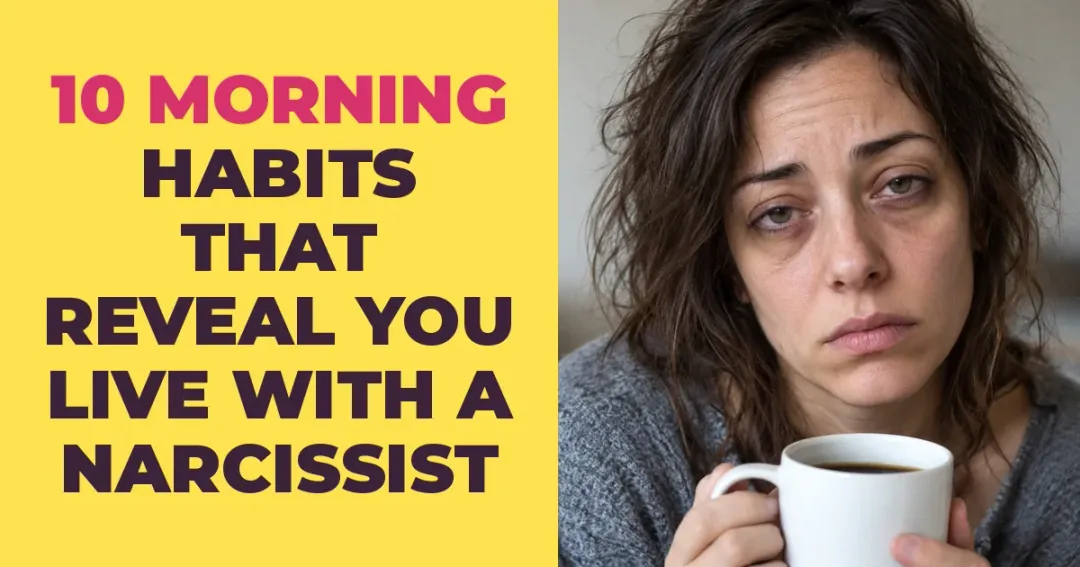
#1 You check their mood before your own
You can tell their mood from the way the bedroom door opens.
A heavy step means keep quiet. A cheerful whistle means you can breathe. You know the difference before you’re fully awake.
Why? When anger can show up without warning, your body learns to stay switched on. Keeping them calm by agreeing becomes the safest move.
So you say yes before you’ve thought. You apologise for the toast. You’re exhausted by nine.
That isn’t being considerate. Considerate doesn’t come from fear.
Next time your chest tightens, slow down for one breath. Whose morning are you actually living?
#2 Their morning outranks yours
In a narcissist’s house, their morning is the only one that counts.
They need the bathroom first. They need the car at eight. Your early meeting? “Can’t you just go in later?”
And if they have to wait five minutes, the sighing starts.
In their mind, they’re owed more than everyone else. A normal limit feels like a slap to them, so your simple request lands as an attack.
That’s why asking for the shower at 7:30 feels like declaring war.
Try jotting down, quietly, what you give up each morning. Your phone’s notes app will do.
The list will say what they won’t.
#3 A simple question starts a fight
A basic question before breakfast can turn into a full-blown fight.
You ask, “Did you pay the electric bill?” Ten minutes later you’re hearing about every mistake you’ve made since the day you met.
See also 13 Red Flag Moves Narcissists Make When They Meet Your Friends
Out of proportion? Completely.
Research on threatened egotism fits this. A bruised ego makes a narcissist more likely to hit back, and they aim at the person they hold responsible. Your innocent question sounded like a verdict.
So you start pre-editing. You rehearse sentences in the shower. You say sorry for things that were never yours.
Stick to short facts, or don’t raise it when it feels unsafe. If the anger turns into threats, get out of the room.
No bill is worth your safety.
#4 Breakfast comes with a side of silence
Silence at the breakfast table can be a punishment in disguise.
They chat to the kids. They laugh at the radio. They talk to the dog. To you? Nothing.
It can last for days after one small disagreement. Then one morning they’re back, cheerful, as if nothing happened.
Being treated like air hits two deep needs: to belong, and to count. That’s why it can hurt like a physical wound, and why so many give in just to end it.
Tell them once you’re happy to talk when they’re ready. Then get on with your morning.
No chasing. No begging by the kettle.
#5 The whole morning is about their day
Every morning conversation somehow circles back to their big day.
Their meeting. Their boss who doesn’t appreciate them. Their genius idea, slightly exaggerated.
You mention your mum’s hospital appointment. “Mm. Anyway, so then I said…”
When someone’s self-worth has to be topped up from outside, everyone near them becomes an audience. Your feelings only count if they touch theirs.
Slowly you feel like a mirror on legs. Your needs become a nuisance.
Look at the pattern over months, not one rushed Tuesday.
Is it ever your turn?
#6 You never know who’s coming downstairs
You never know which version of them will walk into the kitchen.
Monday, a kiss on the forehead and fresh coffee. Tuesday, a cold stare because you bought the wrong milk. No reason given.
See also How To Cleverly Outsmart A Narcissist
Then a sweet morning right after a cruel night, and it feels like hitting the jackpot.
Psychologists call this intermittent reinforcement. Warmth you can’t predict grips harder than warmth you can count on. Slot machines run on the same rule.
So you try harder and get less back. One good morning makes three bad ones seem fine.
Try marking good mornings and bad ones on a calendar for a month.
The average is the real relationship.
#7 Charming to the neighbour, cold to you

The neighbour gets their warmest smile while you get a grunt.
On the driveway it’s “Morning, Pete! Lovely day!” Back inside, the face drops before the door has even shut.
Many narcissists pour energy into how they look to others. Praise is fuel for how they see themselves. The doorstep is a stage. The kitchen isn’t.
And that gap costs you. Friends tell you you’ve got a keeper. Nobody buys the other version, and bit by bit you stop buying it too.
Believe what you see behind closed doors. If one person has witnessed both faces, talk to them.
You’re not imagining the switch.
#8 Your day needs their approval first
Your plans for the day get checked, questioned and approved before you leave.
“Where are you going? Who’ll be there? Why are you wearing that?”
Maybe they glance at your phone while you pour cereal. Maybe there’s a rule about when you must be home.
One question alone looks harmless. That’s the trick. Lots of little rules and penalties stack up until your freedom has quietly gone, with no single big moment to point to. Psychologists call this coercive control.
Your life shrinks. You hear yourself asking permission for a coffee with a friend.
Hold on to a little money and a few contacts that are yours alone. A domestic abuse service can help you plan for safety.
Since when did coffee need a permission slip?
See also 8 Foolish Mistakes Narcissists Make
#9 Promises made on the way out the door
Big promises often get made with one foot already out the door.
“Tonight I’ll fix the shelf.” “This weekend we’ll book the holiday.” “After this busy patch, things will change.”
The shelf is still broken. The holiday never gets booked.
There’s a popular name for this: future faking. It isn’t a formal term, but the idea is simple. Shared plans make you invest, and walking away starts to feel like losing a future you’ve already paid into.
The odd kept promise works like those surprise good mornings.
And when you ask? You’re made to feel unreasonable.
Go by what has really happened. Pick your own deadline.
Words are cheap at 7am.
#10 Your shoulders drop when the door closes
If your whole body relaxes when they leave for work, that’s telling you something.
Before that, there was the eye-roll when you spoke. The sarcastic “Wow, up early for once” as you came downstairs. The mocking voice repeating your words.
Then the door shuts. The house exhales. So do you.
Long-term research on couples found contempt and stonewalling ranked among the clearest warning signs that a relationship would fall apart. Mockery isn’t a harmless quirk.
No wonder you shrink in your own kitchen.
Point it out calmly, one time. Then see if respect ever returns.
You already know how that house feels at 8:01.
None of these mornings mean something is wrong with you. They mean you’ve been paying close attention, for a long time, just to get through the day.
That same attention can work for you now. Pick one habit from this list and simply notice it this week.
Your mornings can belong to you again.
If you feel unsafe: in the US, call the National Domestic Violence Hotline at 1-800-799-7233 (thehotline.org). In the UK, call the National Domestic Abuse Helpline on 0808 2000 247. If you are in immediate danger, call your local emergency number.
Sources
- Goffman, E. (1959). The Presentation of Self in Everyday Life. Doubleday.
- Walker, P. (2013). Complex PTSD: From Surviving to Thriving. Azure Coyote.
- Herman, J. L. (1992). Trauma and Recovery. Basic Books.
- Campbell, W. K., Bonacci, A. M., Shelton, J., Exline, J. J., & Bushman, B. J. (2004). Psychological entitlement: Interpersonal consequences and validation of a self-report measure. Journal of Personality Assessment, 83(1), 29-45.
- Bushman, B. J., & Baumeister, R. F. (1998). Threatened egotism, narcissism, self-esteem, and direct and displaced aggression. Journal of Personality and Social Psychology, 75(1), 219-229.
- Williams, K. D. (2009). Ostracism: A temporal need-threat model. Advances in Experimental Social Psychology, 41, 275-314.
- American Psychiatric Association. (2022). Diagnostic and Statistical Manual of Mental Disorders (5th ed., text rev.).
- Pincus, A. L., & Lukowitsky, M. R. (2010). Pathological narcissism and narcissistic personality disorder. Annual Review of Clinical Psychology, 6, 421-446.
- Ferster, C. B., & Skinner, B. F. (1957). Schedules of Reinforcement. Appleton-Century-Crofts.
- Dutton, D. G., & Painter, S. (1993). Emotional attachments in abusive relationships: A test of traumatic bonding theory. Violence and Victims, 8(2), 105-120.
- Stark, E. (2007). Coercive Control: How Men Entrap Women in Personal Life. Oxford University Press.
- Arkes, H. R., & Blumer, C. (1985). The psychology of sunk cost. Organizational Behavior and Human Decision Processes, 35(1), 124-140.
- Gottman, J. M. (1994). What Predicts Divorce? The Relationship Between Marital Processes and Marital Outcomes. Lawrence Erlbaum.
Belle Souls articles explain patterns described in psychology research and recovery writing. They are not a diagnosis and not a substitute for help from a qualified professional.