Narcissists rarely need a real reason to start a fight.
One minute you’re making dinner. The next, you’re defending yourself over a tone of voice you never used.
Later you replay it in your head and can’t find the moment it went wrong.
You feel tired, a bit crazy, and somehow guilty.
Here are 7 things going on when a fight comes out of nowhere, and what each one does to you.
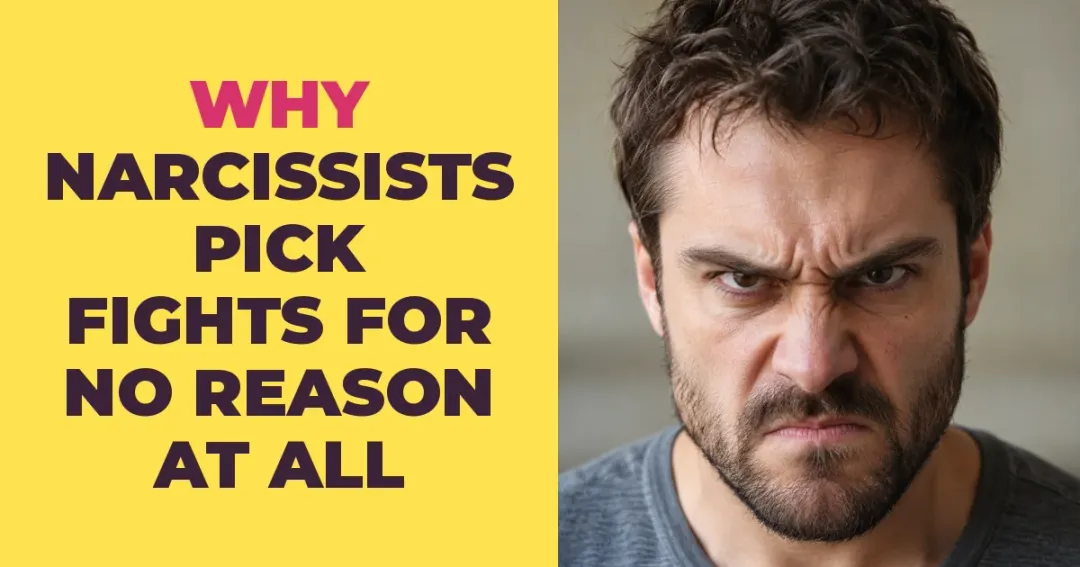
Why it feels so random
From the outside, these fights seem to come from nowhere.
But a narcissistic person often borrows their sense of worth from other people. So everyone close gets sorted into two boxes. Fans. Or threats.
Under the loud or sulky surface sits a fragile self-image that needs guarding around the clock.
So the fight isn’t really about you. You just happen to be standing closest.
#1 A tiny comment bruised their ego
To a narcissist, a small comment can feel like a full-blown attack.
You ask, “Did you pay the electric bill?” Simple question. Suddenly you’re hearing how you never appreciate anything and treat them like a child.
Psychologists who study threatened egotism describe this pattern. Bruise a narcissist’s image, even by accident, and their aggression tends to rise. It gets aimed at whoever they decide did the bruising.
Sometimes the punishment comes days later, over a remark you’d already forgotten.
So you start editing every sentence before it leaves your mouth. You say sorry for crimes you didn’t commit.
If you have to raise something, keep it brief and stick to facts. If it doesn’t feel safe, you don’t have to raise it at all. And once anger tips into threats, walking out of the room is allowed.
The bill was never the problem.
#2 Your normal request felt like an insult
Entitlement turns your ordinary limits into personal insults.
You say you can’t drive them to the airport on Saturday because you’re working. You’d think you had set the house on fire.
See also The One Thing Narcissists Can’t Bear to Lose
Psychologists call this entitlement: the quiet conviction that they’re owed extra, and that the usual rules are for other people. Being made to wait in line? An outrage.
To someone like that, a normal no sounds like an attack. So they hit back.
“I’d do it for you. But fine, now I know where I stand.”
Bit by bit, even a fair request starts to feel like a risk, and your side of the scale keeps getting heavier. One thing helps. Quietly note what you hand over, and stop saying yes before they’ve finished asking.
Your no was never the crime.
#3 Your good news is the real target
The fight that ruins your big day often isn’t an accident.
You get the promotion. You call them, buzzing. Within an hour they’re furious about the dishes you left this morning, and the promotion never comes up again.
Or it’s your birthday, and somewhere between the restaurant and the car park, a war breaks out over nothing.
Envy runs high in narcissism. They need to be the one on top, so your win lands like their loss. They make it smaller, take it over, or wreck it.
A fight does all three at once. Suddenly the evening is about them. “Must be nice when everything goes your way.”
Before long, you sit on good news for days. Joy starts to feel like something that will cost you. A good tell: watch who goes silent when things go well for you, then take your news to the people who cheer.
The promotion is still yours. The dishes can wait.
#4 They enjoy watching you flinch
Some difficult partners get a real kick out of your discomfort.
They poke at the thing you’re most insecure about, right in front of your sister. You flinch. They smirk. “Relax, I’m only joking. Why do you make everything a thing?”
Researchers have a name for this: everyday sadism. They added it to three other ‘dark’ traits, turning the trio into a ‘Dark Tetrad’.
See also How Narcissists End Up Living in Old Age
For someone high in it, a little cruelty is its own reward. No other payoff needed. A fight out of nowhere serves it up nicely.
Living with it, home starts to feel like a place where you’re prey. You learn to keep your face blank.
Teasing that ends the second you say ‘stop’ is something else. The tell is whether your hurt seems to cheer them up. If it does, give them less to watch.
That remark in front of your sister wasn’t a joke.
#5 Random fights keep you on edge
Fights with no warning teach your body to brace all the time.
The car pulls into the driveway and your shoulders are already up by your ears.
Unpredictable anger keeps your inner alarm running day and night. Your body also finds a fast fix: soothe them. Agree, smooth it over, back down.
So you agree before the question’s finished. You say sorry when they drop a fork.
Psychologists call this fawning. Its root is fear. Not good manners.
The price is bone-deep tiredness. Your own wants go blurry.
Next time your stomach drops, name it and take a slow beat. Then practise saying no where it’s safe, like turning down a second slice at a friend’s. How long since you felt off duty?
#6 The blame lands on you, somehow
Many of these fights exist to move the blame off them and onto you.
You see a message on their phone that doesn’t add up. Ten minutes later, you’re the one accused of cheating.
Psychologists call it projection. Pinning their own behaviour on you means they never have to look at it in themselves.
And if you push back? “Unbelievable. You go through my phone and I’m the bad guy?” Then the sulking starts, and somehow you end up comforting them.
Researchers call this DARVO. They deny it, go after you for asking, then cast themselves as the one who’s been wronged.
See also The Moment You Stop Doing This, the Narcissist Loses All Interest
Research found it leaves the person who spoke up blaming herself more, which is why it works so well at shutting the conversation down.
What helps: say the original problem once more and stay on it. Skip the urge to answer every jab they throw back. And when the same accusation keeps coming, notice what it says about them.
You were never the one on trial.
#7 Making up keeps you hooked
The tender make-up after a blow-up is part of the hook.
Thursday they snap at you over a coffee cup. By Saturday there are flowers on the counter and they’re the partner you fell for.
That rare apology? It feels like hitting the jackpot.
Here’s how it works. Warmth you can’t predict, mixed in with coldness, hooks harder than warmth that’s steady. A reward with no schedule is the toughest kind to walk away from. Same reason slot machines are hard to leave.
So the blow-ups and the sweetness are a team. You give more and get less back. And the nice days make the bad ones feel survivable.
Keep a private tally of good days and bad days, in a hidden note or on a trusted friend’s phone. Then judge by the average, not the best day.
What does an ordinary Tuesday look like?
None of these fights mean you’re too sensitive, too much, or slow to see it.
Look at what keeps happening over months, not at one bad night. One blow-up over the bill means little. Ten of them over a year tell you something.
And if it’s getting heavy, pick one person you trust. Tell them everything, start to finish.