You put your phone down for one minute, and they’ve already picked it up.
To a narcissist, a locked door can feel like a threat. Your phone is one.
Maybe they scroll through it like it’s the TV remote. Maybe they ask who you’re texting, then ask again, sharper. Maybe you’ve started tilting the screen away without even thinking.
And somehow, wanting a little privacy has turned into proof that you’re guilty of something.
It isn’t.
Researchers describe phone and location checks as part of a wider pattern called coercive control. Here are 8 reasons your phone is never truly yours with a narcissist, and what that control is really about.
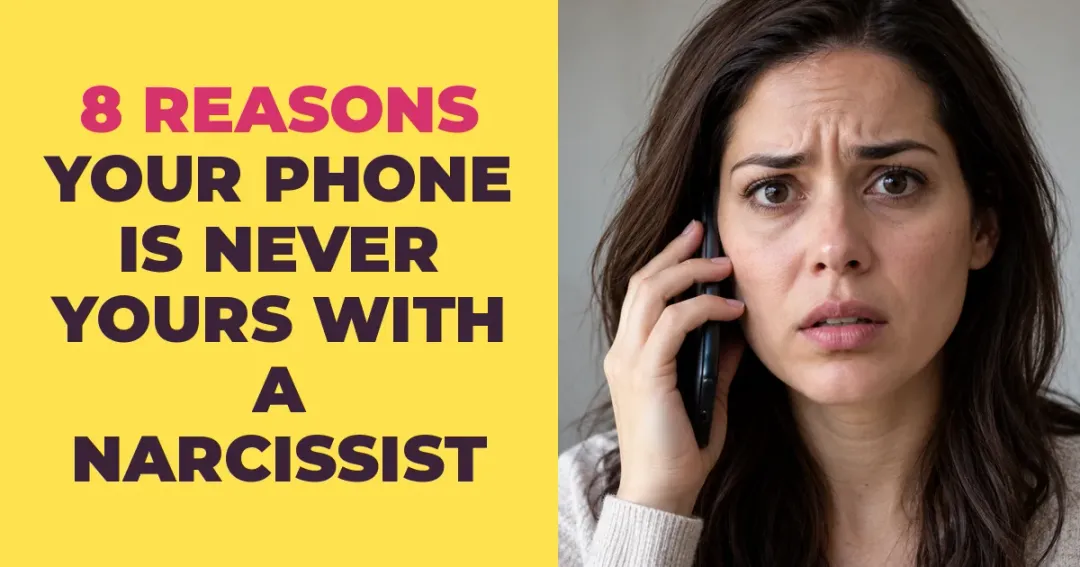
Why your phone scares them
A narcissist’s self-worth tends to lean on other people propping it up. That splits the world into two camps: fans, and dangers.
Your phone is full of other people. Friends, family, coworkers, that old school group chat. All of it lives in a space they can’t control.
That’s the problem.
Coercive control is built from many small rules, each one easy to shrug off, that slowly add up. Checking your phone and location is one of them.
#1 They read your phone like it’s theirs
Checking your phone is one of the quiet ways control moves in. It starts casually. They pick it up while you’re cooking and scroll like it’s the morning paper. Then they hand it back with a look.
“Who’s Sarah? Why’d she send a heart?”
This kind of control almost never arrives as one dramatic scene. It drips in: a check on Monday, a question on Thursday.
That’s why it’s so hard to explain to anyone. No single thing sounds bad enough on its own.
But you feel it. Bit by bit, your life shrinks. Texting your cousin starts to feel like something you should run past them first.
You hand the phone over before they even ask now.
When did that start?
See also 10 Things The Narcissist Does Once They Realize They’ve Lost You
#2 Their phone stays face down
The rules about phones in your home only seem to apply to you.
Yours gets checked at dinner. Theirs lives face down, on silent, with a passcode that changed last month.
Funny how that works!
Ask about it and you’ll hear, “Wow. So you don’t trust me?”
Psychologists call this entitlement: a settled sense that they deserve more and the rules are for other people. To someone like that, a normal limit stings, so your simple question feels like an assault.
Research also ties narcissism to treating love like a game, with exes and admirers kept within reach. None of this means you need to go looking. You don’t.
You already know the rules are different. That’s information enough.
#3 Their accusations say more about them

The accusations often say more about them than about you.
You’re laughing at a meme your sister sent. They’re across the couch, watching your face instead of the show.
“Who’s making you smile like that?”
Psychologists call this projection. What they don’t want to face in themselves, they pin on you instead, so they never have to look at it.
So the accusation has little to do with what’s on your phone. It comes from what they won’t look at in themselves.
Meanwhile you’re stuck proving your innocence over things that never happened, and the real issue gets lost in the noise. Try this instead. Say the facts once, then stop.
Keep hearing the same accusation? It’s telling you something. About them.
#4 Your location becomes a leash
Sharing locations can start out sweet and slowly turn into surveillance.
At first it felt romantic. “I just like knowing you’re safe.”
Then the texts begin. “Why are you at the pharmacy? You said you were going straight home.”
Ten extra minutes turns into an interrogation.
Location tracking often sits next to other rules in coercive control: what you spend, how long you’re out, which friends are okay. Each check is small. Together, they teach you that every move needs a reason.
See also This Is What Happens When The Narcissist Loses Their Grip On You
So you start pre-explaining. You text “stopping for milk” before you’ve even parked the car.
That isn’t love keeping you safe. It’s a map of where you’re allowed to be.
#5 Every message gets filed for later

Some partners don’t react to what they find on your phone. They save it.
Months ago, you vented to a friend about your mother-in-law. One bad day, a few honest texts. You forgot all about it.
They didn’t. It comes out mid-argument, word for word. “Funny, that’s not what you told Jess.”
Research on Machiavellianism describes exactly this kind of patient strategy. Store up details. Wait. Keep a calm, pleasant face for everyone else.
So the trap is usually built before you spot it. And friends who only ever see the polite version find your story hard to believe.
One thing that helps is keeping fewer personal details anywhere they can get to. Your private thoughts need a private place.
You weren’t careless. You were trusting.
#6 Asking for privacy starts a fight
One quiet request for privacy can set off a reaction way out of proportion.
You say, gently, “Can you not go through my phone?” And the room changes. “What are you hiding? I knew it.”
Then you pay for it days later, over something that has nothing to do with phones.
Studies of what psychologists call threatened egotism show that a narcissist who feels insulted tends to hit back harder, straight at the person they hold responsible. Even a basic question about privacy can land as a challenge to their image.
So a basic question becomes a fight. Again.
Soon you’re rehearsing sentences in your head and saying sorry for things that were never your fault. If their anger ever tips into threats, get out of the room. Your safety comes first.
Wanting privacy was never the crime.
#7 You start editing every text

Living under constant checking trains your body to stay on high alert.
See also Valentine’s Day With A Narcissist Exposes Everything That’s Missing in Your Relationship
You reread a text to a coworker three times. You delete a harmless joke. You clear the chat before you walk through the door.
Not because you did anything wrong.
Psychologists call it hypervigilance and fawning. When anger can come out of nowhere, your body learns to watch for it nonstop and smooth things over before it lands. Your phone buzzes and your stomach drops.
Rereading every single text wears you out.
And slowly you lose track of what you’d say if nobody were reading. One small thing helps: when that jolt hits, name it to yourself and take a beat before you answer.
Who were you before every word needed checking?
#8 Friends drift because nothing is private

When any chat might be read, you slowly stop chatting.
Your sister texts. You mean to reply. But you know what comes next: “What does she want now?”
So the group chat goes quiet. Lunch plans fade. The friend who used to call every Sunday stops trying.
One unanswered message at a time, your circle shrinks.
Cutting you off from people is one of the ways manipulation keeps its grip. Your phone was your line to the outside, and constant checking frays it.
So reaching back out is one of the ways you get your footing again. Pick one person who feels safe. One honest conversation, somewhere you can talk freely.
They took your privacy. They don’t get to keep your people.
If your phone hasn’t felt like yours in a long time, you’re not being dramatic. It’s a pattern, and patterns can be named.
Where it’s possible, hold on to a few contacts, a little money and some support that are only yours. And if things ever feel dangerous, specialist abuse services can help you think through safety, quietly and on your terms.
Your private life still belongs to you. Even now.