Her love felt like a storm. Huge, sudden, impossible to ignore.
A narcissistic woman rarely shows up looking like the villain. She shows up looking like the best thing that ever happened to you.
Then the warmth turns into rules, moods and tests you never signed up for. And you keep calling it love, because that’s how it started.
This list is for the men who end up with her, and for anyone watching someone they care about go through it.
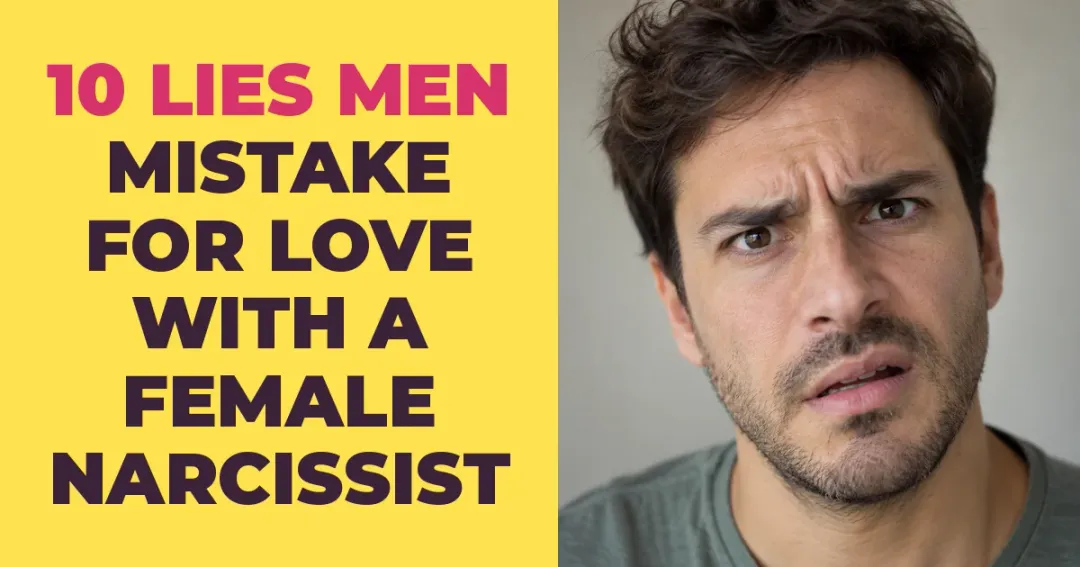
Here are 10 lies men mistake for love when dating a female narcissist.
#1 Intensity isn’t the same as intimacy
Fast, overwhelming attention can feel like fate when it’s really speed.
Week two, she’s naming your future dog. Texts start at 7am and don’t stop. She calls you her soulmate before you’ve met her friends.
It feels like nobody has ever seen you like this.
Psychologists call this love bombing. All that speed glues you to her early, long before a bad week shows you who she is under pressure. Later, those first weeks are what you ache to get back.
One way to tell: say “not yet” and watch her face.
Real interest can wait. Pressure can’t.
#2 Checking your phone is control

A partner who tracks your every move isn’t proving how much she cares.
At first it’s flattering. She asks who texted. She wants your location “just so I know you’re safe.” She sulks when you see your sister without her.
Then the rules arrive.
Researchers name this coercive control. No single rule looks huge. Stacked together, the little rules and little punishments eat away at your freedom, so there’s rarely one dramatic incident to show anyone.
Bit by bit, your life shrinks. Soon a pint with a friend needs her approval.
Couples can agree on rules together. One person writing them, and punishing every slip, is a different thing.
Who decided you need a pass to leave the house?
See also This Is What Happens The Second You Become A Threat To The Narcissist
#3 Being needed is not being loved
Being the one who fixes everything can feel like love, but often it isn’t.
Her car, her landlord, her fight with her boss. You sort it. She says, “I’d be lost without you,” and you glow for a week.
Some call this codependency. It’s a popular term, not a diagnosis, for building your days around her moods and her needs while yours wait.
Looking after her feels like control and safety. And a self-focused partner is glad to let you keep doing it.
The cost? Burnout. Resentment you can’t say out loud.
Try asking what you want before what she needs.
If even “what do I want for dinner?” leaves you blank, notice that.
#4 Hot and cold isn’t emotional depth
Unpredictable warmth hooks you harder than steady kindness ever could.
Tuesday she’s cold and won’t say why. Thursday she’s in your lap, laughing at your jokes like nothing happened.
You tell yourself she’s complicated. Deep.
Psychologists call this intermittent reinforcement. When a reward turns up at random, the habit of chasing it gets very hard to drop. Slot machines run on exactly that.
So you try harder and get less back. And one sweet evening makes a rotten week seem survivable.
Keep a quiet tally of good days and bad ones for a month. Look at the whole month, not the highlight.
What does the tally say?
#5 Her sad story is not a free pass
Understanding her pain doesn’t mean you have to keep absorbing it.
On the third date she told you about her father, then whispered, “You’re the only one I’ve ever told.”
Now every cruel moment gets filed under that story.
Psychologists call this cognitive dissonance: the strain of believing “she loves me” and “she hurts me” at once. To ease it, the mind keeps finding reasons the hurt doesn’t count.
So you defend her. “She’s had a hard life.” Choices feel impossible, and you argue with yourself at 2am.
See also What The Narcissist Doesn’t Want You To Find Out About Their Phone
Try jotting down the plain facts of each incident, and leave out the excuses.
Her past may be real. It doesn’t excuse what happens in your kitchen.
#6 She chose you, then kept her options open
Fast commitment can feel like proof, but it can vanish just as fast.
She moved in after a month. Then her ex started texting “just as friends.” She flirts with the waiter while you’re holding her bag.
You feel replaceable. That’s the point.
Research ties narcissism to a game-playing love style. Several doors stay ajar, real closeness stays out of reach, and interest fades once she feels she’s won.
Needing time before committing is fine. Leaving you unsure as a tactic is different.
Watch whether every warm spell is followed by her pulling back.
How many weeks have those “just friends” texts kept coming?
#7 Her public charm proves nothing
How she treats a room full of people says little about how she treats you.
At the party she’s warm, funny, touching your arm. Your mum adores her. Your mates say, “You’re so lucky.”
Then she says nothing for the whole drive back.
Researchers have long studied how we polish the version of ourselves others see. A narcissist may work extra hard at it, since being admired is what props up her worth.
Most of us are a bit nicer in company. What matters is the jump from kind to cruel once the door shuts.
And when nobody believes you, you start doubting yourself.
Trust the version that comes home with you.
#8 Praise that turns sour when you win

Her early praise can feel like pride in you, until you actually succeed.
At the start she bragged about you to everyone. Now you get the promotion and she says, “Bit late at your age, isn’t it?”
Then she changes the subject.
Psychologists describe two sides of narcissism: admiration and rivalry. Charm does the winning early. Later, rivalry often takes the wheel, and anything you gain counts as something she lost.
See also Why Your Phone Is Never Truly Yours With A Narcissist
So good news starts to feel risky to mention at home.
Take your wins to the people who light up when they hear them.
You shouldn’t have to shrink to be loved.
#9 The dream house was never coming
A beautifully painted future can keep you parked in the waiting room for years.
The cottage by the sea. The trip to Japan. The wedding, “once work calms down.” Ask about it later and she says, “I never promised that.”
Some call this future faking, a popular term rather than a formal one. Shared plans tie you in. Once you’ve poured yourself into that imagined life, quitting feels like throwing it away.
Every time you raise it, there’s a reason. “After this busy time.” Then the next busy time.
Genuine plans that collapse get a new date. These simply disappear.
Count what has really happened, and set a timeline of your own.
How many “next years” have there been?
#10 Staying through pain isn’t loyalty
The pull to stay can be built by the hurt itself.
She screams, then cries in your arms. You defend her to your brother. You miss her the night after she called you pathetic.
You call it loyalty. Your friends call it something else.
Psychologists call this trauma bonding. When one person holds more power, and harm keeps swapping with tenderness, the attachment can end up tighter than anything a peaceful couple feels.
So walking away can hurt in your body, while your head and your heart argue.
Your mind is doing something well documented. It isn’t weakness.
Loyal to her? Fine. When were you last loyal to yourself?
None of these lies make you foolish. They work because, in the moment, they feel exactly like love.
Pick one from this list and simply notice it this week. Then say it out loud to one person you trust outside the relationship.
Start with the tally of good and bad days. A month on paper is hard to argue with.