You jump when your phone buzzes. You rehearse sentences in your head before you say them out loud.
Even on a quiet Sunday, your chest stays tight.
That isn’t you being dramatic. Living with unpredictable anger trains your body to stay on alert.
That alarm can be turned down. Slowly, but it can.
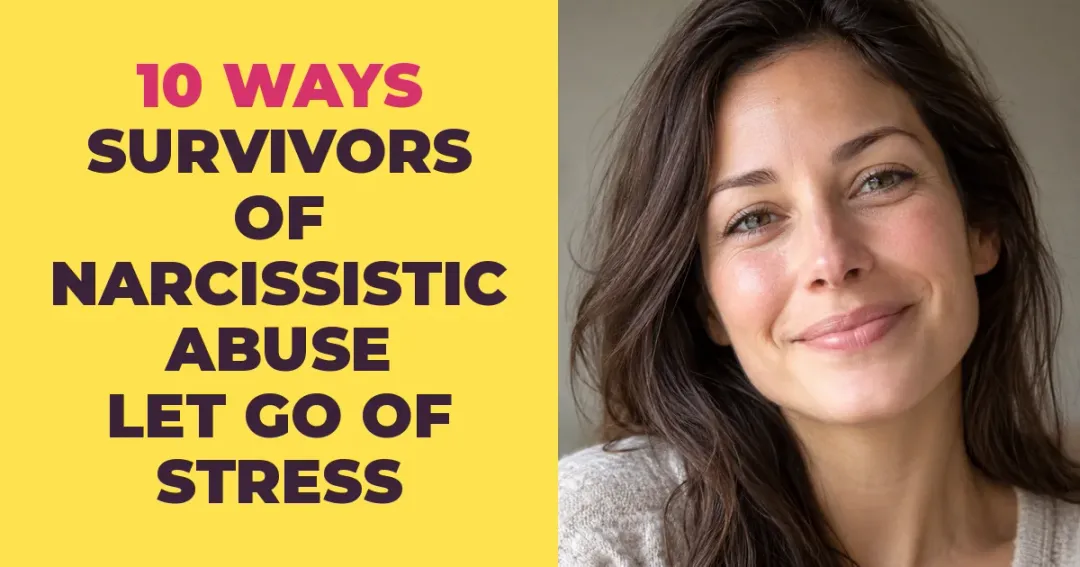
Here are 10 ways survivors of narcissistic abuse let go of stress, with one small thing to try from each.
#1 Your shoulders finally drop
Letting go of stress starts with noticing how hard your body has been working.
You know the drill. Keys in the door. The car door slamming a little too hard. Whether they say ‘Hi, love’ or just ‘Hey.’
In two seconds you’ve read the mood and adjusted.
Why? Psychologists call it hypervigilance. When anger can come out of nowhere, your body learns to stay on guard and to calm things down by agreeing.
No wonder you’re exhausted.
Survivors start by catching the alarm. Jaw clenched? Breath shallow? They name it, then slow down on purpose.
Your body has been on duty for years. It’s allowed to clock off.
#2 Rest stops feeling like a crime
Guilt about resting is one of the hardest habits to shake.
You sit down with a cup of tea and they walk past. ‘Must be nice.’ Suddenly you’re up, wiping a counter that was already clean.
Organising your life around someone else’s moods can feel like safety. A self-focused partner rewards it, so rest starts to feel risky.
The price is burnout, plus resentment you can’t say out loud.
Research on self-compassion describes treating yourself with the kindness you’d give a friend. It lowers shame and self-blame.
So survivors take the nap. They leave the dishes.
Nobody needs to earn a sit-down.
#3 Putting it on paper
Writing things down is one of the quietest ways to stop doubting yourself.
‘That never happened.’ ‘You’re too sensitive.’ Hear that enough and you start wondering if your memory is broken.
See also What a Narcissist Does the Second You Fall Apart That a Loving Partner Never Would
It isn’t. Gaslighting works by making you doubt what you saw, so their version of events wins.
Some survivors keep a plain note on their phone. The date. What was said. What happened. No guessing at why.
Why does that help? When someone you love hurts you, your mind works overtime explaining it away. A list of facts cuts through the excuses.
Paper doesn’t argue back.
#4 Learning there’s a name for it
Finding out your feelings have a name can lift a huge weight.
Maybe you’ve lain awake asking why you still miss them. Why you defended them to your sister. Why you went back.
Psychologists call this trauma bonding. Cycles of harm and kindness, plus a power imbalance, can build a bond stronger than in calm relationships.
So the pull is real. It’s a known reaction, and weakness has nothing to do with it.
Reading about it late at night isn’t wasted time. One word can turn ‘What’s wrong with me?’ into ‘Oh. That’s what happened.’
You weren’t weak. You were hooked.
#5 Going grey rock on purpose

Being boring is one of the most underrated ways to protect your peace.
Maybe you can’t cut contact. You share kids, a lease or a family group chat. Then: ‘Wow. Nice of you to finally answer.’
The old you would’ve written three paragraphs back.
Grey rock, as it’s popularly called, means short, dull, factual replies. ‘Pickup is at 5.’ Done. Others choose no contact and block every account.
Either way, fewer reactions give a manipulator less to work with, and the trauma bond starts to fade. It’s rough at first. Calmer later.
If they might escalate, a domestic violence service can help you plan for safety first.
Nothing to grab onto. That’s the point.
#6 A pause before every yes
A pause of a few seconds can break years of automatic yes.
‘After everything I’ve done for you.’ ‘I thought I could count on you.’ Your mouth says yes before your brain catches up.
See also 10 Ways Narcissists Talk Themselves Into Being The Good Guy
There’s a popular name for this: fear, obligation and guilt, or FOG. Guilt trips and reminders of old favours make no feel costlier than giving in.
Stacked up day after day, small pressures like this are part of what researchers call coercive control. Your world gets smaller.
So survivors buy time. ‘Let me check and get back to you.’
Their feelings are theirs to carry.
What would happen if you didn’t answer straight away?
#7 Getting help from people who get it
Isolation is part of how manipulation works, so reconnection is part of how recovery works.
Think about it. How often did you hear ‘Your friends are just jealous’ or ‘Therapists only hear one side’?
Survivors often start with one trusted person who hears the full, messy story.
Some find a therapist who understands abuse. Some join a support group. Some call a hotline just to talk it through.
None of that means you’re weak. It doesn’t mean the relationship has to end today, either.
Stuck? Write down what you want help with.
One person. One honest conversation. That’s a start.
#8 The inner critic loses its grip

The harshest voice in your head is often the one that sounds like yours.
‘How did I not see it?’ ‘Everyone else knew.’ ‘I’m so stupid.’ It plays on a loop at 2 a.m.
Research on betrayal blindness describes what’s going on. When you depend on someone, your mind can block out signs of their betrayal to keep the bond intact.
That isn’t stupidity. It’s protection.
Survivors start catching the critic mid-sentence. Would I say this to a friend? Then they say what they’d tell her instead.
Self-compassion lowers shame and self-blame, two of the heaviest leftovers of manipulation.
Your mind was protecting you. Return the favour.
#9 Old friends come back in

Friends who are glad when you win are worth more than any spa day.
Maybe you stopped calling them. Good news got a flat ‘Good for you, I guess’ at home, so you learned to keep wins quiet.
See also 7 Cruel Things Narcissists Do Right After You Have Forgiven Them
Research on narcissistic rivalry describes this shift. Over time, your gain gets treated as their loss, and the cheering stops.
Feelings went the same way. You cried, they changed the subject.
So survivors send the text they’ve been putting off. ‘I miss you. Coffee soon?’
They take the promotion, the small win and the bad day to people who actually respond.
Who used to light up when you called?
#10 Taking back what they mocked

The hobby they mocked might be the thing that brings you back to yourself.
The guitar in the cupboard. The sketchbook. ‘Bit old for that, aren’t you?’ ‘Who do you think you are, an artist?’
A sneer like that can come from envy. Your joy threatens their need to feel superior, so they shrink it.
And it worked. You stopped.
Reconnecting with old interests is part of rebuilding, the kind of self-compassion you can actually see. Small routines that belong only to you.
Ten minutes of bad drawing counts. One wobbly chord counts.
They buried it. You get to dig it up!
Stress doesn’t leave all at once. It loosens, one quiet evening at a time.
Pick one thing from this list. Just one. Try it this week and notice what your shoulders do.