The narcissist doesn’t leave the control at the bedroom door.
Behind that door, there’s no one else to see it.
You lie there next to them, wide awake, wondering what you did wrong this time. Maybe nothing happened that anyone else would notice. A turned back. A sigh. A screen glowing at 1 a.m.
Each move is small on its own. Together, they add up to a life run on their rules, in the one room that was supposed to be yours too.
Here are 8 bedroom tactics narcissists use to keep a partner in line, and what each one is really doing to you.
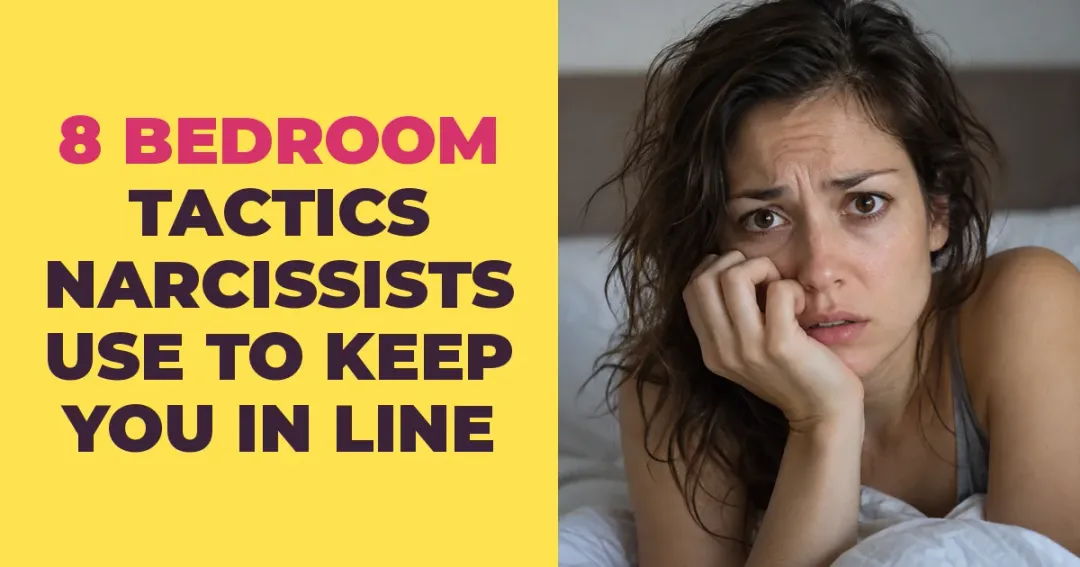
#1 They turn their back on you
A turned back in bed can be louder than any shouting match.
You reach for their hand after a tense dinner. They pull it away, roll over, and lie there like a wall. In the morning they’re chatty with the dog.
No words. Just a cold back.
Silence used as punishment hits a basic need to belong and to matter. Psychologists who study being ignored say it can hurt much like physical pain. That’s exactly why it works so well on you.
So you apologise for something you can’t even name, just to make it stop.
There’s a difference here. A partner who says “I need an hour to cool off” and comes back is fine. A partner who goes cold for days to make you crack is something else.
Say once that you’re open to talking. Then sleep. You don’t have to beg your way back into your own bed.
#2 Affection becomes a prize you earn
In their hands, affection stops being love and becomes a reward.
Tuesday they’re warm, playful, all over you. Wednesday you get a flat “I’m tired” and a closed door. Nothing changed. Except their mood.
Then, right after a cruel week, they’re suddenly sweet again. It feels like winning the jackpot.
See also 11 Unwritten Rules Narcissists Make You Live By
That’s the hook. Kindness that shows up on an unpredictable schedule is harder to walk away from than steady kindness. It’s the same pull that keeps people feeding a slot machine.
You start working harder for less. The good nights make the bad weeks feel bearable.
Try this quietly: count the warm days against the cold ones. Judge the relationship by its average night. Its best night lies.
What does the average look like?
#3 The fight starts when the lights go out
A comment you forgot can come back as a fight at midnight.
You’re half asleep when they bring up something you said at your sister’s on Sunday. You barely remember saying it. They’ve clearly been chewing on it for days.
“You made me look like an idiot.”
A narcissist may lash out hard at whoever they blame for bruising their image. Research on threatened egotism links narcissism with more aggression after a perceived insult, aimed right at the source. Tonight that’s you.
So the lecture runs until 2 a.m., and somehow you’re the one saying sorry.
No wonder you’ve started pre-editing every sentence at dinner.
If the anger turns into threats, leaving the room isn’t rude. It’s safe.
#4 Your sleep is their playground
For some partners, your exhaustion is the entertainment.
You’ve got an early shift. They scroll videos with the sound up and the screen right in your face. You ask nicely. The volume goes up a notch.
Then the smirk.
Or it’s the endless flipping, sighing and yanking of the duvet every time you drift off.
Researchers describe a trait they call everyday sadism: some people find small cruelties rewarding in themselves. Making you wait or worry can be part of the appeal, and a noisy screen at midnight is one easy way to do it.
One way to tell. Playful teasing stops when you ask. This doesn’t. Notice whether your upset seems to please them.
See also 8 Signs He Has a Second Life (Hidden Right in Front of You)
Going flat and quiet to take the fun out of it is a skill, and a smart one.
#5 Your soft spots get used against you
What you whisper at night can come back to you as an insult.
Late one night you told them how ashamed you feel about your body. Or how your dad never once said he was proud of you.
Weeks later, mid-argument: “No wonder your father couldn’t stand you.”
Then, when you cry: “You’re too sensitive.”
Here’s what stings most. Studies suggest narcissists often can see what you feel, and show more empathy when prompted to take your view. So the cruelty looks more like a choice than a blind spot.
Little by little, you stop sharing anything soft. You start doubting your own reactions.
Your tender stuff belongs with people who handle it gently. Who are those people for you?
#6 Closeness is followed by a cold wall
The closer the night, the colder the morning often is.
You finally had a sweet, close evening. You felt seen. By breakfast they’re on their phone, short with you, already somewhere else.
“What? I’m just busy.”
Research links narcissism with a game-playing style of love. Real closeness gets avoided, and interest often drops once they feel they’ve won.
Last night, in their eyes, they won.
So you end up chasing the warmth you had for free twelve hours ago, searching their face over coffee for any trace of it.
Watch the order of things over a few months. Does closeness always come right before distance?
#7 An ex gets invited into your bed
An ex doesn’t have to be in the room to be used against you.
You’re lying close, and out it comes. “My ex never minded that.” Or a casual mention of the coworker who “really gets them.”
Your stomach drops. That’s the plan.
Psychologists call this triangulation. Instead of dealing with a problem between the two of you, they pull in a third person to stir up jealousy and pressure.
See also When You Stop Chasing A Narcissist After The Breakup, This Is What Happens
Suddenly you’re auditioning in your own bedroom. Trying harder. Wondering if you measure up to a ghost.
Think about it. You never signed up for a contest.
Quietly refusing to compete takes the air right out of it. Let them play that game alone.
#8 Guilt does the asking for them
When guilt does the asking, a no can start to feel impossible.
You say “not tonight.” They don’t argue. They just sigh, roll away, and mutter, “After everything I’ve done for you this week?”
Then the sulking starts. It can last days.
There’s a popular name for this: FOG, short for fear, obligation and guilt. It has no formal definition, but it describes emotional blackmail that makes saying no feel more costly than giving in. It sits close to what researchers call coercive control.
Over time, yes comes out on autopilot. You check their face before you check your own feelings.
Your no is allowed to be a full sentence. Their disappointment is theirs to carry.
Try a pause before answering. Even three seconds. Whose feeling is it, really?
If you saw your nights in this list, you’re not imagining it, and you’re not asking too much.
Start small. Tell one person you trust the full story, out loud, in daylight. If you ever feel afraid in your own bed, a domestic abuse service can help you think through your safety.
Picture falling asleep without replaying what you said at dinner, or saying sorry for a silence you didn’t start. Wanting that back is fair.
If you feel unsafe: in the US, call the National Domestic Violence Hotline at 1-800-799-7233 (thehotline.org). In the UK, call the National Domestic Abuse Helpline on 0808 2000 247. If you are in immediate danger, call your local emergency number.
Sources
- Stark, E. (2007). Coercive Control: How Men Entrap Women in Personal Life. Oxford University Press.
- Herman, J. L. (1992). Trauma and Recovery. Basic Books.
- Bancroft, L. (2002). Why Does He Do That? Inside the Minds of Angry and Controlling Men. Berkley.
- Williams, K. D. (2009). Ostracism: A temporal need-threat model. Advances in Experimental Social Psychology, 41, 275-314.
- Ferster, C. B., & Skinner, B. F. (1957). Schedules of Reinforcement. Appleton-Century-Crofts.
- Dutton, D. G., & Painter, S. (1993). Emotional attachments in abusive relationships: A test of traumatic bonding theory. Violence and Victims, 8(2), 105-120.
- Bushman, B. J., & Baumeister, R. F. (1998). Threatened egotism, narcissism, self-esteem, and direct and displaced aggression. Journal of Personality and Social Psychology, 75(1), 219-229.
- Buckels, E. E., Jones, D. N., & Paulhus, D. L. (2013). Behavioral confirmation of everyday sadism. Psychological Science, 24(11), 2201-2209.
- Hepper, E. G., Hart, C. M., & Sedikides, C. (2014). Moving Narcissus: Can narcissists be empathic? Personality and Social Psychology Bulletin, 40(9), 1079-1091.
- Campbell, W. K., Foster, C. A., & Finkel, E. J. (2002). Does self-love lead to love for others? A story of narcissistic game playing. Journal of Personality and Social Psychology, 83(2), 340-354.
- Bowen, M. (1978). Family Therapy in Clinical Practice. Jason Aronson.
- Forward, S., & Frazier, D. (1997). Emotional Blackmail. HarperCollins.
Belle Souls articles explain patterns described in psychology research and recovery writing. They are not a diagnosis and not a substitute for help from a qualified professional.