You’ve watched the narcissist charm a whole room, then go cold the second the front door shuts.
That polished version is a mask.
You’ve seen behind it. Maybe for years. Maybe you said so out loud once, and the house hasn’t felt the same since.
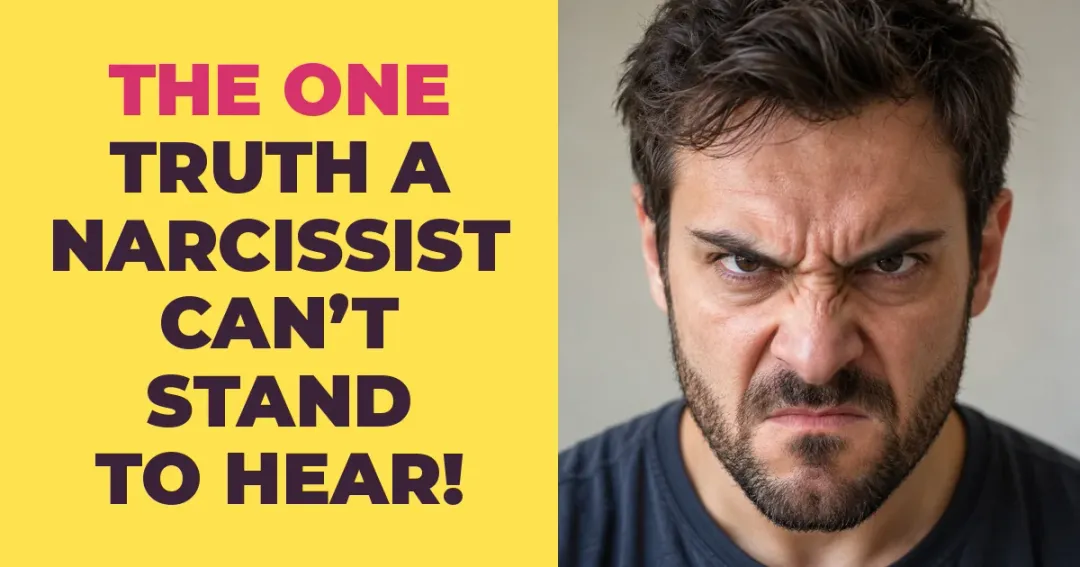
There is one truth a narcissist can’t stand to hear: you’re not who you pretend to be, and I can see it.
Here’s why that truth shakes them so badly, what they do when it surfaces, and why it stays true even when they deny it.
Why the mirror scares them
Research on narcissism describes two faces: a loud one that shows off, and a quiet one that sulks and feels wronged.
Both protect the same thing. A fragile self-image.
When a person’s sense of worth depends on outside confirmation, everyone around them becomes one of two things: a source of admiration, or a threat to it.
The moment you see clearly, you move from the first group to the second.
#1 The charm is a show for others

The person everyone else adores is not the person who comes home with you.
At the party, they’re hilarious. They top up drinks, ask about everyone’s kids, hug your mum a little too long so she sees it.
In the car home? Silence.
Then a flat, cold “Did you really have to tell that story?” and a list of everything else you got wrong tonight.
Narcissists often invest heavily in their public image, because admiration is what feeds their self-worth. Your clear view of them threatens all of it.
So your friends say you’re lucky. Your family thinks you’re exaggerating. And slowly, you start doubting what you saw with your own eyes.
You know which version is real.
#2 You started editing every word
Living with a narcissist slowly turns you into your own full-time editor.
You start texts with “Sorry, quick question” and soften them three times before sending. You hear the keys in the door and already know the mood.
See also 8 Reasons Why a Narcissist Will Set Out to Ruin You Financially
Why?
Because a tiny comment can set off anger that’s completely out of proportion. A question about dinner becomes a fight. A joke becomes a week of punishment.
Unpredictable anger like that trains your body to stay on alert. Psychologists call it hypervigilance, and the constant pleasing that comes with it, fawning.
So you agree fast. You apologise for things you didn’t do. Over time, you lose track of what you even want, or who you were before all this.
Being careful was how you stayed safe.
#3 They rewrote your memory, line by line
Gaslighting works by making you doubt your own memory until their version wins.
You bring up the comment they made at dinner. “That never happened.” You say it hurt. “You’re too sensitive.”
Research describes gaslighting working best when power is uneven, where your trust in them lets them control the story of what happened.
So you start keeping notes on your phone. Screenshots. Dates. Proof, just to feel sane in your own home. That’s how far it can go.
Two people can recall the same night differently. That’s normal. Denying what you clearly saw, again and again, until you stop trusting yourself, is something else entirely.
Writing things down as they happen, and checking with one person outside the relationship, helps you keep hold of what’s real.
Your memory was never the problem.
#4 Then one day, you say it out loud

When the truth finally comes out, a narcissist rarely hears it. They flip it.
Maybe it was something small that tipped you over. A broken promise. One more joke at your expense in front of friends.
You said it calmly: “You treat everyone better than you treat me.”
“I never did that. How dare you.” Then a list of your faults. Then tears, or a long sulk, until you were the one comforting them.
Researchers call this DARVO: deny, attack, reverse victim and offender. It tends to leave the person who spoke up blaming herself, which is exactly why it ends the conversation.
See also 9 Unsettling Reasons Narcissistic Grandparents Are More Dangerous Than You Realize
And that’s how you ended up apologising. What helps is keeping the original issue clear in your own mind, without arguing every counter-attack point by point.
Your first point was true. It still is.
#5 Their anger lands on the messenger
A narcissist’s rage is often aimed squarely at whoever bruised their image.
Research on threatened egotism found that narcissists respond to insults with more aggression, aimed at the source of the insult.
In their eyes, the source is you.
Sometimes it’s an explosion over one small remark: “Oh, so now I’m the bad guy?” Sometimes it’s cold fury that fills the house all evening.
Or it comes days later, as punishment for a comment you’d already forgotten making. You’re left guessing what set it off.
Everyone gets angry. The sign here is anger far bigger than the moment, pointed at the person who spoke up.
If anger ever turns into threats or breaking things, leaving the room and reaching out for help come first. Being safe matters more than being heard.
#6 They accuse you of what they do
Projection lets a narcissist hand you the very traits they can’t stand to see in themselves.
You catch a lie, and suddenly you’re the liar!
They shout, then snap, “Why are you so angry?” They take and take, then call you selfish for asking for one evening to yourself.
Psychologists describe projection as seeing an unwanted trait in someone else, so a person never has to face it in themselves.
Meanwhile, you’re defending yourself at midnight in the kitchen against things you never did. By the end, you’ve lost track of what the fight was even about.
One way to tell is to treat repeated accusations as information about them. State the facts once. Then stop over-defending.
Their accusations often describe them, not you.
#7 Your truth doesn’t need their signature

What you saw stays true, whether or not the narcissist ever admits it.
See also Why Narcissists Cast Themselves as Heroes While Tearing Down Everyone Around Them
They may never say “You were right.” Don’t wait on it.
Two of the heaviest things manipulation leaves behind are shame and self-blame.
Research on self-compassion describes it lowering both. In plain terms, it means talking to yourself the way you’d talk to a friend who’d lived through this.
Isolation is part of how manipulation works. So telling one trusted person the full story is a real step back toward yourself. That might be a friend, a support group or a therapist who understands abuse.
You saw it. You lived it.
Their agreement was never required.
The narcissist can deny it, rage about it or rewrite it. None of that changes what happened in your kitchen, your car, your life.
You don’t need them to agree.
Start small today. A walk alone. A message to someone who listens. Something that’s only yours.