You share good news and the room goes cold.
A narcissist may smile and say all the right things. Inside, your joy lands like a slap.
Maybe it was the flat ‘good for you’ when you got the promotion. The row that kicked off on your birthday. The way your best days keep ending with you saying sorry.
It’s not in your head.
Here are 7 reasons a narcissist hates to see you happy, and what each one reveals about them. Not about you.
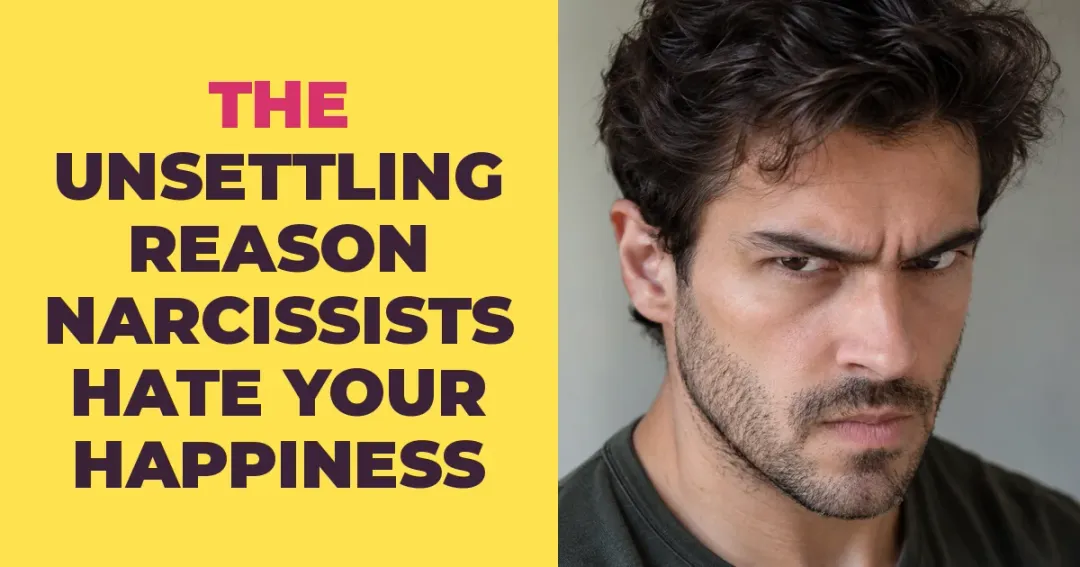
Why your joy feels like a threat
A narcissist’s sense of worth leans on outside confirmation. Admiration holds them up. Anything pulling attention away can register as a threat.
Your happiness does exactly that.
Psychologists studying narcissistic admiration and rivalry describe two modes. Early on, charm wins people over. Over time, putting others down takes the wheel.
That’s how the person who once cheered for you ends up treating your joy as a contest.
#1 Your good news turns them sour
Your best news can be the exact moment a narcissist’s mood sinks.
You come home buzzing about the job offer. They glance up from their phone. ‘Oh. Good for you.’ Then they ask what’s for dinner.
Envy shows up a lot in narcissism, especially the quieter, thin-skinned kind. Your luck reminds them they aren’t on top. So they belittle it, claim it or wreck it. A fight on your birthday is a classic.
Everyone feels a twinge of jealousy now and then. Using it as a weapon against you is something else.
So you start keeping quiet about good things. The promotion comes up weeks later, casually, like it’s nothing. Being happy starts to feel like a gamble.
A simple test: see whose face falls when life goes well for you.
And whose doesn’t.
#2 Every win of yours is their loss
With a narcissist, your gain often gets booked as their loss.
You mention your new personal best at the gym. ‘Cute. I used to lift more than that.’ You finish a painting, and they point out what’s off with the light.
See also How to Make a Narcissist Chase You, Unravel, and Self-Destruct
They compete with you instead of standing beside you.
Why? Research on narcissistic rivalry links it to knocking others down so their own rank stays safe. Ambition is fine. Rivalry is when your success gets scored against them.
And it’s the same person who adored you at the start. Charm came first. The cutting edge arrived later. No wonder your head spins.
Telling them about a win starts to feel risky, so you play it down before they can. Take your wins to people who are actually glad, and notice how different that feels.
You were never too much. You were winning.
#3 They need the spotlight back
When you shine, a narcissist often scrambles to pull the spotlight back.
You’re laughing with friends at dinner. Halfway through your story, they cut in with a louder one. Or they sulk the whole drive home. ‘No, I’m fine. You obviously had a great time without me.’
Psychologists describe two faces of narcissism, one loud and one quiet, and many narcissists switch back and forth. The loud one shows off. The quiet one goes cold and keeps score. Both shield a self-image that cracks easily.
Your happy evening didn’t star them. That’s the offence.
So you tread carefully. You laugh a little quieter. You scan their face before letting yourself enjoy anything.
Watch their mood the next time attention goes to someone else.
Same thing every time, right?
#4 Your feelings get brushed aside
A narcissist can often see your joy perfectly well and still choose to ignore it.
You tell them you can’t wait for the weekend away with your sister. They start talking about their back. When you push, it’s ‘Why are you so sensitive about everything?’
Research on narcissism and empathy turned up something telling. By default, their empathy was low. When nudged to picture the other person’s side, it rose. So the caring is often there. They simply choose not to use it.
See also 9 Ways Toxic Grandparents Try to Take Your Place as the ‘Real’ Parent
Read that again.
That’s why you stop telling them what makes you happy, and start wondering if your reactions are wrong.
Someone awkward with feelings who keeps trying is a different story. This is spotting your joy and stepping right over it.
Take your happy news to people whose faces light up. They’re out there.
#5 Some enjoy dimming your light
For some difficult people, knocking you down a peg feels rewarding in itself.
You’re getting ready to go out, feeling good for once. They lean in the doorway. ‘Bold choice. Brave of you, honestly.’ Then they smirk when you flinch.
Researchers named a trait everyday sadism: enjoying other people’s discomfort in small, ordinary ways. They added it to the Dark Triad to make a ‘Dark Tetrad’. For someone high in it, the cruelty is the reward.
Not every narcissist has this trait. Teasing that’s fun and ends when you say stop is something else.
But if your happiness seems to annoy them and your hurt seems to please them, take note.
Living with that, you train your face to give nothing away. It can feel like being hunted, not loved.
The less you react, the less they have to enjoy.
#6 A happy you needs them less
A happy, busy you has less time to orbit their every need.
Maybe you fixed their problems first for years. Covered for them with your mum. Felt guilty sitting down. Then you start keeping your own plans, and they notice. ‘You’ve changed. You used to care about me.’
Codependency is a popular word, not a diagnosis. It means arranging your life around someone else’s needs and moods while yours get pushed aside. It overlaps with what research calls fawning: staying safe by pleasing.
A partner who’s all about themselves gets a lot out of that arrangement. Of course they like it.
So when your life fills up, the free service stops.
Try this. Next time they ask for something, pause and check what you want first. Then let them handle the results of their own choices.
See also Kids Are a Narcissist’s Easiest Targets — Here’s How to Make Yours Untouchable
Burnout is not a love language.
#7 They return when you’re thriving
Many narcissists reappear right when you finally start to feel good again.
Months of nothing. Then you post one photo from the beach, laughing. That night your phone buzzes. ‘I miss you. I’ve been doing a lot of thinking.’ Or there’s a sudden emergency only you can fix.
Many call this hoovering. It’s a popular label, not a clinical one, for attempts to reel you back in.
It often shows up when they need something or feel you’ve moved on. It runs on your hope that the good old days will return.
Psychologists call the hook underneath intermittent reinforcement: kindness that arrives unpredictably grips harder than steady kindness.
To them, your happiness can look a lot like being replaced. By your own life.
Old hope may rush back. Look at what they’ve actually done, not what they’re promising now, and decide your reply in advance.
You built that happiness without them.
How they react to your joy says a lot about them. It says nothing about what you’re worth.
Self-compassion, talking to yourself the way you’d talk to a good friend, helps ease the shame and self-blame manipulation often leaves behind.
So keep laughing. Keep your plans. Save your good news for people who clap!