Narcissists rarely give themselves away with one big scene.
It’s the small stuff. The compliment that stings an hour later. The story they tell at dinner that used to be yours.
Each thing on its own sounds too petty to mention. So you don’t.
And then you wonder why you feel so tired around them.
Strange little habits like these often add up to something bigger, and what counts is how often they keep happening.
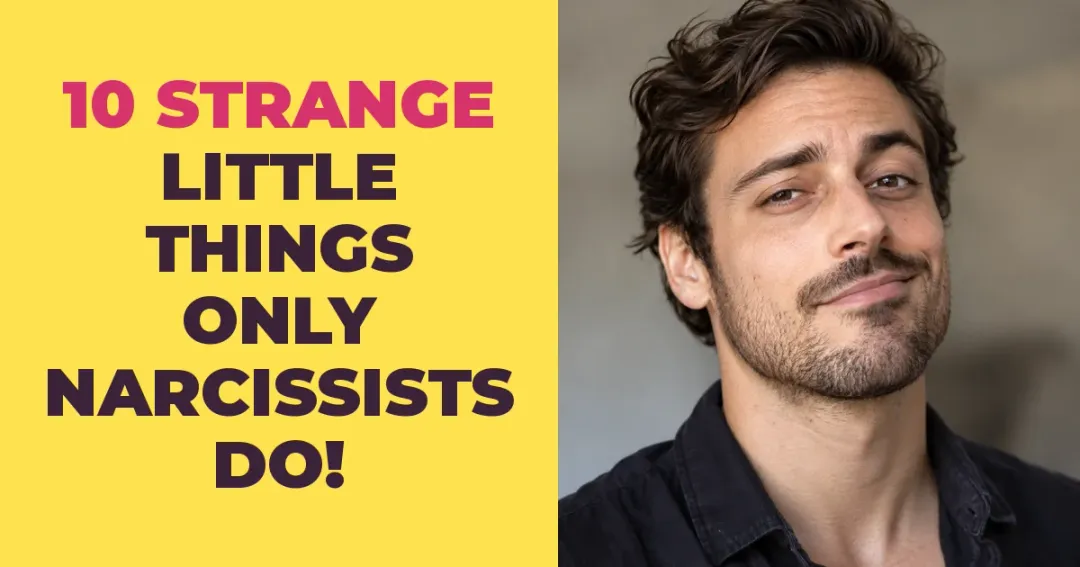
Here are 10 strange little things narcissists do, and what each one is really about.
#1 Lovely in public, frosty at home

The person everyone adores at dinner may barely speak to you on the drive home.
At dinner they laugh at your jokes, top up your glass and tell your friends how proud they are of you. Then the car door shuts. Silence. Or a list of everything you did wrong.
Why the switch? Many narcissists pour energy into how others see them, because applause from outside is what keeps their self-worth standing.
Your friends get the highlight reel. “You’ve got a good one there,” they say.
And you start to doubt what happens at home.
Believe what you live with in private. That’s who they are when nobody’s clapping.
#2 Their compliments come with a hook

A narcissist’s compliment often has a small blade hidden inside it.
“You look great. Much better than last time.” “Good for you, getting that job. They must have been desperate.”
It sounds like praise. It lands like a slap.
Researchers who study narcissistic rivalry describe a status-guarding streak. If you rise, they feel they’ve slipped, so they knock you down a notch.
So they can’t fully cheer. They have to shave a bit off first.
Over time, you start keeping your wins to yourself. Notice that.
Who in your life just says “Well done” and means it?
#3 Bragging dressed up as a shrug

Some narcissists work their achievements into every conversation, sometimes disguised as a complaint.
See also What Happens to Narcissists After 65
“Ugh, my boss wants me to lead everything. So annoying.” “I barely studied and still got the top mark. Weird.”
Then they wait. For the gasp.
Narcissism runs on a hunger for applause. When self-worth depends on what others reflect back, they keep casting for praise, and the story tends to get bigger with every retelling.
Meanwhile, your news gets a nod. Your needs feel like an interruption.
One humblebrag is nothing. Look at a whole season of them.
Is anyone ever allowed to be impressive but them?
#4 Your idea becomes their idea

A narcissist may copy what you do, then act like they thought of it first.
You take up running. Suddenly they’re training for a marathon. You mention a business idea over coffee, and three weeks later it’s their idea, told at a party.
“What? Lots of people do that.”
Envy shows up a lot in narcissism, research suggests, most of all in its quieter, prickly form. When you do well, their sense of being on top wobbles. So they make your win smaller, ruin it, or take it.
Copying is the taking part.
Sound petty? Maybe. But it keeps happening.
Pay attention to who goes flat when good things happen to you. And who suddenly wants exactly what you have.
#5 Every story turns into their tragedy

Your bad day can quickly become a story about their much worse life.
You tell them your mum is in hospital. Within a minute you’re hearing how nobody ever visited them, how hard their year has been, how misunderstood they are.
And somehow you’re comforting them.
Researchers describe a softer-looking, vulnerable side of narcissism. Prickly. Full of grievances. Secretly sure they’re better than everyone, yet unseen. Casting themselves as the wounded one keeps a brittle ego safe.
Point it out? They sulk. “Wow. I can’t even talk to you anymore.”
It’s not shyness or a hard life that marks this. It’s how often your pain gets pushed aside for theirs.
See also 7 Hidden Weaknesses That Bring Every Narcissist Down
Whose turn is it to be hurting? Theirs. Almost every time.
#6 Shared wins somehow belong to them

Shared wins have a funny way of becoming theirs alone.
You planned the whole holiday. Booked it, packed for it, found the restaurant. At dinner with friends, it’s “I found this amazing place.”
The house you both fixed up? “My project.”
Psychologists call this entitlement: a quiet conviction that they’re owed more than the rest of us. Grabbing the credit for something you built together fits right in.
Correcting them feels petty. Asking for an even split of the credit feels like lighting a fuse.
So you hand over more and get less back, without a word. Jot down what you contribute, even just in your notes app.
You were there. You know who booked the flights.
#7 A new person is suddenly perfect

Out of nowhere, one new person becomes the most amazing human alive.
A coworker, a gym friend, a neighbour. Their name comes up at every meal. “Jess is so easygoing. She’d never make a fuss about this.”
Ouch.
There’s a name for this: triangulation. A problem between the two of you gets a third player added, someone to make you jealous or push you harder. It saves them from talking to you straight.
New people often get the full charm. The cold side shows up later.
Suddenly you’re in a contest you never signed up for.
You don’t have to enter that race.
#8 They understand your pain just fine

Narcissists often understand your feelings perfectly well. They just don’t act on them.
You cry, they change the subject. You say you’re hurt, and you hear “You’re too sensitive.”
Then, mid-argument, they bring up the exact insecurity you told them about at 2 a.m.
So they were listening.
In studies, narcissists showed less empathy at first, yet more of it when asked to imagine the other person’s view. In other words, it can be switched on. They often just don’t.
See also 10 Weird Habits Only Narcissists Have
No wonder you’ve gone quiet about your feelings and second-guess every reaction. Bring your heart to people who actually respond to it.
Some people will. Gladly.
#9 Their memory fails during apologies

The moment you ask for an apology, their memory suddenly stops working.
You bring up last night’s comment. Blank face. “That never happened.” Then, a beat later: “And how dare you accuse me of that.”
There’s a research term for it: DARVO. They deny, go on the attack, then swap places so they’re the wounded one. Research suggests the person who raised the problem walks away blaming herself more.
Which is exactly why it works.
Ten minutes later, you’re the one apologising. For bringing it up.
Make a quick note on the day something happens. If you raise it, keep coming back to the first issue and let the counter-attacks slide past.
Your memory is fine. Theirs is selective.
#10 They accuse you of their own moves
The thing they accuse you of is often the thing they’re doing.
“You’re always on your phone.” Said by the person glued to theirs. “Stop shouting!” Said while shouting.
It’s dizzying.
The name for this is projection. Spotting a flaw in you is easier than facing it in the mirror.
You end up arguing your innocence over things you never did, and the original problem quietly disappears.
Here’s a different lens. A charge that shows up again and again may tell you more about them than about you. Say what’s true one time. Then stop explaining.
Sometimes the accusation is a confession.
If you saw your life in this list, you’re not being dramatic. One odd moment means little. A pattern over months tells you far more.
You don’t have to prove any of it to them. You only have to stop doubting what you saw.
Start small. Tell one person who knows you well one true thing that happened this week.