Narcissists rarely lock the door on you. They make leaving the house feel like more trouble than it’s worth.
Then one day you notice. The friends who used to call have gone quiet. You missed your sister’s birthday and can’t quite say why.
Your world got smaller.
You can’t point to the day it shrank. That’s no accident. This kind of control usually arrives in small, reasonable-sounding steps.
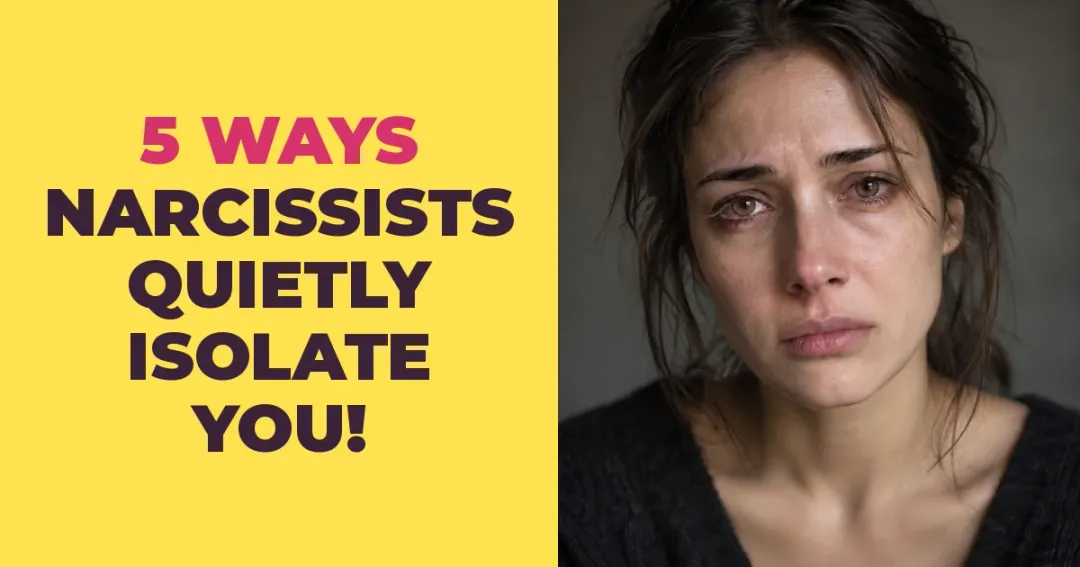
Here are 5 ways narcissists quietly isolate you, and how to spot each one while it’s still happening.
Why it’s so hard to see
Researchers describe a pattern called coercive control. Lots of little rules, and little penalties for breaking them, slowly eat away at your freedom.
No single moment looks like much. A comment. A sigh. A rule about who’s “too much drama.”
That’s why it’s so hard to explain.
And isolation is part of how manipulation works. The fewer people close to you, the fewer people you can check things with.
#1 Your friends suddenly aren’t good enough
A narcissist rarely bans your friends; they just make each one feel like a problem.
Your best friend is “a bad influence.” Your mum “always stirs things up.” The coworker you like? “She’s fake. I can see it, even if you can’t.”
Each comment sounds like concern. Some even sound protective.
Research links narcissism, especially its quieter form, with envy. Running down the people you love is one way that envy leaks out. Their jokes, their jobs, their marriages are all fair game.
Researchers who study coercive control describe a related move: quietly choosing your company for you. Your friends become the price of a calm evening.
Nobody says “You can’t go.” But going costs you. The sigh when you grab your coat. The cold shoulder in the car home. The lecture the next day.
So you see them less. It’s easier.
One skipped coffee at a time, the circle shrinks. So ask yourself: does any friend ever pass their test? If none do, the problem was never your friends.
See also Narcissists Blame You for These 9 Things, but It’s Usually Their Own Confession
#2 Your time stops being your own
To a narcissist, your free time belongs to them by default.
You mention Saturday lunch with your cousin. Suddenly they need you. The car, the errand, the sulky “I thought we’d finally have one day together.” Funny how that day always lands on yours.
Say no, and watch the mood drop.
Psychologists call this entitlement. Underneath it sits a belief that they’re owed more than anyone else, and that the usual rules don’t apply to them.
So a normal limit from you lands like an insult. Your plan isn’t a plan to them. It’s a slight, and keeping it feels like an attack.
Slowly the balance tips. You hand over more of your week and get less of theirs back. Their plans are fixed. Yours are “flexible.” Even asking for one evening back feels like picking a fight.
So you stop making plans.
One thing helps: don’t say yes in advance. Give your answer when you’re ready, not when they push. Your Saturday was yours first.
#3 They sulk until you stay home

Some narcissists never forbid your plans; they simply sulk until you cancel them.
You’re getting ready for a girls’ night. They’re on the sofa, quiet. “No, go. Have fun. I’ll just be here on my own. Again.”
Keys in hand, you suddenly feel like a monster.
Research describes a quieter side of narcissism. Less showing off, more hurt feelings, grudges and self-pity. When the attention drifts away from them, the moping starts.
Underneath, it’s guarding the same fragile self-image as the loud version. It just does it by feeling hard done by.
Then comes the guilt trip. “After everything I’ve done for you, you’d rather be with them?”
There’s a popular name for this squeeze: FOG, short for fear, obligation and guilt. It isn’t a formal term. It describes how guilt makes “no” feel more expensive than “fine, I’ll stay.” It links to a researched pattern called coercive control.
See also 9 Things Narcissists Do When Revenge Is All They Can Think About
Try one small pause before you answer. Their mood is real to them. It still isn’t your curfew.
#4 Birthdays somehow always go wrong
Your best days are the ones a narcissist often seems least able to share.
Your promotion dinner. Your best friend’s wedding. Your fortieth. Somehow there’s a fight in the car before you’ve even parked.
Or they come, then sit in a corner with a face like thunder, so everyone spends the evening checking on them instead of you.
Why? Envy.
When you shine, they feel smaller, and that pokes at their need to come out on top. So they dim the moment, take it over or ruin it. A day when everyone’s looking at you is an easy target.
The cost lands on you. Good news starts to feel like something to keep quiet. You downplay the promotion, or skip the party just to dodge the fight.
That’s isolation too. Quieter than a rule.
Pay attention to whose face falls when things go well for you. Then share the next win with someone whose face lights up. You’re allowed to be happy out loud!
#5 They take control of the money

Money can be the quietest wall a narcissist builds around you.
It might start as help. “Let me handle the bills, you’ve got enough on your plate.” Then your card lives in their wallet.
Soon you’re asking for cash to meet a friend for coffee, and explaining why you need it.
Sometimes the answer is no.
Researchers have a name for it: economic abuse. It covers taking over, draining or undermining your money, your income and your independence.
The reason is simple and cold. If every penny runs through them, walking away gets harder. So does a train ticket to see your mum, or a dinner out with your oldest friend.
Maybe you’ve started tucking receipts away. Maybe money feels like a cage. Control over spending is one of the patterns listed under coercive control, a recognised form of domestic abuse.
See also 8 Things Every Narcissist Lies About Without Thinking
A little money that’s only yours, copies of your records, and a talk with a domestic abuse service can give you room to think. They worked quietly. So can you.
None of this happened because you’re weak or naive. It happened in small steps that are easy to miss, especially when each one comes wrapped in “I’m only looking out for you.”
The way back can be just as small.
One text to an old friend. One coffee you don’t cancel. Start with one person, and let the world get bigger from there.