Ask a narcissist about the dishes and you could be on trial for two hours.
You start out asking why they were late. You end up apologising for your tone, your timing and somehow your mother.
The original question? Gone.
You’ve tried explaining. Calmly, then loudly, then in a long text at 2 a.m. None of it lands.
Every word you add just gives them more to twist.
There’s a better move, and it fits in one short sentence. Below: the exact words, why they work, and what usually happens next.
Why the fight is rigged
Behind the swagger or the sulk, there’s often a fragile self-image that a narcissist is guarding.
Some guard it loudly and grab every conversation. Others guard it quietly: they sulk, keep score and play the wounded one whenever they’re challenged. Many flip between the two.
Either way, being wrong feels like a threat to who they think they are. So the argument was never really about the dishes. It was about protecting that image.
Challenge them, and the wounded act often follows.
#1 Every complaint becomes your fault
Bring up one problem and a narcissist may hand you back a list of yours.
You ask about the money missing from the joint account. Ten seconds later it’s “I didn’t take a cent. How dare you even ask me that?”
Then come your faults. Your tone. Your friends. The birthday you forgot three years ago. The way you “always” bring things up at the worst time.
Next come tears or a day-long sulk, and somehow you end up soothing them.
Psychologists have a name for this pattern: DARVO. They deny, they attack, then they flip who’s the victim and who’s the offender. Research found it leaves the person who spoke up blaming themselves more.
No wonder it shuts the talk down so fast. Your question about the money simply vanishes.
Over time, you just quit raising things. Silence starts to feel safer than another round.
See also A Narcissist’s Downfall Begins the Moment They Push an Empath Too Far
And the money? Still missing.
#2 Explaining yourself just feeds them

Every extra explanation hands them one more thing to pick apart.
You’re “selfish” a week after they emptied the savings. You’re “angry” while they yell at you all the way home.
So you build a case. Dates, receipts, screenshots, all of it, saved in a folder on your phone like you’re preparing for court.
It gets you nowhere. Psychologists call this projection: pinning a trait they can’t stand onto you, so they never have to spot it in the mirror.
Then they add “You’re imagining things” and “You overreact to everything.” Now the story is being rewritten while you’re still in the middle of it. You start to wonder if they’re right.
That’s gaslighting. It works best when they hold the power over whose version counts.
And somewhere in there, the thing you came to talk about gets lost.
A quick test? Treat a charge that keeps coming back as information about them, while staying honest about whether any of it is fair. State the facts once. Then stop talking.
#3 The sentence is short and dull
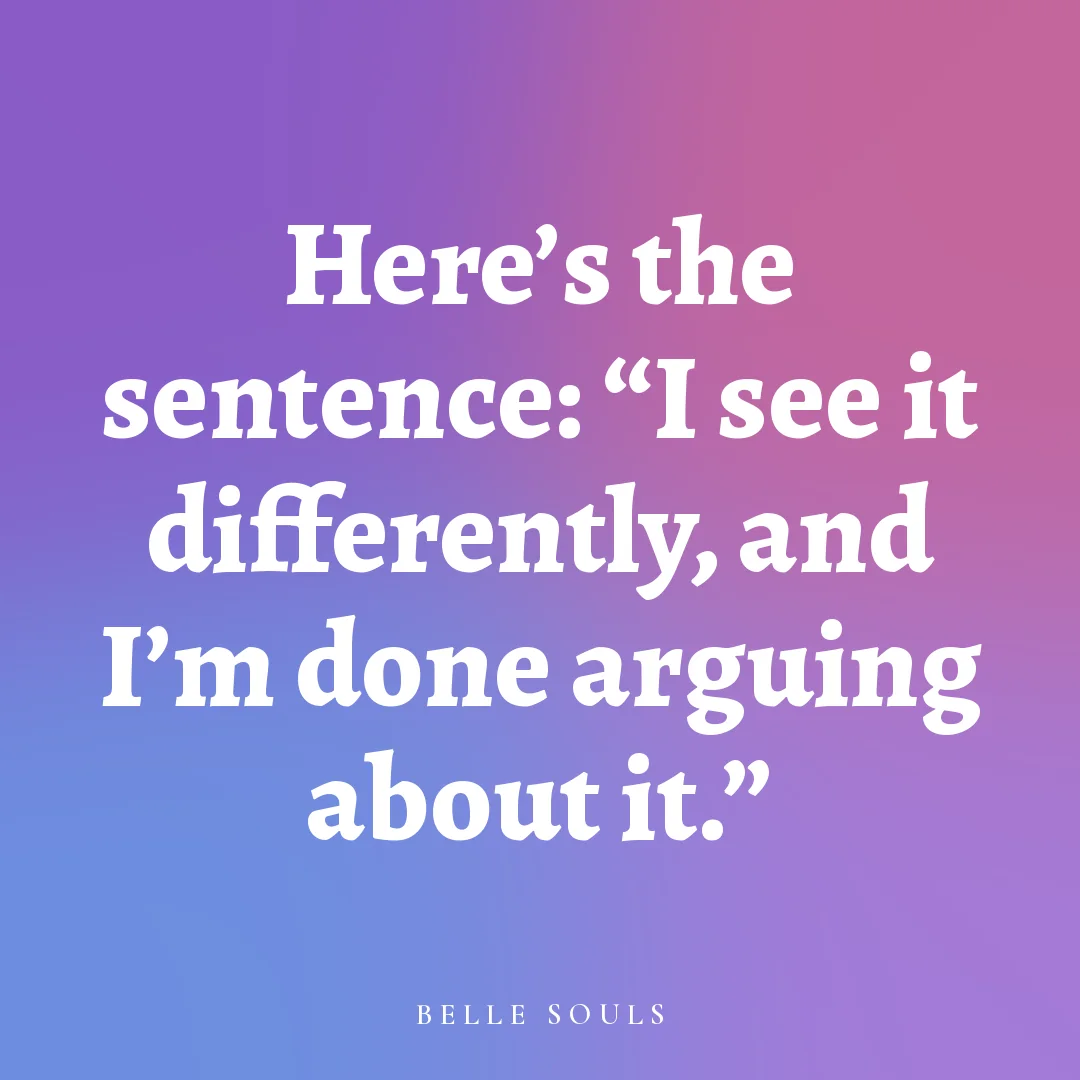
Here’s the sentence: “I see it differently, and I’m done arguing about it.”
That’s all. No speech, no evidence, no second paragraph.
It works because it needs nothing from them. A boundary is about your own actions, not their behaviour, so they don’t have to agree for it to hold.
No confession required. No calming down required. No agreeing that you were right. You’re just choosing what you’ll do next, and that part is yours.
Picture dinner. The old “You always do this” routine starts. You say your line, take your plate and head for the dishwasher.
If they fire back with something new, name the first issue one more time or leave it. Answering each new jab only restarts the trial.
One time out loud. Then follow through, again and again.
See also 9 Things in Narcissistic Relationships That Aren’t Normal at All
Same words tomorrow. Same plate in the dishwasher.
#4 Your reaction is the real prize

With some difficult people, the hurt look on your face is the goal.
They crack a joke about your weight at your sister’s table. You flinch. They grin. “Relax, it was a joke.” Now everyone is looking at you. Nobody says a word.
Researchers call this trait everyday sadism. For people high in it, small cruelties are a reward on their own, not just a tool.
So your line needs to land flat.
Say it the way you’d ask someone to pass the salt. No eye roll, no wobble, no slammed door. Keep your voice low and your face bored.
Words only. Nothing else for them to chew on.
A clue worth noticing: does your upset seem to cheer them up? If so, trust your eyes.
Give them a shrug instead of a flinch.
#5 Expect a bigger storm at first

Refuse the fight for the first time, and the noise often rises before it settles.
Think about it. When their image feels threatened, being refused can feel like an insult.
Research on threatened egotism found that insults make narcissists more aggressive, and the anger lands on whoever they blame.
That could mean icy fury. A banged cupboard. Payback days later for a remark you can’t even recall. Or a long, loud list of everything you’ve ever done wrong.
Or the sneer: “Oh, so now you’re too good to talk to me?”
You may catch yourself pre-editing every word, or apologising for things you never did. That’s the fear talking, not proof you were wrong.
Pushback at first is common and doesn’t mean the boundary failed.
One firm line. If the anger becomes threats, smashed things or anything physical, get out of the room and get help. No sentence is worth getting hurt for.
#6 Grey rock is for contact you can’t skip

When you can’t cut contact, grey rock keeps every exchange short and boring.
See also Behind Closed Doors, Narcissists Love These 7 Hobbies That Would Unsettle You
It’s a popular name, not a clinical term. The idea is simple: share as little as possible and stay dull and unreactive.
Short factual replies. Logistics only. “Pickup is at five.” Put it in writing where you can. No feelings, no history, no defending your character.
Less contact and fewer reactions give a manipulator less to work with, and over time the bond can fade.
Grey rock won’t change them, and it isn’t a way to win.
It isn’t safe in every situation. If they might escalate, talk to a domestic violence service about a safety plan first.
The first weeks can feel like withdrawal. You’ll itch to explain, to fix it, to finally be understood. That’s normal.
Calm tends to come later, not first.
You were never bad at arguing. The game was rigged against you from the start.
One calm sentence won’t fix them. It isn’t meant to. It’s there to give back your voice, your evenings and a bit more faith in your own memory. That’s a lot to win back with ten words.
The next time the trial starts, you already know your line. Say it once. Then go do something that’s yours, and if it feels right, tell one person you trust what happened.