The words sound almost normal. Then you walk away feeling smaller, and you can’t say why.
Narcissists often say one thing and do another.
Kind at the party, cold in the car home. You raise one problem and get handed a list of your faults. Then you lie awake replaying it, wondering if the problem is you.
Some lines are built to make you doubt yourself.
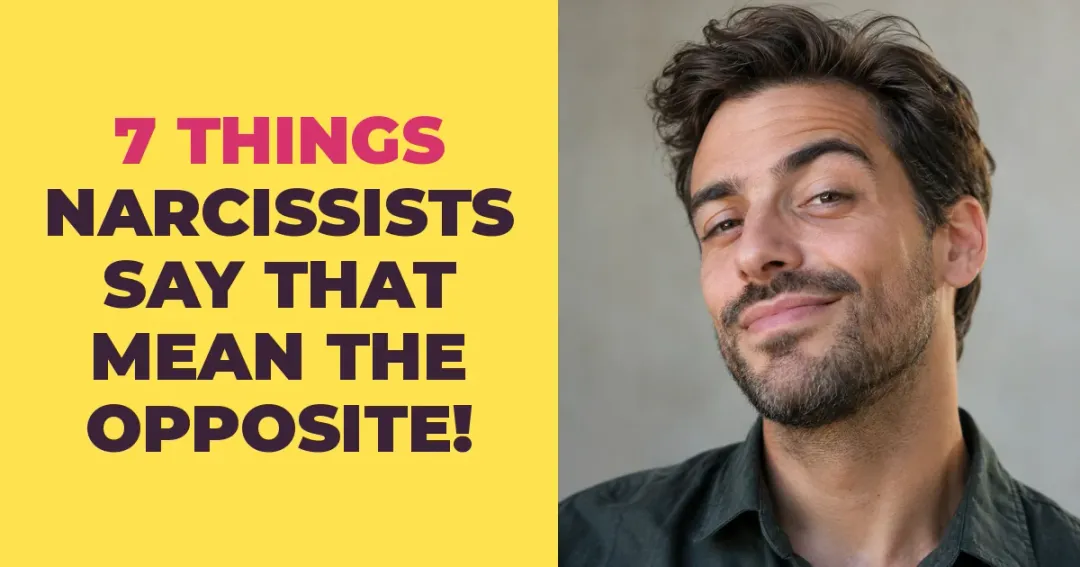
Here are 7 things narcissists say that really mean the opposite, and what each one quietly does to you.
Why their words flip
A narcissist’s sense of worth often leans on outside approval. So the people close to them tend to get treated as admirers or as threats.
What they say can serve that.
So don’t judge by one line. Judge the pattern over months, and expect the behaviour to stay the same rather than waiting for change.
#1 Your feelings are the problem, apparently
Calling you too sensitive makes your hurt vanish, and their part in it too. You tell them the comment at dinner stung.
They sigh, check their phone and mutter, “Here we go again. You’re too sensitive.”
And just like that, you’re the one saying sorry.
Research on narcissism and empathy suggests it’s often lower by default. When narcissists were nudged to imagine the other person’s view, more of it showed up. So it looks more like a choice than a missing skill.
You begin second-guessing your own reactions. You open up a little less each time, then not at all. Why bother?
A partner who’s clumsy with feelings still tries to help. This one notices your pain and walks past it.
Bring your hurt to people who actually hold it. The sting from that dinner comment was never the problem.
#2 ‘That never happened’ is a tactic
Denying what you both saw lets a narcissist write their own version of events.
You mention the night they yelled at you on the drive home. They tilt their head, half amused. “That never happened. You’re making things up again.”
See also 7 Signs a Narcissist Is Faking Their Love for You
You were there. You know it.
Psychologists call this gaslighting. The aim is to make your memory feel shaky so their story wins, and it works best when they hold more power and you still trust them.
Two people recalling things differently is normal. Gaslighting goes further. It denies what you saw until you start doubting yourself.
Maybe you already keep notes, proof that a Tuesday really happened. Good. Jot things down as they happen, somewhere only you can reach.
And run them past one person outside the relationship.
Their denial doesn’t erase the drive home.
#3 The joke was the point

A cruel joke that only ever lands on you was never really a joke.
At your sister’s birthday, they bring up your cooking, your parking, the time you cried in a meeting. Everyone laughs. You smile and count the minutes.
Later, in the car: “Relax, I was kidding. You can’t take anything.”
Researchers use the term everyday sadism for people who enjoy small doses of someone else’s discomfort. For them, your wince is the payoff.
Mocking ‘jokes’ at your expense also sit near contempt: the eye-rolls, the sneers, the talking down. Living with that can make you feel small inside your own home.
Real teasing stops the moment you ask. This keeps going. Watch their face when you’re hurt. Does it look like they’re enjoying it?
Did they smile when you flinched?
#4 Their favours come with a bill
A narcissist’s favours can turn into a debt that never gets paid off.
You say you can’t drive their mum to the airport on Saturday. Silence. Then: “Wow. After everything I’ve done for you?” Out comes the list. The rent they covered that one winter. The lift home from work.
There’s a popular name for this: FOG, which stands for fear, obligation and guilt. It isn’t a formal term.
It describes how guilt trips and reminders of old sacrifices make no feel too expensive to say. Researchers studying coercive control describe something related: lots of small pressures that slowly shrink your freedom.
See also 5 Things You Should Do Right Away After Leaving a Narcissistic Relationship
Bit by bit, yes comes out on autopilot. Their moods start to feel like your job.
Try a pause. “Let me get back to you” gives you room to sort their feelings from what’s actually yours to carry.
A gift with strings attached is a loan.
#5 Someday is a holding pattern

Big plans about your future together can keep you waiting for years.
The cabin in the mountains. The road trip. The wedding. “After this crazy stretch at work, I swear.”
The crazy stretch never ends.
Future faking is a popular, informal name for this: detailed promises that keep you invested, with no real intention behind them.
It ties into a research idea called intermittent reinforcement. Warmth that arrives unpredictably grips harder than steady kindness. And after you’ve poured years into a shared future, walking away feels like losing it.
Meanwhile, asking makes you feel unreasonable. Genuine plans fall through too, but they get a new date. Go by what has actually happened, and pick a timeline of your own.
How many somedays have you waited through?
#6 Somehow they become the victim
When you raise a problem, a narcissist may end up as the injured one.
You finally mention the late-night texts from their ex. Within a minute it’s “So now you’re snooping? I can’t believe you’d think that of me.” Then the tears start.
Twenty minutes later, you’re the one comforting them.
This pattern has a name, DARVO: they deny it, attack you, then swap roles so they’re the victim and you’re the offender. Studies show it leaves the person who spoke up blaming herself more.
So you say sorry for raising it. The time after that, you stay quiet.
Steer back to what you came to talk about. Skip the counter-attack. One calm line is enough: “I’m talking about the texts.”
Notice who ended up apologising.
#7 Their accusations describe them
What a narcissist accuses you of is often what they’re doing themselves.
See also 5 Phrases Narcissists Use to Control You
You get home fifteen minutes late from the gym, and they’re waiting in the hall. “Who were you actually with? I know your type.”
Their own phone, of course, stays face down.
Psychologists call this projection. Pinning a trait they can’t stand on you means they never have to look at it in themselves. So the one shouting calls you angry. The one taking calls you selfish.
And you lose whole evenings defending yourself against things you never did, until the real issue gets buried.
Fair criticism that stings is something else. But the same accusation, over and over, that never fits you? Treat it as information about them. Say where you were once, then stop.
If ‘selfish’ never fits you, it may be telling you about them.
One kind sentence can’t cancel months of jabs, denials and guilt trips.
Watch what they do over months, not single moments. The pattern tells you far more than any line they say.
Start with one person who knows the whole story. Before you talk, write down what you want help with, so the words stay yours.