Narcissists rarely need to shout to make you feel small.
A smirk does it. A sigh. A story told slightly wrong, in front of people you love, so you’re the punchline.
And afterwards you’re the one lying awake at 2am, replaying it, wondering if you really are that slow.
You’re not.
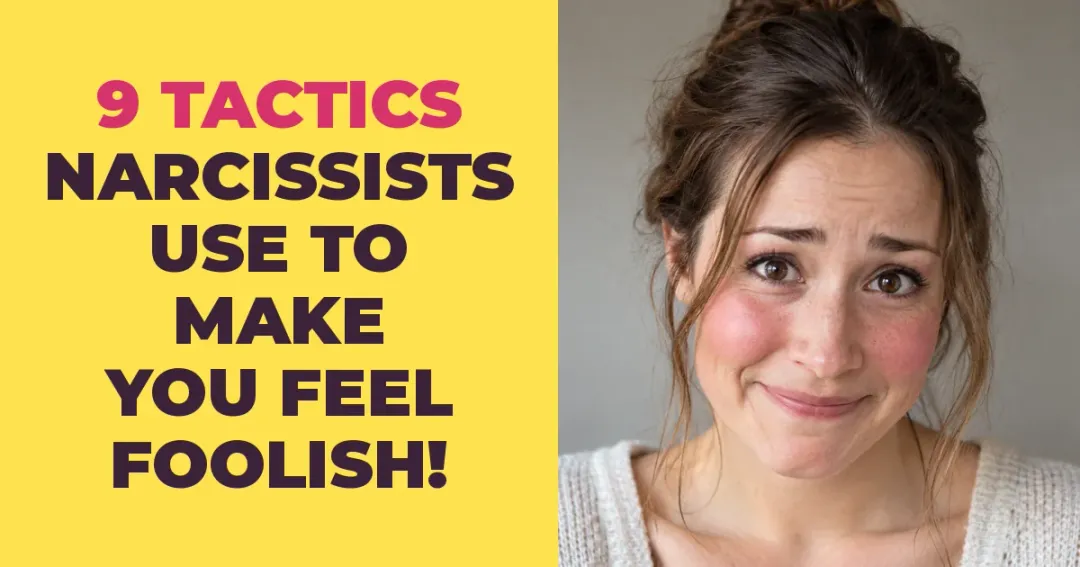
Here are 9 tactics narcissists use to make you feel foolish, and why each one works so well.
#1 They rewrite what you saw

The quickest way to make you feel foolish is to make you doubt your own eyes.
They said it. You heard it. Two days later, over the dishes: “I never said that. You’re imagining things again.”
Psychologists have a name for it: gaslighting. It thrives when one partner holds more power, and your trust becomes the gap they slip a new version through.
So you start keeping notes. Screenshots. Dates. Proof of a conversation you both had.
A clear mind does that when its reality keeps getting edited.
What helps: write things down as they happen, in your own words, and check them with one person outside the relationship.
Your memory isn’t the problem.
#2 They talk right over you
Talking over you is a quiet way of saying your words don’t count.
You’re halfway through a story at dinner. They cut in, finish it wrong, and get the laugh.
Then: “Sorry, were you saying something?”
Research describes a loud, showy type of narcissism. It grabs every conversation and can’t bear sharing the stage. All that volume guards a self-image that bruises easily.
Push back, and their mood turns cold or sulky. So you start walking on eggshells just to finish a sentence.
One way to tell: watch them when someone else holds the room. Do they go quiet and sulky? Interrupt louder?
Your story was worth finishing.
#3 Your soft spots become the punchline

For some people, your discomfort is the fun part.
You told them, privately, that you hate your laugh. Now, at a friend’s birthday, they do an impression of it, loud. Everyone giggles.
See also The Narcissist Keeps You Broke Deliberately, Here’s Why
You flinch. They smirk. “Come on, it was a joke.”
Researchers have a name for this trait: everyday sadism. Small cruelties feel good to the person doing them, no other payoff needed.
Over time you feel more like prey than a partner, even in your own living room. You learn to keep a straight face, just in case.
The tell? Playful teasing stops when you ask nicely. This kind doesn’t. Does your hurt seem to please them?
That smirk is your answer.
#4 The eye-roll waits for the car ride home

The person everyone at the party adores may not be the one who drives you home.
In public, they’re warm, funny, attentive. Your friends say you’re lucky.
Then the car door shuts. Silence, or a mocking echo of your voice: “Ooh, look at me, I’m so interesting.”
Many narcissists pour energy into how others see them, because applause props up their sense of worth. You get what’s left over.
Long-running research on couples found contempt, like eye-rolling and sarcastic “jokes”, ranks among the best predictors that a couple will split.
No wonder you feel small in your own home. And when you tell people, they often don’t believe you.
Trust what happens behind closed doors.
#5 You’re the last one to know

Quietly building alliances means everyone else knows the plan before you do.
The plans changed. The dinner moved to Friday. Your friends, your family, everyone knew but you, and you found out in front of them.
“I told you last week. You never listen.”
Psychologists call this style Machiavellianism. Think flattery, lies and patient planning, all while their name stays spotless.
They may tuck away what you tell them for later. By the time you spot the plan, it’s already done.
Speak up, and others see someone calm and reasonable who rarely loses their temper. Not the person you live with.
So share less personal stuff. When you agree on plans, send a quick text: “Confirming dinner Friday at 7.” Now it’s written down, not just remembered.
See also 9 Signs You Feel Lonelier with a Narcissist Than on Your Own
#6 Decisions happen without you

The more they decide for you, the smaller your world gets.
Who you see this weekend. What you wear to it. Whether that purchase was really necessary.
“I just know what’s best for us.”
Psychologists call this pattern coercive control. Rule by rule, punishment by punishment, your freedom gets chipped away.
That’s why it’s so hard to point to one big moment. There isn’t one. There are hundreds of tiny ones.
Then one day you catch yourself asking permission to buy shampoo.
If this sounds like home, hold on to some money and phone numbers that are yours alone, and consider calling a domestic abuse service to talk through staying safe. Shampoo shouldn’t need a vote.
#7 Suddenly everyone’s on their side
Bringing in a third person turns a fair disagreement into you against everyone.
“Even my mum thinks you overreacted.” “Everyone noticed how you were at the wedding.” Notice how rarely they say who.
Family systems research calls this triangulation. Instead of dealing with the tension between you two, they drag someone else into it.
Sometimes those others start doing the pushing for them. People online call them “flying monkeys”. It’s a popular label, not a diagnosis.
Often they mean well. They’ve only heard one carefully polished version.
You end up outnumbered in your own circle.
Talk only to the person involved. Messengers don’t need your defence.
#8 Somehow you end up saying sorry
You raise one problem, and by bedtime you’re the one apologising.
Maybe it’s the comment they made about your sister.
“I never said that, and how dare you accuse me!” Then a list of your faults. Then tears, or a sulk, until you comfort them.
Researchers call this DARVO. It stands for deny, attack, reverse victim and offender. Studies show it leaves the one who spoke up feeling more to blame.
No wonder the conversation dies.
Name the original issue calmly and return to it. If it heats up, step away. You don’t have to win the exchange. You don’t owe the counter-attack a point-by-point answer.
See also 6 Reasons Why Narcissists Marry You So Their Lives Are Easier
What were you upset about in the first place? Start there.
#9 Your wins feel like a threat to them
A narcissist may put you down hardest when you start to outshine them.
You get the promotion. Finish the course. Fix the thing they swore couldn’t be fixed.
“Well, anyone could have done that.” Or: “Don’t let it go to your head, you’re not that clever.”
Research on admiration and rivalry describes how this shifts. Early on, charm does the work. Later, competition takes over, and anything you gain counts as their loss.
Envy adds fuel. Your success pokes at their need to feel above you, so they shrink it.
So the promotion news sits in your phone for days, until you can tell a friend who’ll actually scream with joy. Tell her first.
Feeling foolish was never the same as being foolish.
If you saw yourself in this list, that doesn’t make you naive. It means you were paying attention. Start with one tactic: notice it, name it in your head, write it down.
Look at the pattern across months, not one bad night. Patterns are much harder to argue with.
You were never the fool in the room.