A narcissist rarely announces they’re in charge. They just slowly become it.
You notice it in small ways. The way you check their face before you speak. The way you say sorry first, every time.
No single moment looks big enough to complain about. That’s how control often creeps in: one tiny rule here, one little punishment there, and nothing dramatic enough to name.
So it starts to feel normal.
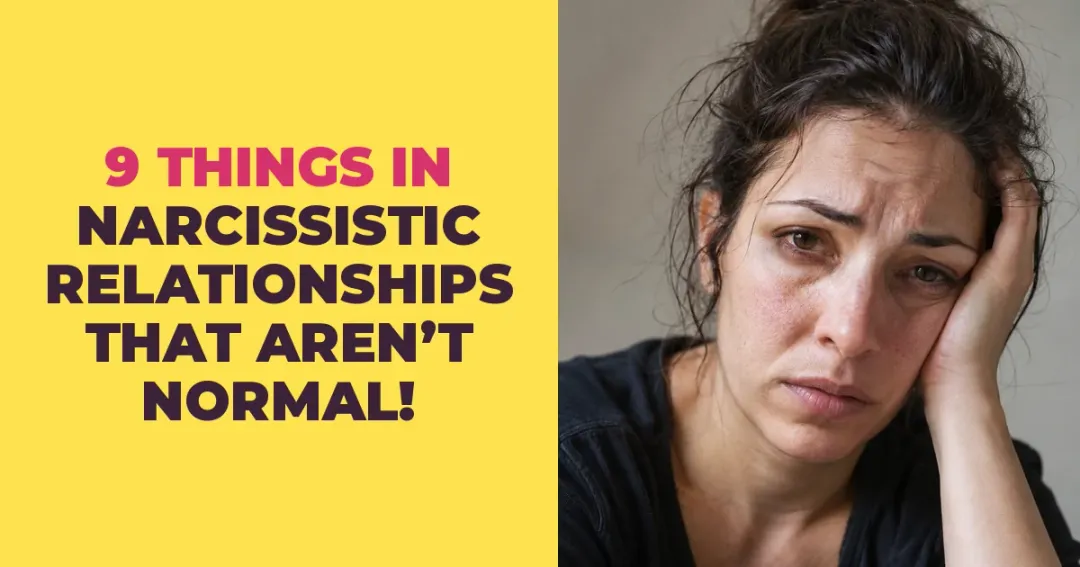
It isn’t. Here are 9 things in narcissistic relationships that aren’t normal at all, and why they happen.
#1 You know their mood before they speak
You learn their mood from the sound of the keys in the door.
A heavy step means trouble. A slammed cupboard means stay quiet. A cheerful whistle means you can breathe, for now. The ping of their text decides your whole evening.
Psychologists call it hypervigilance.
When anger can arrive at any moment, your nervous system learns to stand guard. It scans faces and messages for trouble, then tries to defuse it early by agreeing, soothing, giving in.
No wonder you’re exhausted by 9 a.m.
Next time your stomach drops at a sound, catch that jolt and let yourself move slower. That’s your body trying to keep you safe.
That isn’t nerves. It’s training.
#2 Their bad day comes first
When they’re hurting, the whole house stops. When you’re hurting, nobody notices.
Their rough meeting gets an hour of your attention, dinner made, phone on silent. Then you mention your own awful day and they reach for the remote.
Or worse: “You’re too sensitive.”
Research on empathy in narcissism points somewhere uncomfortable. Left to themselves, they tend to show less of it. Ask them to picture your side, and it goes up. So it looks less like can’t and more like won’t.
So you start keeping your feelings to yourself. You even doubt whether you’re allowed to have them.
Bring those feelings to the people who lean in when you talk. You’ve spent enough on someone who looks away.
See also Behind Closed Doors, Narcissists Love These 7 Hobbies That Would Unsettle You
#3 Saying no feels impossible
In a narcissistic relationship, yes stops being an answer and becomes a reflex.
They ask you to cancel your plans. You hesitate for one second, and here it comes: “After everything I’ve done for you?”
So you cancel.
Many people call this FOG: fear, obligation and guilt. It’s a popular term, not a diagnosis. A hint of consequences, a list of past sacrifices, a heavy sigh. Each one makes no feel more expensive than yes.
It works a lot like the small pressures researchers describe in coercive control.
Before you answer the next request, pause. Their feelings are real, but they aren’t your job to fix.
What would happen if you said “Let me think about it”?
#4 Speaking up ends with your apology
You raise one problem and somehow walk away apologising for it.
You mention the lie about Saturday. Ten minutes later you’re hearing every mistake you’ve made since the day you met, and they’re the one in tears.
“I can’t believe you’d accuse me of that.”
Psychologists have a clunky name for it: DARVO. Deny, attack, then flip who’s the victim and who did the harm. Studies found it leaves the person who spoke up blaming themselves more. No wonder it ends the talk so fast.
After enough rounds, you stop bringing anything up at all.
If you do speak, stick to the one thing you came to say and steer back to it. Skip defending every new charge they throw.
Saturday still happened.
#5 Ordinary things need their permission
You’re a grown woman asking permission to buy shampoo.
Maybe it was never said out loud. But you know the rules. Which top is “too much”. How long the grocery run may take. Who checks the bank app.
Researchers call this pattern coercive control.
There’s rarely one dramatic moment. Instead there’s a pile of little rules and little punishments, and each one takes a sliver of your freedom. That’s why it’s so hard to explain to anyone else.
See also 6 Harmless Hobbies Narcissists Take Up Just for Show
Your world gets smaller. Quietly.
If this feels close, hold on to a little money and a few phone numbers that are yours alone. A domestic abuse service can help you think through staying safe.
Shampoo shouldn’t need a meeting.
#6 Your friends slowly disappear
Losing your friends rarely feels like being cut off. It feels like drifting.
Nobody bans your best friend. They just sulk every time you see her. “She’s a bad influence.” “You always come home different.”
So you see her less. Then not at all.
Choosing who you get to spend time with is a hallmark of coercive control. Fewer friends means fewer people asking how you really are.
And fewer people to check the story against.
Getting back in touch is how the way back usually starts. You don’t need the whole crowd back. Start with one person and one honest message.
Who’s the first name that came to mind?
#7 Good news feels risky to share
In a healthy relationship, your win is good news. Here, it’s a threat.
You get the promotion. You tell them over dinner. They say “Huh, good for you,” then spend the evening picking at your cooking.
And your birthday? Somehow there’s always a fight.
Research links narcissism with envy, most of all in its quieter, more fragile form. Your success pokes at their need to be the one on top. So they make it smaller, take credit for it, or wreck the mood.
So you start keeping wins to yourself. Even happy days feel like walking on ice.
Watch whose face falls when things go well for you. Then celebrate with people who cheer louder than you do.
Hiding your wins was never your idea.
#8 You lose track of what you want
Somewhere along the way, their needs became your schedule and your own disappeared.
A friend asks what you want for dinner and you genuinely don’t know. You know what they like. You know which restaurant won’t start a fight.
See also 10 Everyday Struggles Narcissistic Abuse Survivors Feel Too Ashamed to Share With Anyone
Your own taste? Gone quiet.
There’s a popular word for this, codependency. It isn’t a diagnosis, but it ties into what researchers call fawning: keeping the peace by pleasing.
Looking after them can feel like the safest place to stand. And someone wrapped up in themselves is happy to let you.
The cost is burnout, and resentment you can’t say out loud. Feeling guilty for resting is a clue.
Each morning, start with one question: what would I like today? Even if the answer is just tea.
#9 The person hurting you is your comfort

The person who hurt you is often the one you run to for comfort.
They say something cruel in the car. By midnight you’re crying on their shoulder, and it feels like relief when they finally hold you.
Hurt, then comfort, from the same person.
Psychologists call this trauma bonding. When one person holds more power, and cruelty keeps getting followed by tenderness, the attachment can grow tighter than it would in a calm relationship. Your head and your heart pull in opposite directions.
So you stick up for them with your friends, ache for them hours after a fight, then feel ashamed of both.
Drop the shame. Your mind is doing something well documented, and it says nothing bad about you. People outside the relationship can help loosen the knot.
You needed comfort. That was never the problem.
Seeing yourself in more than one of these doesn’t mean you’re broken. You adapted to something that was never normal, and you did it to get through.
You don’t have to sort it all out today. Pick the one that hit hardest and start there.
Seeing it for what it is counts.