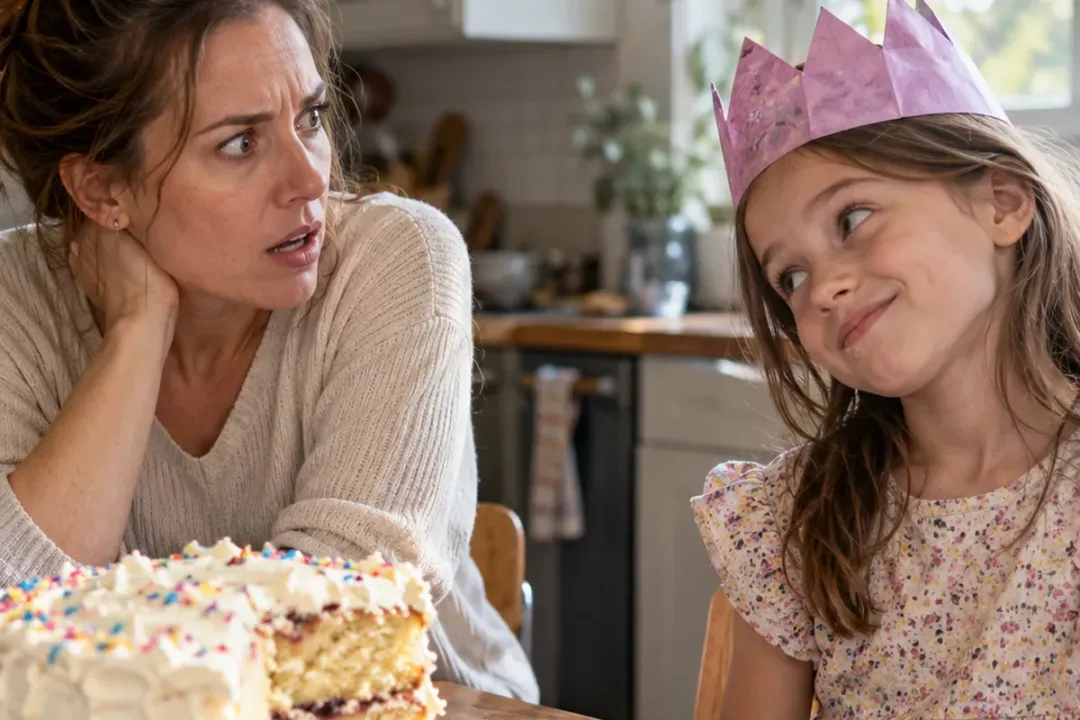
My daughter tilted her head to the left, the exact way her father does, and said it.
“There she goes. Too sensitive, as always.”
She was nine. She had a smear of frosting on her chin from her own birthday cake.
And she had just used my husband’s words. His pause. Even the little sigh at the end.
Grant laughed so hard he had to set his coffee down.
“That’s my girl,” he said, and held up his hand.
Lily slapped it. Then she looked at me, waiting to see what I would do.
I knew that look. I had worn it for eleven years.
What had I done to earn it?
I had asked her to thank her grandmother for the sweater she’d just tossed on the floor.
That was all. I had said, quietly, “Lily. Grandma drove an hour to bring that.”
Then the head tilt. Then the sigh. Then the line.
Joyce, my mother-in-law, smiled into her napkin.
My son Owen kept eating his cake. Grant’s brother checked his phone.
Nobody at that table seemed to notice anything at all.
Except me. And I was the one who was supposedly too sensitive.
The first time Grant said it, we had been married four months.
We were at his friend Marco’s house. Someone made a crack about my job at the library. Glorified shushing, he called it.
Everybody laughed. I didn’t.
In the car, I told Grant it had stung a little.
He patted my knee. “Dana. Come on. It was a joke. Too sensitive, as always.”
He said it softly. Almost sweetly. Like it was something he loved about me.
I believed him. I believed a lot of things back then.
Then he started saying it to other people.
At dinners, if I went quiet. At barbecues, if I didn’t laugh at something.
He would turn to the table, tilt his head, and sigh. “There she goes. Too sensitive, as always.”
See also My Mother-in-Law Smiled Through My Entire Wedding – Then I Read What She Wrote in the Guest Book
Everyone laughed. I laughed too.
Not laughing would only prove him right.
The year Joyce turned sixty, I planned her party.
Three months of work. The invitations. The slideshow of old photos I scanned one by one. The lemon cake from the bakery she loved.
Grant gave the toast.
“I just wanted Mom to see how loved she is,” he said, his voice catching. “So I put this together.”
Joyce cried and hugged him for a long time.
In the kitchen afterward, I said, “Grant. I did all of that.”
He looked at me the way people look at a stain on a good shirt.
“Seriously? Tonight? It was for Mom, Dana. Not a contest.”
Then his cousin walked in, and his smile came back on. Warm. Easy. Like nothing had happened.
That was the thing about Grant’s smile.
It went on and off like a porch light. And it was only ever off for me.
Over the years, he got better at it.
He would tell people I had agreed to things I never agreed to.
“We talked about this,” he’d say to his brother. “Dana said it was fine.”
I had no memory of saying it. None. But he sounded so sure.
So I started keeping notes on my phone. Dates. What he said. What I said.
I told myself it was a grocery list app. I almost believed that, too.
The worst one was the night of Owen’s fever.
He was two. His temperature hit 104, and I wanted to go to urgent care.
Grant said I was overreacting. He went to bed.
I drove Owen there myself at midnight. Ear infection, both sides.
A week later, at his brother’s house, Grant told the story.
“I knew something was off,” he said. “I told Dana, we’re not waiting. Get him in the car.”
His brother nodded. Joyce said, “Good instincts, honey.”
I opened my mouth. Grant looked at me across the table. Just looked.
See also 8 Bedroom Tactics Narcissists Use To Keep A Partner In Line
I closed it again.
Later, alone, I asked him why he’d told it that way.
“Because that’s what happened,” he said. “Are we really going to fight about who loves our son more?”
When I pushed back, he went quiet.
Two days. Three. Once, almost a week.
He would talk to the kids in a bright, happy voice. He would talk to the dog. He would walk past me like I was a chair.
The whole house felt like holding my breath underwater.
I always broke first. I always apologized.
For what, I could never have told anyone.
And through all of it, I told myself one thing.
The kids are too little to notice.
There were signs I didn’t want to see.
In January, Lily started rolling her eyes when I asked her to set the table.
In February, she called me dramatic when I cried at a movie. Grant grinned at her over the popcorn.
I told myself it was a phase. Nine going on fifteen.
After the cake, I cleaned up the kitchen alone.
Joyce came in to get a glass of water. She put a hand on my arm.
“Grant’s just teasing, sweetheart. Lily adores him.”
She squeezed. “Don’t make it a thing.”
That night, I tucked Lily into bed. Her party crown was still on her nightstand.
“Mom?” she said. “Mad at me?”
“No, baby.”
She picked at her blanket. “Dad says it all the time. He says it’s funny because it’s true.”
I didn’t say anything. I couldn’t.
Then she whispered something that made my whole body go cold.
“He gave me a dollar the first time I did it. He said I sounded just like him.”
I kept my face still. I had eleven years of practice.
“When was the first time?” I asked.
She shrugged. “Before Christmas. We practiced in the car.”
Practiced.
In the car. On the way to school. While I was home packing lunches for the next day.
See also 11 Unwritten Rules Narcissists Make You Live By
I kissed her forehead and turned out the light.
Then I sat down on the hallway floor outside her door and opened my phone.
I scrolled back through the notes. Years of them.
I searched for two words. Too sensitive.
I stopped counting at two hundred.
Then I scrolled to December.
There it was. A note I’d typed and forgotten. “G and L laughing in car when I came out. Stopped when I opened door. Said it was a private joke.”
A private joke. About me.
It hadn’t been a joke. It had never been a joke.
It was a lesson. And now he was teaching it to her.
The next morning, Grant was making eggs and humming.
I waited until the kids were in the other room.
“Grant. Did Lily get a dollar for saying that line to me?”
The humming stopped. The smile went off.
“Wow,” he said. “So now we’re interrogating a nine-year-old? Over a dollar?”
“Did she?”
He set down the spatula. His voice went low and wounded.
“I work all week. I come home, I play with my kids, I make them laugh. And my own wife thinks I’m some kind of monster.”
He shook his head slowly. Then he tilted it.
“There she goes,” he said. “Too sensitive, as—”
He stopped. Not because of me.
Because Owen was standing in the doorway in his dinosaur pajamas, watching us.
Six years old. Listening. Learning.
Something in me went very quiet. Not scared quiet. Clear quiet.
“Don’t say that again,” I said. “Not to me. Not about me. Not in front of them.”
Grant laughed, short and sharp. Then he picked up his plate and walked out of the room.
I knew what came next. The silence. Days of it.
I waited for the old panic to rise up in my chest.
It didn’t come.
Instead, I went upstairs and took the paper crown off Lily’s nightstand. I put it in my drawer.
Not to punish her. To make sure I never lost sight of the day she showed me the truth.
That afternoon, I called my sister Rae.
She listened to the whole thing without saying a word.
“How long has he been saying it?” she asked.
“Since the beginning.”
“I know,” she said. “I heard him at the wedding. I didn’t think it was my place.”
She was quiet for a second. “It’s my place now. The basement’s empty. Bring the kids.”
By Wednesday, Joyce was calling.
“Grant says Dana’s threatening to take the kids over a little joke,” she said. “What is going on with her?”
She was talking about me in the third person. To me.
I almost laughed. It was so familiar.
“I’m not going to talk about my marriage with anyone but Grant,” I said. “Take care, Joyce.”
Then I hung up. Politely.
She called three more times that week. I let every call go to voicemail. Each message was a little colder than the last.
Two weeks later, I packed while Grant was at work.
I didn’t sneak. I left a note on the counter that said where we were and that he could call the kids anytime.
He didn’t call me. He called Lily.
On speaker, I heard him say, “Mom’s having a hard time, bug. Be extra nice to her.”
Lily looked up at me with big, worried eyes.
I smiled at her. I wasn’t the one having a hard time. Not anymore.
Three months after that, we had a small apartment ten minutes from the library.
Grant told everyone I was going through something. Hormones, maybe. Stress.
His porch light was on full blast for all of them.
Some people believed him. Marco did. Joyce did.
I let them.
Explaining myself to people who had laughed along for eleven years felt like shouting into a pillow.
Grant sees the kids every other weekend now.
At the handoffs, he’s all sunshine. He hugs the kids, waves at Rae, tells me I look great.
Then the kids climb into his car, and his eyes go flat for one second before the door shuts.
I used to spend whole weekends replaying a second like that.
Now I go to work, shelve books, come home, and sleep.
The first time Lily came back from his place, she was different. Sharper. Rolling her eyes at everything I said.
I didn’t fight it. I didn’t lecture.
I just stayed the same. Every day. Calm and boring and there.
One night in late spring, she knocked a full glass of juice off the table.
It went everywhere. On her homework. On her new shoes.
Her chin started to shake. Her eyes filled up.
Then she sucked in a breath, wiped her face hard, and muttered, “Sorry. Too sensitive.”
I put down the dish towel. I knelt next to her chair.
“Lily. Nobody in this house gets called that. Not even by herself.”
She stared at me. “Then what do we say?”
I thought about it. I wanted to get it right.
“We say, ‘That hurt,'” I told her. “And then somebody listens.”
She looked at the juice dripping off the table. “That was annoying, not hurt.”
“Then we say ‘that was annoying,’ and we get paper towels.”
She laughed. A real laugh, not his.
A few weeks later, Owen lost a Lego piece under the couch and burst into tears.
I was at the sink. Before I could turn around, I heard Lily’s voice.
“That hurt, huh?”
Owen sniffled and nodded.
“Okay,” she said. “I’ll get the flashlight.”
She didn’t tilt her head. She didn’t sigh.
She just got down on the floor next to her brother and started looking.
I turned back to the dishes.
My hands weren’t shaking. They hadn’t been for a while.
This story is fiction, inspired by the kinds of experiences our readers share with us. Names, places and details are invented.