
Month: October 2026
6 Reasons Narcissists Are Nicer To Everyone Else Than To You

Narcissists save their best self for people who don’t live with them.
The neighbour gets a warm laugh. The waiter gets a joke and a big tip. Your sister thinks they’re an absolute delight.
Then the front door closes. You get the sigh, the eye-roll, the silence.
You’re not imagining the gap.
And you didn’t cause it.
Here are 6 reasons narcissists are nicer to everyone else than to you.
What’s going on underneath
Psychologists describe narcissism as a lasting pattern: a constant need for admiration, low empathy and a sense of being special.
For someone with this pattern, worth depends on outside confirmation. So the people around them tend to get sorted into sources of admiration, or threats to it.
New people are easy sources.
The ones who see them up close are harder to dazzle. And only a clinician can diagnose anyone, so look at the pattern over months, not one moment.
#1 New people still clap for them
A narcissist’s charm works best on people who haven’t seen behind it yet.
Watch them at a party. They know everyone’s name, ask about the new job and laugh in all the right places. People walk away glowing.
That was you once.
Research on narcissistic admiration and rivalry describes two sides. Early on, charm and self-promotion win people over. Later, the rivalry side takes over: cutting remarks, coldness, competing with you instead of backing you.
So the new people get the first chapter. You get the later ones, starting in the car on the way home: ‘Why did you tell that boring work story? Everyone was cringing.’
That’s why you keep chasing the person you met at the start, replaying old dates and wondering where they went.
One way to see it clearly: compare how they treat people they’ve just met with how they treat people who know them well. The gap tells you more than any single good day.
You didn’t lose them. You just stopped being new.
#2 Their public image is their lifeline
For a narcissist, a good reputation feeds something they can’t do without: admiration.
So the mask goes on easily in public.
They volunteer at the school fair. They praise your mother’s cooking. They’re first to offer a lift and first to send flowers when someone’s ill. Your friends sigh, ‘You’re so lucky.’
Research on impression management describes how people shape the picture they give others. Narcissists invest heavily in theirs, because admiration feeds their self-worth.
Everyone is a bit more polite in public. The gap here is between kind and cruel.
And the cruel part happens where nobody’s watching. The snapped ‘What now?’ when you walk in. The cold back in bed. So when you hint at it, you get blank looks, and you start to wonder if you made it up.
Trust what happens behind closed doors. It counts for more than anything they do for an audience.
The party version is the advert. You live with the product.
#3 Kindness is a tool they pick up
A narcissist can understand your feelings perfectly well and still choose not to act on them.
Think about it.
Studies found narcissists show less empathy by default, but more when they’re prompted to see the other person’s view. That suggests it’s more of a choice than an inability.
And with other people, there’s a payoff. The boss, the in-laws and the friend with the holiday cottage get warmth, eye contact and endless patience, because warmth gets them something.
You? You cry after a horrible day and they change the subject to theirs. Or they sigh, ‘You’re way too sensitive.’
Over time, you stop sharing feelings at all, even the good ones. Then you start doubting your own reactions.
Here’s one way to tell the difference. Someone awkward with emotions still fumbles towards helping. A narcissist sees the pain clearly and steps around it.
Take your feelings to people who actually respond to them. Your tears were never too much.
#4 Everyone else becomes their witness
Being lovely to everyone else quietly builds a wall of people who won’t believe you.
Some manipulators play the long game. Research on Machiavellianism describes a cynical, strategic style: saying what each person wants to hear, rarely losing their temper in public and keeping a clean reputation while working against someone.
So they’re endlessly patient with your dad. They help your best friend move house. They tell the group chat, gently, how worried they are about you lately. Nobody hears an attack. That’s the point.
By the time you say something is wrong, everyone has already seen someone calm, reasonable and helpful.
‘But they’re so nice,’ your friend says. Your stomach drops.
You only see the plan once it’s finished.
What helps is boring but useful: share less personal detail with them, and put anything you agree on in writing. Fewer details means fewer tools for them.
They have the charm. You have the facts.
#5 Rationed warmth keeps you hooked
When warmth is rare and unpredictable, it hooks you harder than steady kindness ever could.
The neighbours get the sunny version every time they wave over the fence. You never know which version is coming home.
Tuesday, a hug and your favourite takeaway. Wednesday, one-word answers. Thursday, a sweet text an hour after a cruel comment, as if nothing happened.
Why does that keep you holding on?
Behaviour rewarded on an unpredictable schedule is the hardest to stop. It’s the same principle that keeps people feeding slot machines. A rare apology starts to feel like a jackpot!
So you work harder for less, reading their mood like a weather forecast. And the good days make the bad ones feel bearable.
Try this for a month: jot down which days were good and which were bad. Then judge the relationship by the average, not by its best day.
What does your average look like?
#6 Your hurt tells them it’s landing

Some difficult people actually enjoy your discomfort, and you’re the one close enough to hurt.
Researchers call this everyday sadism. They added it to the Dark Triad to make a ‘Dark Tetrad’, and for people high in this trait, cruelty is rewarding in itself.
It looks like teasing that lands exactly where it hurts. At dinner with friends, or in front of your family, they bring up the thing you’re most insecure about, then laugh when you flinch.
‘Relax, it was a joke.’
Everyone else at the table gets the charming version. The sting is kept for you, because your reaction is the prize.
Your hurt isn’t a side effect. It’s the reward.
No wonder you’ve learned to hide your face. One way to tell: playful teasing stops when you ask. This doesn’t. Notice whether your distress seems to please them.
If it does, believe what you see.
Their niceness to everyone else was never proof that you’re the problem.
It shows what they can do when they want to, and who they choose to do it for. Trust what you live with over what they perform.
Your memory is allowed to be right.
Sources
- Goffman, E. (1959). The Presentation of Self in Everyday Life. Doubleday.
- American Psychiatric Association. (2022). Diagnostic and Statistical Manual of Mental Disorders (5th ed., text rev.).
- Pincus, A. L., & Lukowitsky, M. R. (2010). Pathological narcissism and narcissistic personality disorder. Annual Review of Clinical Psychology, 6, 421-446.
- Back, M. D., Kufner, A. C. P., Dufner, M., Gerlach, T. M., Rauthmann, J. F., & Denissen, J. J. A. (2013). Narcissistic admiration and rivalry. Journal of Personality and Social Psychology, 105(6), 1013-1037.
- Hepper, E. G., Hart, C. M., & Sedikides, C. (2014). Moving Narcissus: Can narcissists be empathic? Personality and Social Psychology Bulletin, 40(9), 1079-1091.
- Christie, R., & Geis, F. L. (1970). Studies in Machiavellianism. Academic Press.
- Jones, D. N., & Paulhus, D. L. (2014). Introducing the Short Dark Triad (SD3). Assessment, 21(1), 28-41.
- Ferster, C. B., & Skinner, B. F. (1957). Schedules of Reinforcement. Appleton-Century-Crofts.
- Dutton, D. G., & Painter, S. (1993). Emotional attachments in abusive relationships: A test of traumatic bonding theory. Violence and Victims, 8(2), 105-120.
- Buckels, E. E., Jones, D. N., & Paulhus, D. L. (2013). Behavioral confirmation of everyday sadism. Psychological Science, 24(11), 2201-2209.
Belle Souls articles explain patterns described in psychology research and recovery writing. They are not a diagnosis and not a substitute for help from a qualified professional.
A Narcissist Loses Their Grip On You Once You Learn This One Skill

You tiptoe. You explain. You apologise for things you can’t even name anymore.
And still, the narcissist in your life gets to decide how your whole day goes.
Their grip runs on your reactions.
Every flinch, every long explanation, every rushed sorry gives them something to work with. Fewer reactions leave them less to hold on to.
There’s one skill that changes this, and it doesn’t need their permission. Here’s what it is, why it works, and how to start using it.
#1 You’ve learned to read their every mood
You can tell what kind of evening it’ll be from the sound of their keys.
The door shuts a little too hard. They haven’t said a word yet, and you’re already softening your voice, scanning the kitchen, planning your lines.
You’re on duty before your coat is off.
When anger shows up without warning, your body learns to stay switched on. It finds the fastest way to calm things down: agree, smooth it over, say yes before you’ve thought.
Psychologists call this fawning and hypervigilance. It’s how you kept the peace. It’s how you kept yourself safe.
But the cost is real. Exhaustion. And slowly losing track of what you actually want.
Next time your stomach drops at the sound of the door, notice it and slow down. When did you last make a choice without checking their face first?
#2 You end up apologising for their mess
You raised one fair point and somehow ended the night saying sorry.
Maybe it was the birthday dinner they skipped. You mention it softly. Seconds later you hear, “Wow. So I’m the bad guy now? After the week I’ve had?” Then comes a long list of your mistakes.
Then comes the sulk.
There’s a research term for this pattern: DARVO. First they deny it. Then they go after you. Then they swap places, and suddenly they’re the injured one.
Studies on DARVO show it leaves the person who spoke up feeling more at fault. So the talk ends fast, and your point vanishes.
No wonder you’ve stopped bringing things up.
That guilt says nothing about you.
#3 They count on your automatic yes

The version of you they like best is the one who never says no.
She drops her plans when they call. She covers the bill again. She folds the second she hears, “After everything I’ve done for you?”
It’s a guilt lever, and it makes saying no feel costlier than giving in.
FOG is a popular name, with no formal definition, for fear, obligation and guilt. It describes emotional blackmail: guilt trips, reminders of old favours and silent disappointment that wears you down.
It sits close to what researchers call coercive control, where lots of small pressures add up until your world gets smaller.
Over time, yes becomes automatic. You start to feel responsible for their moods, like keeping them happy is your job.
Next time, pause. Is that yes real, or scared?
#4 The skill is deciding how you respond
A boundary is what you’ll do, not a rule you hand to them.
The skill is choosing your own action instead of trying to control theirs.
You can’t make a narcissist stop shouting. But you can decide, “If you shout, I’ll leave the room.” And then you leave the room. Every single time.
Boundaries work through your own actions, so they don’t need anyone else to agree. That’s what makes them so hard to argue with.
Boundary is a popular word with no formal definition. It covers only your own actions. Compare that with coercive control, where one person imposes rules on another.
Expect pushback at first. Expect guilt too. Self-respect tends to grow each time you follow through.
Say it once. Act on it every time. Who’s deciding how your evening goes now?
#5 Your calm leaves them nothing to grab
Fewer reactions from you mean less for a manipulator to work with.
They poke the sore spot at dinner, right in front of your sister. “Relax, it was a joke.” Then they watch your face.
Why?
Research on everyday sadism describes some people who find small cruelties rewarding in themselves. For them, your flinch is the prize.
Grey rock is the popular name for staying dull when contact can’t be avoided. Short, flat, factual. “Okay.” “Noted.” “I’ll be there at five.” It can also help the emotional bond fade over time.
Grey rock won’t win you anything. It just stops feeding the fight. If they might escalate, it may not be safe, and a domestic violence service can help you plan.
Staying flat doesn’t mean you feel nothing.
#6 Your memory deserves the final word
Write down what actually happened, and their version stops being the only one.
“You’re making things up.” “You overreact to everything.” “Why are you always so angry?” That last one comes while they’re the one yelling.
Notice who’s actually raising their voice.
Gaslighting is getting you to distrust what you saw and heard, so their account wins. It thrives when the power is lopsided and they hold the story.
Projection often comes along too. Pinning their own behaviour on you means they never have to face it. So you defend yourself against things you didn’t do, and the real problem slips away.
Jot it down the same day: what was said, and when. Keep it somewhere they can’t get to. Check it with one person outside the relationship, state the facts once, then stop defending.
Your notes don’t argue back.
#7 Their silence stops running your day
You don’t have to chase their silence to survive it.
Two days now. They answer your mum’s text, laugh with the neighbour, and walk past you in the hallway like you’re furniture.
Being ignored can hurt like physical pain.
Being shut out hits something deep: the need to feel you belong and that you count. No wonder so many give in.
So you say sorry just to make the quiet stop. You steer clear of anything that might bring it back.
Here’s the skill again. Tell them once, calmly, “I’m here when you want to talk.” Then carry on. Don’t chase. Don’t plead.
Make the coffee. Call your friend. Go for the walk. What happens to their silence when it stops being your whole world?
This skill takes practice, and some days you’ll slip right back into old habits. When that happens, talk to yourself the way you’d talk to a friend. Kindness toward yourself eases the shame and self-blame manipulation leaves behind.
You don’t have to practise alone, either. Telling one trusted person the full story is a strong first step.
Say it once, act on it, and let your response be yours.
If you feel unsafe: in the US, call the National Domestic Violence Hotline at 1-800-799-7233 (thehotline.org). In the UK, call the National Domestic Abuse Helpline on 0808 2000 247. If you are in immediate danger, call your local emergency number.
Sources
- Durvasula, R. (2024). It's Not You: Identifying and Healing from Narcissistic People. The Open Field.
- Herman, J. L. (1992). Trauma and Recovery. Basic Books.
- Cloud, H., & Townsend, J. (1992). Boundaries. Zondervan.
- Neff, K. D. (2003). Self-compassion: An alternative conceptualization of a healthy attitude toward oneself. Self and Identity, 2(2), 85-101.
- Bancroft, L. (2002). Why Does He Do That? Inside the Minds of Angry and Controlling Men. Berkley.
- Walker, P. (2013). Complex PTSD: From Surviving to Thriving. Azure Coyote.
- Freyd, J. J. (1997). Violations of power, adaptive blindness, and betrayal trauma theory. Feminism & Psychology, 7(1), 22-32.
- Harsey, S. J., Zurbriggen, E. L., & Freyd, J. J. (2017). Perpetrator responses to victim confrontation: DARVO and victim self-blame. Journal of Aggression, Maltreatment & Trauma, 26(6), 644-663.
- Forward, S., & Frazier, D. (1997). Emotional Blackmail. HarperCollins.
- Stark, E. (2007). Coercive Control: How Men Entrap Women in Personal Life. Oxford University Press.
- Buckels, E. E., Jones, D. N., & Paulhus, D. L. (2013). Behavioral confirmation of everyday sadism. Psychological Science, 24(11), 2201-2209.
- Sweet, P. L. (2019). The sociology of gaslighting. American Sociological Review, 84(5), 851-875.
- Stern, R. (2007). The Gaslight Effect. Morgan Road Books.
- Baumeister, R. F., Dale, K., & Sommer, K. L. (1998). Freudian defense mechanisms and empirical findings in modern social psychology. Journal of Personality, 66(6), 1081-1124.
- Williams, K. D. (2009). Ostracism: A temporal need-threat model. Advances in Experimental Social Psychology, 41, 275-314.
Belle Souls articles explain patterns described in psychology research and recovery writing. They are not a diagnosis and not a substitute for help from a qualified professional.
Hand A Narcissist Any Of These 11 Things And You Will Regret It

A narcissist rarely gives back what you hand them.
You lent the card. You told the secret. You gave up the weekend, then the year. And now it all seems to be coming back at you, sharpened.
Ask for any of it back? Suddenly you’re the selfish one.
You’re not imagining the pattern. And you’re not too sensitive.
Here are 11 things you should never hand a narcissist, what they tend to do with each one, and what helps.
#1 Your secrets become their ammunition
The secrets you share late at night often get filed away for later.
That story about your dad. The panic attack before your sister’s wedding. The thing you did at uni. They listened so closely.
Months later it comes out at dinner with friends. Or mid-fight, in a calm voice: “Well, given your history…”
Psychologists have a name for this cool, calculated style: Machiavellianism. It plays the long game. Details get stored, and the person storing them still looks perfectly reasonable to everyone else.
Guard the details. Someone’s keeping a file.
#2 That bank card won’t come back
Give a narcissist your bank card and it rarely comes back the same.
They “just need it for the weekend.” Then it lives in their wallet, and you’re asking permission to buy shampoo. Some even run up debt in your name.
Why? Studies of economic abuse point to a simple logic. If every penny runs through them, walking away costs more than you have. Keeping you dependent is the whole idea.
A separate account, copies of your statements, a quiet look at your credit report. A domestic abuse service can help you plan around money safely.
Hiding a coffee receipt? That’s a sign money has become a trap.
#3 Lend them money and kiss it goodbye
Money you lend a narcissist often turns into money they feel they earned.
“I’ll sort you out Friday.” Friday comes. So does the next one. Mention it and they look at you like you asked for a kidney.
Psychologists call it entitlement. Deep down, they believe they’re owed more than everyone else, and that ordinary rules bend for them. So a fair request feels like an attack.
No wonder a simple “Can I have my fifty back?” turns into a war.
Keep a tally. Numbers don’t gaslight.
#4 Cry and they change the subject
A narcissist often understands your pain perfectly well and simply chooses not to act on it.
You finally admit work has you in tears every night. They glance at the TV. “Did you see the score?”
Push a little and you get the sigh. “You’re so sensitive.”
Studies on narcissism and empathy found something telling. When nudged to imagine your side, they managed more empathy. So the coldness looks less like a blind spot and more like a decision.
In front of friends, they’d hand you a tissue. At home, a shrug. Slowly you stop sharing, and start doubting your own reactions.
Take your tears where someone actually reaches for you.
#5 Good news gets spoiled fast
Your happiest moments can feel like a threat to a narcissist’s need to be on top.
You got the promotion! They say “Oh. Good for you,” and go back to their phone.
Your birthday? Somehow there’s a fight.
Envy shows up a lot in narcissism, research suggests, and most of all in the quieter, touchier version. Your win makes them feel smaller, so they shrink it, sour it or steal the moment.
Notice whose face falls when life goes well for you. Your next big news belongs with the people who’d throw confetti.
#6 Promises can eat up years
Big promises about the future can quietly swallow years of your life.
The cottage with the garden. The honeymoon in Greece. Baby names picked in week three. All of it “once things settle.” Things never settle.
Online, people call this future faking. It’s a popular label, not a diagnosis. It lines up with studies tying narcissism to treating love as a game, with commitment kept low.
Every plan you build together becomes a reason to stay. The more you’ve put in, the harder it is to walk away from the dream. Look at what’s actually been done, not what’s been described.
How long have you been packed for a trip that never leaves?
#7 Fear is their favourite lever
Your fears can become the lever a narcissist pulls to get a yes.
You admit you’re scared of ending up alone. Next argument: “Fine. Go. See who else would put up with you.”
Or the guilt trip: “After everything I’ve done?”
Some call this FOG, short for fear, obligation and guilt. It’s a nickname, not a clinical term, though it sits close to what researchers call coercive control.
It works by making no feel more expensive than yes. Give yourself a beat before you reply.
How they feel is theirs to carry.
#8 Praise only makes them hungrier
Admiration is the fuel a narcissist chases, and the tank empties fast.
At the start, you looked at them like they hung the moon. They lapped it up.
Now every story needs applause. “Honestly, I basically ran that whole meeting.” Forget to clap and the mood turns.
Underneath, the pattern is a self-worth propped up by other people’s approval. Studies on admiration and rivalry explain the shift: the charm comes first, and the put-downs creep in once you’re close.
See how lovely they are to the waiter?
Now compare that with the car ride home.
#9 Trust lets them rewrite what happened
The more you trust a narcissist, the easier it is for them to rewrite the past.
You’re sure they said they’d pick up your mum at six. Now it’s “That never happened. You’ve got it mixed up again.”
And because you trust them, you wonder.
Researchers describe gaslighting as thriving where one person holds more power. Your faith in them, plus their control of the story, gives them room to rewrite events.
Jot down what happened the same day, with times. Run it past a friend who isn’t involved.
Doubting yourself is what this is built to cause.
#10 Raise a problem and you’ll end up sorry
Bring one problem to a narcissist and you may walk away apologising for it.
You mention they left you alone at the party without a word. Ten minutes later you’re hearing about every mistake you’ve made since your first date.
Then the tears. “I can’t believe you’d attack me like this.” Now you’re comforting them.
There’s a research name for this: DARVO. They deny, go on the attack, then swap places so they look like the one wronged. Studies show it leaves the one who spoke up blaming herself, which shuts the talk down fast.
Bring it back to the one thing you raised. The party still happened.
#11 Your heart gets hooked on the good days
Hand a narcissist your heart and the good days become the hook. Monday they’re cold. Tuesday they bring your favourite takeaway and whisper, “I don’t deserve you.”
Suddenly Monday doesn’t seem so bad.
Affection you can’t predict grips tighter than affection you can count on. Think of a slot machine. It’s the rare win that keeps you pulling.
Studies on trauma bonding go further. When one person holds more power and hurt keeps alternating with tenderness, the attachment can grow stronger than in a peaceful relationship. No wonder walking away hurts in your body.
Tally the good days and the hard ones for a month. Which pile is taller?
None of this happened because you were foolish. You handed these things over because you loved, trusted and hoped, which is exactly what a good partner does.
You can start taking a few back quietly. A secret kept. A receipt saved. A “not yet” you actually mean.
Save that receipt. Say that “not yet” once, and stick to it.
If you feel unsafe: in the US, call the National Domestic Violence Hotline at 1-800-799-7233 (thehotline.org). In the UK, call the National Domestic Abuse Helpline on 0808 2000 247. If you are in immediate danger, call your local emergency number.
Sources
- Campbell, W. K., Bonacci, A. M., Shelton, J., Exline, J. J., & Bushman, B. J. (2004). Psychological entitlement: Interpersonal consequences and validation of a self-report measure. Journal of Personality Assessment, 83(1), 29-45.
- Christie, R., & Geis, F. L. (1970). Studies in Machiavellianism. Academic Press.
- Jones, D. N., & Paulhus, D. L. (2014). Introducing the Short Dark Triad (SD3). Assessment, 21(1), 28-41.
- Postmus, J. L., Plummer, S.-B., McMahon, S., Murshid, N. S., & Kim, M. S. (2012). Understanding economic abuse in the lives of survivors. Journal of Interpersonal Violence, 27(3), 411-430.
- Hepper, E. G., Hart, C. M., & Sedikides, C. (2014). Moving Narcissus: Can narcissists be empathic? Personality and Social Psychology Bulletin, 40(9), 1079-1091.
- Krizan, Z., & Johar, O. (2012). Envy divides the two faces of narcissism. Journal of Personality, 80(5), 1415-1451.
- Arkes, H. R., & Blumer, C. (1985). The psychology of sunk cost. Organizational Behavior and Human Decision Processes, 35(1), 124-140.
- Campbell, W. K., Foster, C. A., & Finkel, E. J. (2002). Does self-love lead to love for others? A story of narcissistic game playing. Journal of Personality and Social Psychology, 83(2), 340-354.
- Forward, S., & Frazier, D. (1997). Emotional Blackmail. HarperCollins.
- Stark, E. (2007). Coercive Control: How Men Entrap Women in Personal Life. Oxford University Press.
- American Psychiatric Association. (2022). Diagnostic and Statistical Manual of Mental Disorders (5th ed., text rev.).
- Pincus, A. L., & Lukowitsky, M. R. (2010). Pathological narcissism and narcissistic personality disorder. Annual Review of Clinical Psychology, 6, 421-446.
- Back, M. D., Kufner, A. C. P., Dufner, M., Gerlach, T. M., Rauthmann, J. F., & Denissen, J. J. A. (2013). Narcissistic admiration and rivalry. Journal of Personality and Social Psychology, 105(6), 1013-1037.
- Sweet, P. L. (2019). The sociology of gaslighting. American Sociological Review, 84(5), 851-875.
- Stern, R. (2007). The Gaslight Effect. Morgan Road Books.
- Freyd, J. J. (1997). Violations of power, adaptive blindness, and betrayal trauma theory. Feminism & Psychology, 7(1), 22-32.
- Harsey, S. J., Zurbriggen, E. L., & Freyd, J. J. (2017). Perpetrator responses to victim confrontation: DARVO and victim self-blame. Journal of Aggression, Maltreatment & Trauma, 26(6), 644-663.
- Ferster, C. B., & Skinner, B. F. (1957). Schedules of Reinforcement. Appleton-Century-Crofts.
- Dutton, D. G., & Painter, S. (1993). Emotional attachments in abusive relationships: A test of traumatic bonding theory. Violence and Victims, 8(2), 105-120.
Belle Souls articles explain patterns described in psychology research and recovery writing. They are not a diagnosis and not a substitute for help from a qualified professional.
When a Narcissist Knows You Know

Few things threaten a narcissist like being seen clearly.
And lately, something has shifted. You caught the lie. You noticed the pattern. Maybe you said it out loud, or maybe you just stopped laughing at the jokes.
They noticed too.
Now the ground keeps moving under your feet, and you’ve begun to question whether any of it was real.
It was. Here are 8 things a narcissist does when they know you know.
Why being seen scares them
Under all the show, a narcissist’s self-worth tends to be on loan. It leans on other people handing back a polished image.
Think about it. You were the mirror. The moment you see through them, the mirror turns into a threat.
Psychologists describe two faces of narcissism, one loud and one quiet, and plenty of narcissists flip between them. Each guards the same brittle self-image. The loud face shows off. The quiet one sulks and nurses its grievances.
Expect to meet both.
#1 They deny it ever happened

Flat denial tends to come first, usually without a flicker.
You mention the message you saw, the dig at dinner, the missing cash. They meet your eyes, totally calm. “That never happened. You’re too sensitive.”
Psychologists call this gaslighting. It lands because you trust them, and because the story of your shared life has been theirs to tell for years.
So your own eyes start to feel unreliable.
Soon your phone fills with screenshots and notes, saved just to prove you’re not losing it. You find yourself saying sorry after being the one who got hurt.
Couples recall the same evening in different ways all the time. Gaslighting is something else: insisting you didn’t see what you saw, until you stop trusting yourself.
Jot it down the same day. A notebook can’t be talked out of anything.
#2 Suddenly you’re the one with the problem

Catch them lying, and the word “liar” often lands on you instead.
You ask about the woman in the group chat. Within ten minutes it’s “What about your ex? You’re the one hiding things.”
Psychologists call this projection. Pinning the ugly trait on you means they never have to look at it in themselves.
The one who takes everything calls you selfish. The one yelling tells you to calm down.
It’s exhausting. You spend all evening answering charges you never earned, and by bedtime the original question is gone.
Not every jab is projection. Honest criticism hurts sometimes too. But an accusation that keeps circling back says more about them than about you.
Say what’s true once. Then stop explaining.
#3 Now they’re the wounded one

When the facts stop working, a narcissist may flip the script and play the victim.
You finally bring up what hurt you. First it didn’t happen, then you’re cruel for asking, then come the tears. “I can’t believe you’d think that of me. After the week I’ve had?”
Psychologists have a name for this: DARVO. Deny, attack, then reverse who’s the victim and who’s the offender.
Studies show it leaves the person who raised the issue feeling more to blame. No wonder the talk ends so quickly.
Before long you’re the one doing the comforting. You say sorry for speaking up. Next time, you keep quiet.
If you can, steer back to the first issue and let the counter-attack go.
And notice this: do their apologies ever come without a “but”?
#4 The anger comes out of nowhere
A narcissist whose ego gets bruised by being seen often answers with rage.
In the car you ask something simple. “Why did you tell your mum we cancelled?” Now they’re yelling, knuckles white on the wheel, and you’re watching the road go by.
Psychologists studying threatened egotism saw narcissists turn more aggressive after an insult, and they aimed it at the person they held responsible.
Right now, that’s you.
Other times it’s icy silence, or payback days later for a comment you’d long forgotten. So every sentence gets edited before you say it, and you apologise for things you never did.
Anger is human. This kind is far bigger than the moment, pointed at whoever dented the image.
If it ever tips into threats, get out of the room. Being safe matters more than finishing any talk.
#5 Your name gets dragged behind your back
Once you know, a narcissist often hurries to get their story out first.
A mutual friend stops replying. Your sister-in-law asks, softly, if you’re “doing okay.” Somebody mentions you’ve seemed “really unstable lately.”
Psychologists call this relational aggression, and a smear campaign is one form of it. It goes after your standing with people, not your body, so there’s nothing anyone can see.
And people buy it. All they’ve met is the charmer. Life of the party, then stone silent on the drive home.
You feel on trial everywhere. And you lose support at the exact moment you need it most.
Believe what goes on at home. Stay the same steady person, and give time a chance to show who’s consistent.
You’ve seen the private version. That counts.
#6 The future gets painted bright again
Shiny promises about later can keep you hooked in the now.
The moment you start drifting, plans appear. Italy. A house with a garden. “Once this busy stretch at work is over, I promise.”
Many call this future faking. It’s a popular label, not a formal term, for detailed plans offered with no intention of keeping them. It links to research showing that hope rewarded at random is harder to walk away from.
Why does it work? A future you’ve already put yourself into feels too costly to lose.
So you wait.
The date slides and nothing gets rebooked. Bring it up later and it’s “I never said that.” Genuine plans fall through too, but those get a new date.
Look at what’s really happened. How many of those trips have you taken?
#7 They drop you like you never mattered
Stop playing the adoring audience, and a narcissist may just walk away.
No big talk. No closure. Only a flat “I think we want different things,” and within a week a new face shows up in their photos.
Many call this the discard. It’s a popular name for a familiar arc: pedestal, criticism, exit.
Research offers a reason. Narcissism goes along with a game-playing approach to love. The charming side reels you in, and later competition and boredom win out. After they feel they’ve won, the interest drains away.
You feel replaceable.
Somehow the ending feels like your fault, too. Every couple cools down after the early rush. This is different: contempt, then a replacement.
How fast they dropped you says something about them. Not about your worth.
#8 Then the door swings back open
Just as life gets quieter, a narcissist will often reappear.
Maybe it’s your birthday, or three silent months have passed. Your phone lights up. “I miss you. I’ve been doing a lot of thinking.”
Many call this hoovering, a popular word for trying to reel you back in. It tends to turn up when they need something or feel replaced.
The bond is what makes it work. Psychologists call it trauma bonding: when hurt and tenderness keep taking turns, the attachment can grow stronger than in a calm relationship.
So hope floods back. One message, and weeks of progress seem to vanish.
Feeling that pull isn’t weakness. It’s a recognised reaction.
Pick your response ahead of time. Then weigh the history, not the new promise.
Seeing yourself in these pages doesn’t mean you’re imagining things. It means you’re spotting a pattern.
Denial, blame, tears, rage, smears, the vanishing act, the comeback. Once you can name each move, you’ll spot it sooner the next time it starts.
If any of it frightens you, start with one trusted person and tell them everything. Isolation is how manipulation gets its grip, so letting people back in helps you find your footing again.
If you feel unsafe: in the US, call the National Domestic Violence Hotline at 1-800-799-7233 (thehotline.org). In the UK, call the National Domestic Abuse Helpline on 0808 2000 247. If you are in immediate danger, call your local emergency number.
Sources
- American Psychiatric Association. (2022). Diagnostic and Statistical Manual of Mental Disorders (5th ed., text rev.).
- Pincus, A. L., & Lukowitsky, M. R. (2010). Pathological narcissism and narcissistic personality disorder. Annual Review of Clinical Psychology, 6, 421-446.
- Wink, P. (1991). Two faces of narcissism. Journal of Personality and Social Psychology, 61(4), 590-597.
- Miller, J. D., Lynam, D. R., Hyatt, C. S., & Campbell, W. K. (2017). Controversies in narcissism. Annual Review of Clinical Psychology, 13, 291-315.
- Herman, J. L. (1992). Trauma and Recovery. Basic Books.
- Bancroft, L. (2002). Why Does He Do That? Inside the Minds of Angry and Controlling Men. Berkley.
- Sweet, P. L. (2019). The sociology of gaslighting. American Sociological Review, 84(5), 851-875.
- Stern, R. (2007). The Gaslight Effect. Morgan Road Books.
- Baumeister, R. F., Dale, K., & Sommer, K. L. (1998). Freudian defense mechanisms and empirical findings in modern social psychology. Journal of Personality, 66(6), 1081-1124.
- Freyd, J. J. (1997). Violations of power, adaptive blindness, and betrayal trauma theory. Feminism & Psychology, 7(1), 22-32.
- Harsey, S. J., Zurbriggen, E. L., & Freyd, J. J. (2017). Perpetrator responses to victim confrontation: DARVO and victim self-blame. Journal of Aggression, Maltreatment & Trauma, 26(6), 644-663.
- Bushman, B. J., & Baumeister, R. F. (1998). Threatened egotism, narcissism, self-esteem, and direct and displaced aggression. Journal of Personality and Social Psychology, 75(1), 219-229.
- Crick, N. R., & Grotpeter, J. K. (1995). Relational aggression, gender, and social-psychological adjustment. Child Development, 66(3), 710-722.
- Goffman, E. (1959). The Presentation of Self in Everyday Life. Doubleday.
- Arkes, H. R., & Blumer, C. (1985). The psychology of sunk cost. Organizational Behavior and Human Decision Processes, 35(1), 124-140.
- Ferster, C. B., & Skinner, B. F. (1957). Schedules of Reinforcement. Appleton-Century-Crofts.
- Dutton, D. G., & Painter, S. (1993). Emotional attachments in abusive relationships: A test of traumatic bonding theory. Violence and Victims, 8(2), 105-120.
- Back, M. D., et al. (2013). Narcissistic admiration and rivalry. Journal of Personality and Social Psychology, 105(6), 1013-1037.
- Campbell, W. K., Foster, C. A., & Finkel, E. J. (2002). Journal of Personality and Social Psychology, 83(2), 340-354.
- Campbell, W. K., Foster, C. A., & Finkel, E. J. (2002). Does self-love lead to love for others? A story of narcissistic game playing. Journal of Personality and Social Psychology, 83(2), 340-354.
Belle Souls articles explain patterns described in psychology research and recovery writing. They are not a diagnosis and not a substitute for help from a qualified professional.
What Is the Real Root of Narcissism?

The narcissist in your life can look like the most confident person you’ve ever met.
Then a tiny comment, a friend’s promotion or a slow reply sends them into a sulk or a rage.
The door slams. The phone goes quiet for days.
You’ve probably lain awake trying to work out what’s underneath. Was it you? Was it something you said?
It wasn’t. Their self-worth isn’t stored inside them. It has to be topped up by other people.
Here’s how that one fragile root shows up in 10 ways, from your kitchen to the group chat, and what each one means for you.
Loud or quiet, same root
Researchers see two faces of narcissism. One is loud: big, charming, in charge. The other is quiet: prickly, bitter, full of self-pity.
Plenty of them flip between the two.
Both guard the same thin shell. The loud face shows off to keep it safe. The quiet face pulls back and nurses the hurt.
Every point below grows from that root.
#1 They need you to reflect them back
A narcissist can’t feel worth much unless someone else keeps saying so.
You see it at dinner. They tell the promotion story for the third time, then wait. If you don’t gush, the evening goes cold.
Everyone around them ends up in one of two roles. Fan, or danger.
And you? A mirror with a pulse.
What you need lands like a nuisance. “Can we talk about your day later? I’ve had a rough one.”
Watch what keeps happening across months, not one bad night. Does the mirror job ever end?
#2 The quiet ones are just as hungry
Not every narcissist is loud, and the quiet ones guard the same fragile image.
This one doesn’t brag at parties. They sulk in the corner when nobody asks about their week, then go silent on the drive home.
Later: “You didn’t even notice me tonight.”
They tally every slight, and one small comment can sink a whole weekend.
Shyness isn’t this. The giveaway is the sense of being owed.
So you tiptoe through their moods, and their letdowns somehow land on you.
One way to tell? Watch whether an apology ever comes without a “but”.
#3 A small comment feels like an attack
When their image gets bruised, the narcissist often hits back at whoever did the bruising.
You mention, lightly, that the restaurant they booked is shut on Mondays. Suddenly it’s “You always have to make me look stupid.”
Or nothing happens. For three days.
Then you pay for a remark you’d long since forgotten.
Psychologists call this threatened egotism. In that research, an insult made narcissists more aggressive, and they aimed it straight at the person who’d delivered it.
So you rehearse each sentence before it leaves your mouth. You say sorry for stuff that was never yours.
If the shouting ever tips into threats, get yourself out of the room. Your safety outranks any argument.
#4 Your normal requests feel like insults

To an entitled narcissist, a plain request from you can land like a slap.
You ask for the money back from March. They act like you’ve hit them.
“Seriously? After all I do around here?”
Deep down, they feel owed. More than everyone else, and above the rules the rest of us follow. Even waiting in a queue becomes an outrage.
So the scales tip further their way, and asking for an even split feels like declaring war.
Try jotting down, privately, what goes out from your side. Just so you can see it.
The March loan. The cancelled weekend. The airport runs. In ink, it’s hard to argue with.
#5 Your good news feels like their bad news
When you shine, a narcissist often feels it as a blow to their own standing.
You get the job. You call them first. “Oh. Good for you. Is the pay even any better?”
Then a fight on your birthday.
Envy runs strong in narcissism, most of all in the quiet type. Your good luck stings them, so they shrink it down, take credit for it or ruin it.
Before long, you sit on good news. Happy days come with a knot in your stomach.
Pay attention to whose face falls when things go right for you. Then take the next win to someone who cheers.
The friend who squeals down the phone? Call her first next time.
#6 Charm was only the opening act
The charm at the start was how they won you over, but it was never the whole show.
Psychologists call the two sides admiration and rivalry. First comes the dazzle. Later, the put-downs move in and stay.
That’s why the first months felt like a film, and now every sentence has an edge.
New people still get the sparkle! You get “Are you really wearing that?”
So you keep hunting for the person from those first months, and telling them your wins starts to feel unsafe.
The change wasn’t caused by you. It’s the pattern.
#7 Their public image is their oxygen
The applause of the outside world is what keeps a narcissist’s self-worth fed.
At the party they’re hilarious. They top up drinks, laugh at every joke and know the names of everyone’s kids.
In the car home? Silence.
Or a list of everything you did wrong.
Your friends say you’re lucky. Your mum adores them.
That split is why your story gets blank looks, and why you start second-guessing your own days.
Everyone’s politer in public. This is different: kind out there, cruel in here.
Believe what happens when the front door shuts. That’s the real one.
#8 They can feel it, they just don’t

Many narcissists can read what you’re feeling. Often they just don’t act on it.
You’re crying in the kitchen after a horrible day. They glance over and ask what’s for dinner.
Or: “You’re too sensitive. It’s not a big deal.”
In studies, narcissists showed little empathy on their own. When researchers asked them to picture the other person’s side, it went up. So it looks more like a choice than a missing part.
So you go quiet about how you feel, and start wondering if your reactions are off.
Take your hurt to people who respond to it. Why keep handing it to someone who stores it for later?
#9 Accusations often point back at them
What a narcissist accuses you of often says more about them than about you.
They shout, “Why are you so angry?” while their own voice fills the house.
They call you selfish the week after taking your whole bonus.
Psychologists call this projection. Pinning an ugly trait on you means they never have to spot it in the mirror.
Meanwhile you’re arguing your innocence over things you’d never do, and the thing you came to talk about vanishes.
State the facts once. Don’t over-defend.
When the same charge keeps coming back, listen to it as a clue. About them.
#10 A hard childhood doesn’t cancel your pain

Telling yourself “they had a hard childhood” doesn’t make your hurt any smaller.
Maybe you’ve said it to a friend, or to yourself at 2am: “They don’t mean it.”
That thought has a job. Holding “they love me” and “they hurt me” at once is painful, and excuses ease the clash.
Psychologists call it cognitive dissonance. The mind settles the clash by finding reasons for the bad stuff.
Add the years you’ve already given, and every decision feels impossible.
Try noting what happened instead of what it meant. Just the facts, with the date.
Tuesday, 9pm: called you useless. No excuse rewrites that line.
You can’t fix their root. It was never yours to fix.
What you can do is stop waiting for a version of them the pattern keeps not delivering. Judge by months, not moments.
Your memory was right. You saw what you saw.
If you feel unsafe: in the US, call the National Domestic Violence Hotline at 1-800-799-7233 (thehotline.org). In the UK, call the National Domestic Abuse Helpline on 0808 2000 247. If you are in immediate danger, call your local emergency number.
Sources
- American Psychiatric Association. (2022). Diagnostic and Statistical Manual of Mental Disorders (5th ed., text rev.).
- Pincus, A. L., & Lukowitsky, M. R. (2010). Pathological narcissism and narcissistic personality disorder. Annual Review of Clinical Psychology, 6, 421-446.
- Wink, P. (1991). Two faces of narcissism. Journal of Personality and Social Psychology, 61(4), 590-597.
- Miller, J. D., Lynam, D. R., Hyatt, C. S., & Campbell, W. K. (2017). Controversies in narcissism. Annual Review of Clinical Psychology, 13, 291-315.
- Bushman, B. J., & Baumeister, R. F. (1998). Threatened egotism, narcissism, self-esteem, and direct and displaced aggression. Journal of Personality and Social Psychology, 75(1), 219-229.
- Campbell, W. K., Bonacci, A. M., Shelton, J., Exline, J. J., & Bushman, B. J. (2004). Psychological entitlement: Interpersonal consequences and validation of a self-report measure. Journal of Personality Assessment, 83(1), 29-45.
- Krizan, Z., & Johar, O. (2012). Envy divides the two faces of narcissism. Journal of Personality, 80(5), 1415-1451.
- Back, M. D., Kufner, A. C. P., Dufner, M., Gerlach, T. M., Rauthmann, J. F., & Denissen, J. J. A. (2013). Narcissistic admiration and rivalry. Journal of Personality and Social Psychology, 105(6), 1013-1037.
- Goffman, E. (1959). The Presentation of Self in Everyday Life. Doubleday.
- Hepper, E. G., Hart, C. M., & Sedikides, C. (2014). Moving Narcissus: Can narcissists be empathic? Personality and Social Psychology Bulletin, 40(9), 1079-1091.
- Baumeister, R. F., Dale, K., & Sommer, K. L. (1998). Freudian defense mechanisms and empirical findings in modern social psychology. Journal of Personality, 66(6), 1081-1124.
- Festinger, L. (1957). A Theory of Cognitive Dissonance. Stanford University Press.
- Arkes, H. R., & Blumer, C. (1985). The psychology of sunk cost. Organizational Behavior and Human Decision Processes, 35(1), 124-140.
Belle Souls articles explain patterns described in psychology research and recovery writing. They are not a diagnosis and not a substitute for help from a qualified professional.
What Happens To Narcissists In The End?

You’ve probably pictured it. The day they finally get what’s coming to them.
Instead, you watch them glide into a new relationship, a new job and a new circle of fans. Meanwhile you’re the one picking up the pieces.
They get the fresh start. You get 3am replays.
What usually happens is quieter than a thunderbolt. It’s a lasting pattern that shows up at work, with friends and at home.
Here are 6 things that often happen to narcissists in the end, and what each one means for you.
Why the pattern follows them
A narcissist’s sense of worth often depends on other people confirming it. Admiration gets let in. Anything that threatens it gets pushed out.
That’s why the charm comes first. Research on narcissistic admiration and rivalry describes how charm and self-promotion win people over early, and how putting others down takes over later.
Great first impressions. Much worse later ones.
And that need for admiration is a lasting pattern. It shows up across situations, not just on a bad day.
#1 Your replacement shows up fast
A narcissist can move on to someone new so fast it makes your head spin.
You’re still finding their hoodie in your drawer. Meanwhile there’s a new face all over their Instagram, captioned “Finally found my person.”
And somehow you’re being measured against someone who arrived last week.
Research links narcissism with a game-playing love style. That means keeping options open, avoiding real closeness and losing interest once they feel they’ve won.
Lower commitment makes for fast exits and fast restarts. Many keep exes and admirers close the whole time, so the next person is often already nearby.
Online, this arc gets called idealise, devalue, discard. The label is popular rather than clinical, but it sums up the game-playing pattern well: pedestal, slow criticism, sudden cold, someone new.
So if you feel replaceable right now, look at the speed again. It says nothing about your worth.
The new person is just getting the beginning you got.
#2 The charm stays at the party
A narcissist’s charm is often saved for an audience, and home isn’t one.
At the party, they’re the funny one, topping up drinks and asking about your aunt’s knee surgery. In the car home, silence. Then: “Why did you have to tell that story?”
Two different people. Same car.
Narcissists often invest heavily in their public image, because admiration feeds their self-worth. So the gap is bigger than polite versus relaxed: kind out there, cruel in here.
That’s why their friends keep telling you how lucky you are. They only ever get the party version.
And when you finally say something, nobody believes you. So you start doubting your own experience.
One way to tell: trust what happens behind closed doors, and talk to someone who has seen both sides.
Your living room is the real review.
#3 Their stories stop adding up
A narcissist’s promises tend to vanish the moment they come due.
The beach trip “after this busy month.” The ring “once work settles down.” Then, when you finally bring it up: “I never said that.”
Psychologists call that last move gaslighting. It means making you doubt your own memory so their version of events wins.
Future faking is the popular name for the first part. It’s a community term with no formal definition, for detailed promises made to keep you invested, without any plan to follow through.
Detailed plans keep you invested. Once you’ve put years into a shared future, walking away feels like losing it.
So you wait for a life that never arrives, and feel unreasonable for even asking.
In the end, the unkept promises just pile up. Write things down when they happen, then judge by what has actually happened, not by what was promised.
Paper doesn’t gaslight.
#4 One small correction cracks them
The smallest dent in a narcissist’s image can set off the biggest reaction.
You mention, lightly, that the dinner was actually on Tuesday. Suddenly it’s a two-hour fight about how you “always make me look stupid.”
Or the fury arrives days later, over a remark you’d long forgotten.
Research on threatened egotism found that narcissists respond to insults with more aggression. That aggression is aimed at whoever they blame for the insult.
Everyone gets angry. The pattern here is anger way out of proportion, pointed straight at whoever bruised their image.
In the long run, that’s often where it lands: you pre-editing every sentence, apologising for things you didn’t do, while the list of safe topics shrinks.
Keep any criticism short and factual, or skip it entirely when it isn’t safe. If anger turns into threats, leave the room and reach out for help.
How much of your day goes into pre-editing?
#5 They come back when they need something
A narcissist’s comeback message often arrives right when they need something or feel replaced.
It might be “I miss you” at 1am. A sudden emergency only you can fix. A birthday text promising that this time, they’ve really changed.
Online this is called hoovering. It’s a popular label for attempts to pull you back, with no formal definition.
It works because of the bond. Psychologists call it trauma bonding: cycles of harm and kindness, plus a power imbalance, that can build an attachment stronger than calm relationships do.
So old hope rushes back in. Weeks of progress suddenly feel undone.
That’s a known reaction. Not weakness.
Decide in advance how you’ll respond, before any message lands. Then look at the past pattern, not the shiny new promise.
What has “this time” looked like before?
#6 Time exposes the story they spread
Your steady, ordinary behaviour over time answers a smear better than any argument.
Maybe they’ve already told mutual friends you’re “unstable.” Maybe that story started before you even left.
That’s a smear campaign. Research on relational aggression describes it as an attack on your social standing instead of your body, so it leaves no visible evidence.
And suddenly you feel you have to defend your name everywhere.
You don’t.
Behave consistently and let the months do the work. Expect their behaviour to stay the same rather than waiting for them to set the record straight.
If it touches your job or custody, keep dated records of what was said, where and when.
Rumours need repeating. A dated record doesn’t.
The ending you’ve waited for might never arrive as one big moment. That’s hard to accept.
Your ending doesn’t depend on theirs, though. Every day you trust your own memory, keep your own notes and spend time with people who are glad you’re there, you’re writing it.
If you feel unsafe: in the US, call the National Domestic Violence Hotline at 1-800-799-7233 (thehotline.org). In the UK, call the National Domestic Abuse Helpline on 0808 2000 247. If you are in immediate danger, call your local emergency number.
Sources
- American Psychiatric Association. (2022). Diagnostic and Statistical Manual of Mental Disorders (5th ed., text rev.).
- Pincus, A. L., & Lukowitsky, M. R. (2010). Pathological narcissism and narcissistic personality disorder. Annual Review of Clinical Psychology, 6, 421-446.
- Back, M. D., Kufner, A. C. P., Dufner, M., Gerlach, T. M., Rauthmann, J. F., & Denissen, J. J. A. (2013). Narcissistic admiration and rivalry. Journal of Personality and Social Psychology, 105(6), 1013-1037.
- Campbell, W. K., Foster, C. A., & Finkel, E. J. (2002). Does self-love lead to love for others? A story of narcissistic game playing. Journal of Personality and Social Psychology, 83(2), 340-354.
- Back, M. D., et al. (2013). Narcissistic admiration and rivalry. Journal of Personality and Social Psychology, 105(6), 1013-1037.
- Campbell, W. K., Foster, C. A., & Finkel, E. J. (2002). Journal of Personality and Social Psychology, 83(2), 340-354.
- Goffman, E. (1959). The Presentation of Self in Everyday Life. Doubleday.
- Arkes, H. R., & Blumer, C. (1985). The psychology of sunk cost. Organizational Behavior and Human Decision Processes, 35(1), 124-140.
- Sweet, P. L. (2019). The sociology of gaslighting. American Sociological Review, 84(5), 851-875.
- Stern, R. (2007). The Gaslight Effect. Morgan Road Books.
- Bushman, B. J., & Baumeister, R. F. (1998). Threatened egotism, narcissism, self-esteem, and direct and displaced aggression. Journal of Personality and Social Psychology, 75(1), 219-229.
- Dutton, D. G., & Painter, S. (1993). Emotional attachments in abusive relationships: A test of traumatic bonding theory. Violence and Victims, 8(2), 105-120.
- Crick, N. R., & Grotpeter, J. K. (1995). Relational aggression, gender, and social-psychological adjustment. Child Development, 66(3), 710-722.
Belle Souls articles explain patterns described in psychology research and recovery writing. They are not a diagnosis and not a substitute for help from a qualified professional.
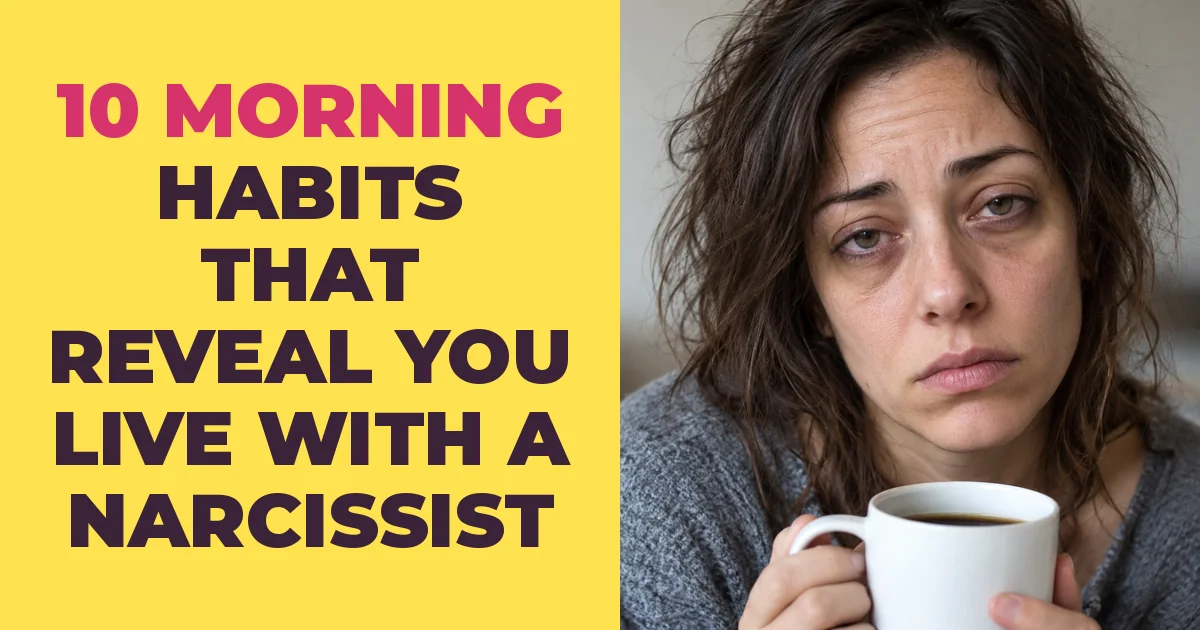
10 Morning Habits That Reveal You Live With a Narcissist

A narcissist doesn’t have to say a word to run your morning.
You hear footsteps on the stairs and your stomach tightens. You haven’t even had coffee yet.
By the time you leave the house, you’re already tired.
Mornings are revealing. The polished public version hasn’t stepped out the front door yet, so what happens in the kitchen is the real thing.
Here are 10 morning habits that reveal you live with a narcissist, and what each one is quietly doing to you.
#1 You check their mood before your own
You can tell their mood from the way the bedroom door opens.
A heavy step means keep quiet. A cheerful whistle means you can breathe. You know the difference before you’re fully awake.
Why? When anger can show up without warning, your body learns to stay switched on. Keeping them calm by agreeing becomes the safest move.
So you say yes before you’ve thought. You apologise for the toast. You’re exhausted by nine.
That isn’t being considerate. Considerate doesn’t come from fear.
Next time your chest tightens, slow down for one breath. Whose morning are you actually living?
#2 Their morning outranks yours
In a narcissist’s house, their morning is the only one that counts.
They need the bathroom first. They need the car at eight. Your early meeting? “Can’t you just go in later?”
And if they have to wait five minutes, the sighing starts.
In their mind, they’re owed more than everyone else. A normal limit feels like a slap to them, so your simple request lands as an attack.
That’s why asking for the shower at 7:30 feels like declaring war.
Try jotting down, quietly, what you give up each morning. Your phone’s notes app will do.
The list will say what they won’t.
#3 A simple question starts a fight
A basic question before breakfast can turn into a full-blown fight.
You ask, “Did you pay the electric bill?” Ten minutes later you’re hearing about every mistake you’ve made since the day you met.
Out of proportion? Completely.
Research on threatened egotism fits this. A bruised ego makes a narcissist more likely to hit back, and they aim at the person they hold responsible. Your innocent question sounded like a verdict.
So you start pre-editing. You rehearse sentences in the shower. You say sorry for things that were never yours.
Stick to short facts, or don’t raise it when it feels unsafe. If the anger turns into threats, get out of the room.
No bill is worth your safety.
#4 Breakfast comes with a side of silence
Silence at the breakfast table can be a punishment in disguise.
They chat to the kids. They laugh at the radio. They talk to the dog. To you? Nothing.
It can last for days after one small disagreement. Then one morning they’re back, cheerful, as if nothing happened.
Being treated like air hits two deep needs: to belong, and to count. That’s why it can hurt like a physical wound, and why so many give in just to end it.
Tell them once you’re happy to talk when they’re ready. Then get on with your morning.
No chasing. No begging by the kettle.
#5 The whole morning is about their day
Every morning conversation somehow circles back to their big day.
Their meeting. Their boss who doesn’t appreciate them. Their genius idea, slightly exaggerated.
You mention your mum’s hospital appointment. “Mm. Anyway, so then I said…”
When someone’s self-worth has to be topped up from outside, everyone near them becomes an audience. Your feelings only count if they touch theirs.
Slowly you feel like a mirror on legs. Your needs become a nuisance.
Look at the pattern over months, not one rushed Tuesday.
Is it ever your turn?
#6 You never know who’s coming downstairs
You never know which version of them will walk into the kitchen.
Monday, a kiss on the forehead and fresh coffee. Tuesday, a cold stare because you bought the wrong milk. No reason given.
Then a sweet morning right after a cruel night, and it feels like hitting the jackpot.
Psychologists call this intermittent reinforcement. Warmth you can’t predict grips harder than warmth you can count on. Slot machines run on the same rule.
So you try harder and get less back. One good morning makes three bad ones seem fine.
Try marking good mornings and bad ones on a calendar for a month.
The average is the real relationship.
#7 Charming to the neighbour, cold to you
The neighbour gets their warmest smile while you get a grunt.
On the driveway it’s “Morning, Pete! Lovely day!” Back inside, the face drops before the door has even shut.
Many narcissists pour energy into how they look to others. Praise is fuel for how they see themselves. The doorstep is a stage. The kitchen isn’t.
And that gap costs you. Friends tell you you’ve got a keeper. Nobody buys the other version, and bit by bit you stop buying it too.
Believe what you see behind closed doors. If one person has witnessed both faces, talk to them.
You’re not imagining the switch.
#8 Your day needs their approval first
Your plans for the day get checked, questioned and approved before you leave.
“Where are you going? Who’ll be there? Why are you wearing that?”
Maybe they glance at your phone while you pour cereal. Maybe there’s a rule about when you must be home.
One question alone looks harmless. That’s the trick. Lots of little rules and penalties stack up until your freedom has quietly gone, with no single big moment to point to. Psychologists call this coercive control.
Your life shrinks. You hear yourself asking permission for a coffee with a friend.
Hold on to a little money and a few contacts that are yours alone. A domestic abuse service can help you plan for safety.
Since when did coffee need a permission slip?
#9 Promises made on the way out the door
Big promises often get made with one foot already out the door.
“Tonight I’ll fix the shelf.” “This weekend we’ll book the holiday.” “After this busy patch, things will change.”
The shelf is still broken. The holiday never gets booked.
There’s a popular name for this: future faking. It isn’t a formal term, but the idea is simple. Shared plans make you invest, and walking away starts to feel like losing a future you’ve already paid into.
The odd kept promise works like those surprise good mornings.
And when you ask? You’re made to feel unreasonable.
Go by what has really happened. Pick your own deadline.
Words are cheap at 7am.
#10 Your shoulders drop when the door closes
If your whole body relaxes when they leave for work, that’s telling you something.
Before that, there was the eye-roll when you spoke. The sarcastic “Wow, up early for once” as you came downstairs. The mocking voice repeating your words.
Then the door shuts. The house exhales. So do you.
Long-term research on couples found contempt and stonewalling ranked among the clearest warning signs that a relationship would fall apart. Mockery isn’t a harmless quirk.
No wonder you shrink in your own kitchen.
Point it out calmly, one time. Then see if respect ever returns.
You already know how that house feels at 8:01.
None of these mornings mean something is wrong with you. They mean you’ve been paying close attention, for a long time, just to get through the day.
That same attention can work for you now. Pick one habit from this list and simply notice it this week.
Your mornings can belong to you again.
If you feel unsafe: in the US, call the National Domestic Violence Hotline at 1-800-799-7233 (thehotline.org). In the UK, call the National Domestic Abuse Helpline on 0808 2000 247. If you are in immediate danger, call your local emergency number.
Sources
- Goffman, E. (1959). The Presentation of Self in Everyday Life. Doubleday.
- Walker, P. (2013). Complex PTSD: From Surviving to Thriving. Azure Coyote.
- Herman, J. L. (1992). Trauma and Recovery. Basic Books.
- Campbell, W. K., Bonacci, A. M., Shelton, J., Exline, J. J., & Bushman, B. J. (2004). Psychological entitlement: Interpersonal consequences and validation of a self-report measure. Journal of Personality Assessment, 83(1), 29-45.
- Bushman, B. J., & Baumeister, R. F. (1998). Threatened egotism, narcissism, self-esteem, and direct and displaced aggression. Journal of Personality and Social Psychology, 75(1), 219-229.
- Williams, K. D. (2009). Ostracism: A temporal need-threat model. Advances in Experimental Social Psychology, 41, 275-314.
- American Psychiatric Association. (2022). Diagnostic and Statistical Manual of Mental Disorders (5th ed., text rev.).
- Pincus, A. L., & Lukowitsky, M. R. (2010). Pathological narcissism and narcissistic personality disorder. Annual Review of Clinical Psychology, 6, 421-446.
- Ferster, C. B., & Skinner, B. F. (1957). Schedules of Reinforcement. Appleton-Century-Crofts.
- Dutton, D. G., & Painter, S. (1993). Emotional attachments in abusive relationships: A test of traumatic bonding theory. Violence and Victims, 8(2), 105-120.
- Stark, E. (2007). Coercive Control: How Men Entrap Women in Personal Life. Oxford University Press.
- Arkes, H. R., & Blumer, C. (1985). The psychology of sunk cost. Organizational Behavior and Human Decision Processes, 35(1), 124-140.
- Gottman, J. M. (1994). What Predicts Divorce? The Relationship Between Marital Processes and Marital Outcomes. Lawrence Erlbaum.
Belle Souls articles explain patterns described in psychology research and recovery writing. They are not a diagnosis and not a substitute for help from a qualified professional.
13 Red Flag Moves Narcissists Make When They Meet Your Friends

A narcissist is rarely more charming than when your friends are watching.
They laugh at the right moments. They remember everyone’s name. Your best friend texts you later: “Okay, they’re a keeper!”
And you stare at that message feeling strangely alone.
The dinner person isn’t always the drive-home person.
Here are 13 red flag moves narcissists make when they meet your friends, and what each one is really doing.
#1 Your friends fall for the charm
A narcissist often saves their best self for the people you love most.
They ask your friend about her new job. They top up every glass. They tell a story where you sound wonderful, and everyone melts.
Why? Applause from an audience props up how they see themselves. Your friends are a fresh audience, so they get the polished show.
So your friends leave glowing. “You’re so lucky.”
Next time you try to describe a bad night at home, who’s going to believe you?
#2 The mask slips on the drive home
The warmth they showed your friends can switch off before you reach the car.
The doors close. Silence. Then: “Your friend is so fake. And what was she wearing?”
Psychologists who study narcissistic admiration and rivalry describe two sides. The charming side comes out for newcomers. The cold, competitive side is kept for the people closest.
That’s why you keep chasing the party version.
Notice the gap between how they treat your friends and how they treat you once the doors shut.
#3 Every story becomes about them
Put a narcissist at a dinner table and the spotlight tends to swing their way.
Your friend starts talking about her trip to Lisbon. Within a minute, they’re telling a louder story about a better trip, a bigger hotel, a funnier waiter.
Researchers describe a loud, bold style of narcissism. Grabbing the spotlight is how it shields an ego that bruises easily.
Your friends stop finishing their sentences.
Watch what they do when the attention moves to someone else. Do they sulk, or pull it straight back?
#4 Good news goes sour around them
Your happy news can feel like a personal threat to a narcissist.
Your friends raise a glass to your promotion. They clap along, then lean over: “Let’s see if you can actually handle it.”
Research ties narcissism, especially its quieter form, to envy. When you shine, they feel smaller. So they mock the win, take credit for it or wreck the moment.
No wonder good news starts to feel risky.
Notice who goes quiet when you win. Then save your best news for the people who cheer the loudest.
#5 Suddenly you’re compared to your friend
Your friends can become a measuring stick you never seem to match.
After brunch it starts. “Sarah is so relaxed. Why can’t you be more like her?” Next week it’s another friend, another flaw of yours.
Psychologists call this triangulation. Instead of sorting things out with you directly, they drag someone else into the picture, and the tension lands on you.
Now you’re competing with a friend who doesn’t even know there’s a contest.
You never have to enter it.
#6 Soft spots turn into punchlines
Some people, narcissistic or not, turn your private insecurities into entertainment for the whole table.
You once told them you hate your laugh. Tonight, in front of everyone: “Do the laugh. It’s hilarious.” They smirk when you flinch.
Researchers describe this as everyday sadism, a trait they added to the Dark Triad. For some people, a small dose of cruelty feels good all by itself. The joke is just the delivery.
Playful teasing stops when you ask. This doesn’t.
Does your distress seem to please them?
#7 Contempt leaks out while you talk
Eye-rolls and little sneers are how contempt shows up in company.
You tell a story at the table. They sigh, roll their eyes, and mimic your voice: “And then I was so upset.”
Everyone laughs awkwardly. You laugh too.
Couples researchers who followed partners for years flagged contempt as one of the worst signs for a relationship’s future. It eats away at things.
So if you feel small, even surrounded by friends, that feeling is real. Not imagined.
#8 They flirt right in front of you
Flirting with your friends keeps you unsure, and a narcissist may like you unsure.
The hand on your friend’s arm. The long compliment about her dress. The wink across the table you weren’t meant to catch.
Researchers link narcissism to treating love like a game. Keep a backup handy. Keep real closeness at arm’s length.
Suddenly you’re fighting for attention that used to come easily. You start to wonder if you’re replaceable.
Steady actions tell you where you stand.
#9 One small joke costs you days
When a friend’s joke stings a narcissist’s ego, you’re the one they blame.
Your friend teases, “Didn’t you get lost last time too?” Everyone laughs. They smile. Then come the icy hours, and a fight three days later about something else.
Studies on what psychologists call threatened egotism showed narcissists hit back harder after a put-down, aiming it at whoever they hold responsible.
So you start pre-editing your friends. Warning them. Steering every chat.
If their temper turns into threats, leave the room.
#10 Stories about you start spreading
A narcissist may quietly rewrite your reputation inside your own friend group.
A friend calls, hesitant. “They said you’ve been really unstable lately. Are you okay?”
Psychologists call it relational aggression: harming you through your friendships and your standing, with gossip as the weapon. There are no bruises to show anyone.
Suddenly you’re defending your name to people who’ve known you for years.
Keep being who you’ve always been. Time speaks louder.
#11 Friends start carrying their messages
Some of your friends may start repeating a narcissist’s version of events without realising it.
A text arrives: “He’s really hurt. Maybe just apologise?” Your friend means well. She’s only heard one version.
There’s a slang name for these messengers: “flying monkeys.” It isn’t a clinical term. It links to triangulation, where a third person gets pulled in to do the pushing.
You don’t owe messengers a defence.
Keep the details private for now. What would happen if you simply didn’t explain?
#12 A night out earns the silent treatment
Time with your friends can come with a price tag called silence.
You get home from girls’ night. They answer the TV, the dog, their phone. Not you. Two days later they act like nothing happened.
Studies on ostracism explain the sting. Being shut out hits your basic need to belong, and the pain can register a lot like a physical one.
So you skip the next night out. Easier.
Tell them once that you’re open to talking. Then live your evening. No chasing. No begging.
#13 Your circle quietly shrinks
Your friendships rarely end in one big fight. They get worn away.
It’s the comments: “Why do you need them when you have me?” “She’s a bad influence.” The sigh when you reach for your coat.
Psychologists call this coercive control. Lots of little rules and penalties pile up until your freedom is gone, without one dramatic event to name.
Your life narrows. Seeing a friend starts to feel like it needs a permission slip.
Keep a few contacts that are only yours.
If more than a few of these landed, believe your own eyes. Any couple can have one awful dinner. The same moves, again and again for months, tell a different story.
Your friends knew you before this person arrived. Many of them still do, and one honest conversation with one of them can be a good place to start.
And if you’re ever scared of how they’ll react, a specialist abuse service can talk your options through with you, with no pressure either way.
If you feel unsafe: in the US, call the National Domestic Violence Hotline at 1-800-799-7233 (thehotline.org). In the UK, call the National Domestic Abuse Helpline on 0808 2000 247. If you are in immediate danger, call your local emergency number.
Sources
- Goffman, E. (1959). The Presentation of Self in Everyday Life. Doubleday.
- American Psychiatric Association. (2022). Diagnostic and Statistical Manual of Mental Disorders (5th ed., text rev.).
- Pincus, A. L., & Lukowitsky, M. R. (2010). Pathological narcissism and narcissistic personality disorder. Annual Review of Clinical Psychology, 6, 421-446.
- Herman, J. L. (1992). Trauma and Recovery. Basic Books.
- Bancroft, L. (2002). Why Does He Do That? Inside the Minds of Angry and Controlling Men. Berkley.
- Back, M. D., Kufner, A. C. P., Dufner, M., Gerlach, T. M., Rauthmann, J. F., & Denissen, J. J. A. (2013). Narcissistic admiration and rivalry. Journal of Personality and Social Psychology, 105(6), 1013-1037.
- Wink, P. (1991). Two faces of narcissism. Journal of Personality and Social Psychology, 61(4), 590-597.
- Miller, J. D., Lynam, D. R., Hyatt, C. S., & Campbell, W. K. (2017). Controversies in narcissism. Annual Review of Clinical Psychology, 13, 291-315.
- Krizan, Z., & Johar, O. (2012). Envy divides the two faces of narcissism. Journal of Personality, 80(5), 1415-1451.
- Bowen, M. (1978). Family Therapy in Clinical Practice. Jason Aronson.
- Buckels, E. E., Jones, D. N., & Paulhus, D. L. (2013). Behavioral confirmation of everyday sadism. Psychological Science, 24(11), 2201-2209.
- Gottman, J. M. (1994). What Predicts Divorce? The Relationship Between Marital Processes and Marital Outcomes. Lawrence Erlbaum.
- Campbell, W. K., Foster, C. A., & Finkel, E. J. (2002). Does self-love lead to love for others? A story of narcissistic game playing. Journal of Personality and Social Psychology, 83(2), 340-354.
- Bushman, B. J., & Baumeister, R. F. (1998). Threatened egotism, narcissism, self-esteem, and direct and displaced aggression. Journal of Personality and Social Psychology, 75(1), 219-229.
- Crick, N. R., & Grotpeter, J. K. (1995). Relational aggression, gender, and social-psychological adjustment. Child Development, 66(3), 710-722.
- Williams, K. D. (2009). Ostracism: A temporal need-threat model. Advances in Experimental Social Psychology, 41, 275-314.
- Stark, E. (2007). Coercive Control: How Men Entrap Women in Personal Life. Oxford University Press.
Belle Souls articles explain patterns described in psychology research and recovery writing. They are not a diagnosis and not a substitute for help from a qualified professional.
How To Cleverly Outsmart A Narcissist

Living with narcissistic behaviour can leave you feeling one step behind.
You leave every argument confused. You apologise for things you didn’t do. And it can feel like they walk away looking calm, reasonable and right.
Same script. Different day.
But their behaviour follows a pattern, and patterns tend to repeat. Once you can see it coming, you can plan for it instead of being caught off guard.
Here are 9 clever ways to outsmart a narcissist, without ever becoming one yourself.
How the game really works
A narcissist’s sense of worth leans on other people confirming it.
So the people around them get sorted into two piles: sources of admiration, or threats to it. Your needs often land in the second pile, treated as an inconvenience.
That’s why outsmarting them has little to do with winning arguments. It means looking at months of behaviour, not single moments, and assuming it won’t change rather than waiting for it to.
Predictable is beatable.
#1 Your notes beat their version
When a narcissist rewrites the past, your own notes are the calmest answer.
You both know what was said in the car on Friday. Then Sunday comes. “That never happened. Honestly, you’re too sensitive.”
Psychologists call this gaslighting. It thrives where one person holds more power, since the trust you place in them gives them room to edit what happened.
Soon you’re doubting your own memory. You might even say sorry for the thing that hurt you.
So jot it down on the day. The date, the time, the exact words. Keep it for yourself, not as ammunition.
And sense-check it with a friend who isn’t part of the relationship.
Your memory isn’t the problem.
#2 The good days are part of the hook
Kindness you can’t predict grips you tighter than kindness you can count on.
Tuesday they’re cold and won’t look at you. Wednesday there are flowers on the counter and a soft “You know I love you.”
Research on intermittent reinforcement explains why. A reward you can’t predict is the toughest one to walk away from. Slot machines run on the same trick.
So one rare apology feels like hitting the jackpot.
Meanwhile the sweet days make the cruel ones seem survivable, and you give more while getting less.
The clever move? Keep a tally. Mark each day as good or bad, then look at the overall average.
Not the one perfect Sunday.
#3 Their confidence hides something fragile
Behind the swagger or the sulking, a narcissist is protecting a fragile self-image.
Researchers describe two forms. The loud one dominates the dinner table and needs the spotlight. The quiet one sulks when nobody notices and keeps score of every slight.
Many switch between both.
Either way, you end up tiptoeing around their moods, and taking the blame whenever they feel let down.
Want to know which one you’re dealing with? Watch the moment the attention shifts off them. Does the mood drop the second someone else gets the floor?
And notice whether an apology ever comes without a “but”.
That’s their weak spot. Not yours.
#4 Criticism hits them harder than you think
To a narcissist, even a small criticism can feel like a direct attack.
You point out they forgot to book the table. Two days later, they’re still punishing you for a remark you’d already forgotten.
Why? Research on threatened egotism found narcissists hit back harder after an insult. The anger lands on whoever they hold responsible.
So you start pre-editing every sentence. You say sorry for things you never did.
Outsmarting this means sticking to plain facts and few words if you criticise at all. Or skipping it entirely, when it isn’t safe.
When anger tips into threats, get out of the room.
Your safety matters more than any point you’re trying to make.
#5 They will steer away from the real issue
Raise one problem with a narcissist and you’ll often end up defending ten of your own.
You mention the comment they made about you at dinner. Within a minute it’s “I never said that, and how dare you accuse me?”
Next come the tears. Ten minutes later, you’re the one handing them tissues.
Psychologists have a name for this: DARVO. They deny it, go on the attack, then swap places so they’re the wronged one. Studies show it leaves the person who spoke up blaming themselves more.
No wonder you’ve gone quiet.
Here’s the clever part. Skip the counter-attack. Calmly name what you first raised, and steer back to it each time.
Dinner. The comment. That’s all.
#6 Being boring starves the drama
Every reaction you hold back leaves a narcissist with less to work with.
The bait text lands at 11pm. “Funny how you always play the victim.”
Many call the answer grey rock. It’s a popular name, not a formal method: when contact can’t be avoided, you stay dull and unreactive.
It links to research on trauma bonds. Cutting back contact and reactions can help that pull loosen.
Short, factual replies. Logistics only. In writing.
It won’t crown you the winner, and it won’t be safe everywhere. If things could escalate, a domestic violence service can help with a safety plan.
Less reaction, less fuel.
#7 Boundaries are about what you do
A boundary is something you do for yourself, never a rule for them.
Telling a narcissist “Stop shouting at me” hands them a rule to break. Saying “If you shout, I’ll leave the room” hands them nothing to push against.
See the difference?
A real boundary works through your own actions, so it doesn’t depend on their agreement.
Say it once. Then follow through, every time.
They’ll probably push back early on, and guilt may hit too. Over time, that guilt tends to make room for more self-respect.
They don’t have to like it.
#8 Guilt is the lever they reach for
Fear, obligation and guilt can make a simple no feel too expensive to say.
“After everything I’ve done for you?” Then the long, heavy silence until you cave and say yes.
Many call this FOG. It’s a popular term for emotional blackmail, not a diagnosis, and it overlaps with what research calls coercive control.
Over time, yes becomes automatic. Their mood starts to feel like your job.
Try a pause. Before answering any request, say “Let me think about it,” and give yourself that space.
Their feelings are real to them. They’re still not your responsibility.
Who would you be without the fog?
#9 Going easy on yourself is the smart move
Shame and self-blame are two of the heaviest things manipulation leaves behind.
You replay it at 2am. How did I not see it? Why did I stay so long?
Would you talk to a friend that way? Probably not.
Research on self-compassion talks about offering yourself the same kindness a good friend would get. It eases shame and self-blame, and that helps recovery.
Start small. Rest without guilt. Pick up the hobby they used to roll their eyes at. Let yourself grieve.
Little daily routines that belong only to you help build a steadier sense of self.
You’re allowed to be on your own side.
You don’t need to be colder or sneakier than a narcissist to outsmart one. You just need to see the pattern clearly, and trust what you see.
Pick one thing from this list. The notebook, the pause, the boring reply. And if it all feels like too much, start by telling one trusted person the full story.
If you feel unsafe: in the US, call the National Domestic Violence Hotline at 1-800-799-7233 (thehotline.org). In the UK, call the National Domestic Abuse Helpline on 0808 2000 247. If you are in immediate danger, call your local emergency number.
Sources
- American Psychiatric Association. (2022). Diagnostic and Statistical Manual of Mental Disorders (5th ed., text rev.).
- Pincus, A. L., & Lukowitsky, M. R. (2010). Pathological narcissism and narcissistic personality disorder. Annual Review of Clinical Psychology, 6, 421-446.
- Herman, J. L. (1992). Trauma and Recovery. Basic Books.
- Bancroft, L. (2002). Why Does He Do That? Inside the Minds of Angry and Controlling Men. Berkley.
- Sweet, P. L. (2019). The sociology of gaslighting. American Sociological Review, 84(5), 851-875.
- Stern, R. (2007). The Gaslight Effect. Morgan Road Books.
- Ferster, C. B., & Skinner, B. F. (1957). Schedules of Reinforcement. Appleton-Century-Crofts.
- Dutton, D. G., & Painter, S. (1993). Emotional attachments in abusive relationships: A test of traumatic bonding theory. Violence and Victims, 8(2), 105-120.
- Wink, P. (1991). Two faces of narcissism. Journal of Personality and Social Psychology, 61(4), 590-597.
- Miller, J. D., Lynam, D. R., Hyatt, C. S., & Campbell, W. K. (2017). Controversies in narcissism. Annual Review of Clinical Psychology, 13, 291-315.
- Bushman, B. J., & Baumeister, R. F. (1998). Threatened egotism, narcissism, self-esteem, and direct and displaced aggression. Journal of Personality and Social Psychology, 75(1), 219-229.
- Freyd, J. J. (1997). Violations of power, adaptive blindness, and betrayal trauma theory. Feminism & Psychology, 7(1), 22-32.
- Harsey, S. J., Zurbriggen, E. L., & Freyd, J. J. (2017). Perpetrator responses to victim confrontation: DARVO and victim self-blame. Journal of Aggression, Maltreatment & Trauma, 26(6), 644-663.
- Durvasula, R. (2024). It's Not You: Identifying and Healing from Narcissistic People. The Open Field.
- Cloud, H., & Townsend, J. (1992). Boundaries. Zondervan.
- Forward, S., & Frazier, D. (1997). Emotional Blackmail. HarperCollins.
- Stark, E. (2007). Coercive Control: How Men Entrap Women in Personal Life. Oxford University Press.
- Neff, K. D. (2003). Self-compassion: An alternative conceptualization of a healthy attitude toward oneself. Self and Identity, 2(2), 85-101.
Belle Souls articles explain patterns described in psychology research and recovery writing. They are not a diagnosis and not a substitute for help from a qualified professional.
8 Foolish Mistakes Narcissists Make

A narcissist’s sense of worth runs on other people’s applause.
They expect special treatment. When it doesn’t come, they get angry.
But you’ve noticed things. The same fights. The same excuses. The same story, told a little differently each time.
That’s not you being paranoid.
Patterns like these repeat. And once you can spot them, they tell you a lot.
Here are 8 foolish mistakes narcissists make, and what each one tells you.
#1 Their accusation may be about them
When a narcissist accuses you of something, listen closely, because they’re often describing themselves.
You come home ten minutes late and get grilled about who you were texting. Meanwhile, their phone lives face-down on the table, and nobody’s allowed to touch it.
Or they shout, “Why are you always so angry?” while they’re the one yelling.
Psychologists call this projection. If the flaw they can’t stand is pinned on you, they never have to spot it in their own mirror.
The cost lands on you. You spend the whole evening proving your innocence, and whatever you wanted to talk about gets lost.
So when the same charge keeps coming back, file it as a clue about them. Say what’s true once. Then stop explaining.
Their words are a mirror. Just not of you.
#2 They explode over nothing
A narcissist’s anger often has very little to do with what you actually said.
You ask, “Did you pay the electric bill?” Simple question. Suddenly the kitchen is a war zone and you’re being called ungrateful.
Why so much fire over so little?
Researchers who study threatened egotism found something telling. When narcissists feel insulted, their aggression goes up, and it’s aimed at whoever they think caused the sting.
Sometimes it isn’t even instant. Three days later, out of nowhere, you pay for a comment you can’t even recall making.
So you rehearse sentences before you say them. You say sorry for things that weren’t yours.
If the anger ever tips into threats, walk out of the room. That isn’t losing. That’s staying safe.
#3 Two faces give the game away
The charming person at the party and the silent one in the car are the same person.
Everyone laughs at their jokes. Your friends tell you how lucky you are. Then the car door shuts and the warmth switches off like a light.
Why the show? Admiration is what props up their self-worth, so they pour energy into how the world sees them.
The slip is the gap itself.
Sure, we all mind our manners in public. Here the gap is far bigger: sweet out there, cutting at home.
Because you’re the only one who sees both, you can start wondering if you’ve got it wrong. Especially when friends shrug. Believe what happens once the front door closes, and lean on anyone who has glimpsed the other side.
You’re not imagining the switch.
#4 Promises with no date attached
A narcissist’s promises sound detailed, but they rarely come with a real date.
The trip to Italy. The new kitchen. The wedding. “After this busy stretch at work, I promise.”
Then the busy stretch never ends.
Many women know this as future faking. It’s a popular term, not a diagnosis, for promises made to keep you invested. Shared plans tie you in, and the more of yourself you pour into that future, the more leaving feels like throwing it away.
Research on unpredictable rewards helps explain the pull: kindness handed out at random grips tighter than kindness you can count on. One small step forward, and the hope comes rushing back.
So you keep waiting on a life that’s always one season away. And asking about it makes you feel like the difficult one.
Count the plans that actually happened since the first “after this busy stretch”. How many?
#5 Sorry rarely comes clean
With a narcissist, a clean apology can be hard to come by, because being wrong threatens a fragile self-image.
“I’m sorry you feel that way.”
Or the classic: “I’m sorry, but you started it.” Sounds familiar?
Researchers describe narcissism with a loud face and a quiet one. Loud brags and grabs the spotlight. Quiet sulks, counts every slight and privately feels better than everyone, just misunderstood. Plenty flip between the two.
Either way, the job is the same: protect a self-image that can’t take a hit. So a small piece of feedback gets treated like an attack. They act like they don’t care, then twist it around until they’re the wounded one.
That little “but” is the giveaway. It shows you their image comes first, even in a moment that should be about you.
You end up tiptoeing around their moods, and somehow their letdowns become your fault.
One quick check: when did you last get a “sorry” with nothing tacked on the end?
#6 Their next move is often easy to guess
A narcissist’s patterns show up across situations, not just on a bad day.
Your friend shares big news, and it turns into their story about a bigger win. The restaurant gives their table away, and the whole evening sours.
That’s because the pattern runs deep. Their self-worth has to be topped up from outside, so everyone around them lands in one of two boxes: fans, or danger.
They expect the VIP treatment. They get furious when it doesn’t show up. Same trigger, same reaction, month after month.
Live with that long enough and you start to feel like a mirror they keep on the wall. What you need? A nuisance.
What helps is boring but powerful. Look at months, not moments. And plan around the behaviour you’ve already seen, instead of the change you keep hoping for.
Months of evidence beat one good evening.
#7 Your notes outlast their version
A narcissist’s version of events can change, but what you wrote down won’t.
“That never happened.” “You’ve got it mixed up.” “You’re too sensitive.”
Said often enough, those lines start to work. That’s gaslighting: chipping away at your trust in your own eyes and memory until their story is the only one left standing.
It does the most damage when one person holds more power. You trust them, so they get to be the narrator.
Your notes give you a record of your own.
Jot things down as they happen, just for you. The date, the exact words, what you saw. Then run it past someone who isn’t inside this relationship.
Two people can recall a day differently. That’s normal. Being told you never saw what you saw is not.
#8 Your good news gives them away
Your happiest moments are often when a narcissist’s envy shows the most.
You get the job. Their reply? A flat “Good for you,” and then a long story about their own day.
Or your birthday dinner somehow ends in a fight in the car park.
Envy shows up a lot in narcissism, most of all in the quieter type. When you shine, their need to be on top feels threatened. So your win gets shrunk, borrowed or ruined.
Before long you’re keeping good news to yourself. Celebrating starts to feel dangerous.
Everyone feels a twinge of jealousy now and then. The difference is what they do with it.
Watch whose face falls when things go right for you. Then take your wins to the people who cheer.
None of this means you were slow for not seeing it sooner. Patterns take time to show, and you were busy living through them.
Pick one pattern from this list, maybe the “but” on the end of a sorry, and watch for it this week. Note the date when it shows up.
You’ve been noticing these patterns all along. Now they have names.
If you feel unsafe: in the US, call the National Domestic Violence Hotline at 1-800-799-7233 (thehotline.org). In the UK, call the National Domestic Abuse Helpline on 0808 2000 247. If you are in immediate danger, call your local emergency number.
Sources
- American Psychiatric Association. (2022). Diagnostic and Statistical Manual of Mental Disorders (5th ed., text rev.).
- Pincus, A. L., & Lukowitsky, M. R. (2010). Pathological narcissism and narcissistic personality disorder. Annual Review of Clinical Psychology, 6, 421-446.
- Baumeister, R. F., Dale, K., & Sommer, K. L. (1998). Freudian defense mechanisms and empirical findings in modern social psychology. Journal of Personality, 66(6), 1081-1124.
- Bushman, B. J., & Baumeister, R. F. (1998). Threatened egotism, narcissism, self-esteem, and direct and displaced aggression. Journal of Personality and Social Psychology, 75(1), 219-229.
- Goffman, E. (1959). The Presentation of Self in Everyday Life. Doubleday.
- Arkes, H. R., & Blumer, C. (1985). The psychology of sunk cost. Organizational Behavior and Human Decision Processes, 35(1), 124-140.
- Ferster, C. B., & Skinner, B. F. (1957). Schedules of Reinforcement. Appleton-Century-Crofts.
- Dutton, D. G., & Painter, S. (1993). Emotional attachments in abusive relationships: A test of traumatic bonding theory. Violence and Victims, 8(2), 105-120.
- Wink, P. (1991). Two faces of narcissism. Journal of Personality and Social Psychology, 61(4), 590-597.
- Miller, J. D., Lynam, D. R., Hyatt, C. S., & Campbell, W. K. (2017). Controversies in narcissism. Annual Review of Clinical Psychology, 13, 291-315.
- Sweet, P. L. (2019). The sociology of gaslighting. American Sociological Review, 84(5), 851-875.
- Stern, R. (2007). The Gaslight Effect. Morgan Road Books.
- Krizan, Z., & Johar, O. (2012). Envy divides the two faces of narcissism. Journal of Personality, 80(5), 1415-1451.
Belle Souls articles explain patterns described in psychology research and recovery writing. They are not a diagnosis and not a substitute for help from a qualified professional.