
Author: Christoph
The Real Reason a Narcissist Turns a Simple Question Into World War III

A narcissist can hear a question and feel an accusation.
You asked what time they’d be home. Or where the money from the joint account went. Something small and normal.
Ten minutes later there’s shouting, a slammed door, and somehow you’re the one saying sorry.
And you lie awake replaying it, wondering what you did wrong.
Nothing.
Here are 6 real reasons a simple question turns into World War III, and what’s going on underneath it.
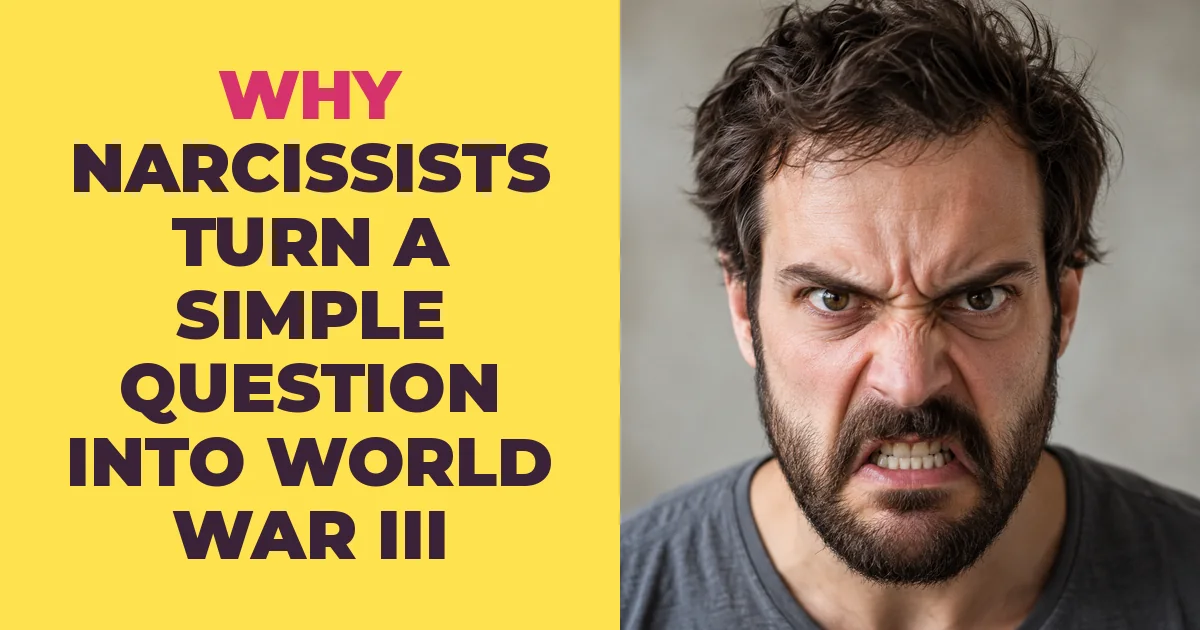
What’s behind the explosion
Psychologists describe two faces of narcissism. A loud one that’s bold and charming, and a quiet one that’s touchy and resentful. Many switch between both.
Both guard the same thing: a fragile self-image.
That’s why they can act like nothing touches them, then rage at the smallest hint of criticism. And to that fragile image, a question can sound a lot like criticism.
#1 Your question lands like an insult
To a narcissist, a simple question can feel like a slap across the face.
You ask, “Did you call the plumber?” over breakfast. They put the mug down hard. “Oh, so now I’m useless? Great. Thanks for that.”
You didn’t say useless. You said plumber. Now you’re somehow arguing about whether you’ve ever respected them.
Research on what psychologists call threatened egotism found that narcissists respond to insults with more aggression, aimed straight at the person they blame.
Their self-image heard an insult anyway. And you happened to be the one holding the coffee.
So you start pre-editing. You rehearse that one little question six different ways in your head before you dare say it. Your whole body braces.
If it does come out, keep it short and factual. And if anger ever tips into threats, leaving the room is a perfectly good answer.
Your question doesn’t need an apology attached.
#2 Rules are for you, not them
Entitlement turns your normal, fair requests into personal attacks in a narcissist’s mind.
You ask them to pay back the money they borrowed in March. Or to text if they’ll be late for dinner.
Basic stuff. The stuff any couple sorts out.
But they look at you like you’ve demanded a kidney. “Why are you keeping score? I can’t believe you’d even bring that up.”
Research on entitlement describes a steady belief that they deserve more than others, and that rules apply to everyone else. So an ordinary limit feels like an insult.
Over time you give more and get less. You start rounding everything in their favour just to skip the fight. Asking for fairness feels like declaring war.
One quiet fix: keep track of what you give. Stop pre-agreeing, pre-paying and pre-forgiving before they’ve even asked.
Asking for what’s fair isn’t greedy.
#3 Suddenly you’re the one on trial
Ask one fair question and the whole conversation ends up being about your faults.
You start with, “Why did you tell your mum I was being difficult?” Five minutes later you’re hearing about your tone, your friends, and something you said two Christmases ago.
Then the tears come. Theirs.
Psychologists call this DARVO: deny, attack, then reverse victim and offender. “I never said that. How dare you accuse me? You always do this to me.”
Research found it makes the person who raised the issue blame themselves more. That’s why it shuts conversations down so well.
And it works. You end up comforting them and apologising for bringing it up. Next time, you don’t.
When it starts, name your original question and go back to it. “I’m asking about what you told your mum.” Calm, and on repeat. You don’t need to fight every counter-attack point by point.
Your question still deserves an answer.
#4 They accuse you of what they do
Often, the thing a narcissist accuses you of is the very thing they’re doing.
You ask, quietly, why they’re yelling. “I’M not yelling! You’re the one who’s always angry!”
You ask who they were texting at midnight. Suddenly you’re the jealous, controlling one.
Psychologists call this projection. Seeing an unwanted trait in someone else lets a person avoid seeing it in themselves.
Your question shines a light on something they don’t want to look at. So they swing the light round onto you.
The cost is real. You spend the whole night defending yourself against things you never did, and the thing you actually asked about quietly vanishes.
One way to tell: when the same accusation keeps coming back, treat it as information about them. State the facts once.
Don’t over-defend.
#5 Your pain is noticed, then ignored
Many narcissists can see exactly how you feel. They just don’t act on it.
You ask, voice shaking, “Why would you say that in front of everyone?” They sigh and check their phone.
“God, you’re so sensitive. It was a joke.” Then the subject changes to dinner.
Research on empathy in narcissism found they show less of it by default, but more when prompted to take the other person’s view.
That suggests empathy is often a choice for them, more than something they can’t do.
So you stop sharing your feelings. Then you start doubting your own reactions. Was it really that bad?
Take your feelings to people who respond.
And stop explaining your pain to someone who uses it.
#6 You learn to stop asking
Each blow-up quietly teaches you that asking questions costs too much.
So you stop asking where the money went. You stop asking who they’re seeing on Friday. You just check their face first.
You read the mood from their keys.
Psychologists call the wider pattern coercive control. Lots of small rules and punishments add up until your independence is gone, which is why it’s so hard to point to one big incident.
Living with unpredictable anger also trains your body to stay on alert, and to calm things down by agreeing.
Your world gets smaller. You ask permission for ordinary things, and lose track of what you even want.
If this is your home, keep some money and contacts of your own. A domestic abuse service can help you think through safety.
You were always allowed to ask.
A question about money, time or a text message is a normal part of sharing a life.
If asking one feels like pulling the pin on a grenade, that tells you something about the room, not about you.
Trust what you saw. Wanting answers was never the problem.
If you feel unsafe: in the US, call the National Domestic Violence Hotline at 1-800-799-7233 (thehotline.org). In the UK, call the National Domestic Abuse Helpline on 0808 2000 247. If you are in immediate danger, call your local emergency number.
Sources
- Bushman, B. J., & Baumeister, R. F. (1998). Threatened egotism, narcissism, self-esteem, and direct and displaced aggression. Journal of Personality and Social Psychology, 75(1), 219-229.
- Wink, P. (1991). Two faces of narcissism. Journal of Personality and Social Psychology, 61(4), 590-597.
- Miller, J. D., Lynam, D. R., Hyatt, C. S., & Campbell, W. K. (2017). Controversies in narcissism. Annual Review of Clinical Psychology, 13, 291-315.
- Campbell, W. K., Bonacci, A. M., Shelton, J., Exline, J. J., & Bushman, B. J. (2004). Psychological entitlement: Interpersonal consequences and validation of a self-report measure. Journal of Personality Assessment, 83(1), 29-45.
- Freyd, J. J. (1997). Violations of power, adaptive blindness, and betrayal trauma theory. Feminism & Psychology, 7(1), 22-32.
- Harsey, S. J., Zurbriggen, E. L., & Freyd, J. J. (2017). Perpetrator responses to victim confrontation: DARVO and victim self-blame. Journal of Aggression, Maltreatment & Trauma, 26(6), 644-663.
- Baumeister, R. F., Dale, K., & Sommer, K. L. (1998). Freudian defense mechanisms and empirical findings in modern social psychology. Journal of Personality, 66(6), 1081-1124.
- Hepper, E. G., Hart, C. M., & Sedikides, C. (2014). Moving Narcissus: Can narcissists be empathic? Personality and Social Psychology Bulletin, 40(9), 1079-1091.
- Stark, E. (2007). Coercive Control: How Men Entrap Women in Personal Life. Oxford University Press.
- Walker, P. (2013). Complex PTSD: From Surviving to Thriving. Azure Coyote.
- Herman, J. L. (1992). Trauma and Recovery. Basic Books.
Belle Souls articles explain patterns described in psychology research and recovery writing. They are not a diagnosis and not a substitute for help from a qualified professional.
What Narcissists Keep in Their Home That Nobody Is Meant to See

From the outside, your home looks fine.
Better than fine, even. Friends see the nice cups, the easy laugh, the partner who helps clear the table. You see the phone that stays face down and the mood that drops the second the door shuts.
And when you try to put it into words, it sounds like nothing.
It isn’t nothing. A narcissist’s home often has a back room nobody else gets to see.
Here are 7 things a narcissist often keeps hidden at home, and what each one is really for.
Why the picture matters so much
Narcissism, as a lasting pattern, runs on admiration. Their sense of worth leans on how other people see them.
So the people around them get sorted fast. Either you’re a mirror that makes them look good, or you’re a threat to the picture.
Anything that could dent the picture gets treated as a threat.
Only a clinician can diagnose anyone. What you can do is judge the pattern over months, not one bad night.
#1 The person behind the front door
A narcissist often saves their kindest side for people who don’t live with you.
At the barbecue, they’re the funny one. Topping up drinks, asking about everyone’s kids, carrying plates to the kitchen. Your sister leans over and whispers that you’re so lucky.
Then the car door shuts, and the warmth goes with it. “Did you have to tell that story? You embarrassed me.”
Why the effort out there? Many narcissists invest heavily in their public image, because admiration feeds how they feel about themselves. At home, nobody’s clapping, so the effort stops.
That gap is exactly what makes you doubt yourself. If everyone sees a sweetheart, maybe the problem is you?
It isn’t. Trust what happens behind the closed door.
The silent car ride home counts too.
#2 Old flames on a face-down phone
Many narcissists keep exes and admirers close, on a phone that rarely leaves their hand.
At home, it charges on their side of the bed, screen down. The ex who still “just checks in.” The coworker who likes every photo and somehow always gets a heart back.
Ask about it once and you’ll hear it: “She’s just a friend. Why are you so jealous all of a sudden?”
Research links narcissism with a game-playing style of love. Keep options open, avoid real closeness, lose interest once they feel they’ve won.
So you end up competing for attention you once got for free.
You start to feel replaceable at home.
Taking time to commit is normal. Keeping you unsure on purpose isn’t. Does their closeness always come right before distance?
#3 Money you never get to see
A narcissist may keep the money, the cards and the statements where you can’t see them.
The statements go to their email. Your card is “safer” in their wallet. Then a letter arrives about a debt in your name you never agreed to.
Ask about it and suddenly you’re the problem. “Why are you checking up on me? Don’t you trust me?”
Meanwhile you hide a coffee receipt in your pocket.
Why does it matter so much? Without money of your own, leaving becomes harder, and that keeps you dependent.
Couples budget together all the time, and that’s fine. Here, one person holds every key and you’re asking for your own money.
Your own account, your own records, a look at your credit report now and then. That’s a floor to stand on.
#4 The tracking that only goes one way
In a controlling home, your phone and location get checked while theirs stay locked.
“Where are you? Send me a picture.” Your location is shared, but theirs somehow never is. Your phone gets picked up the minute you leave the room.
Each rule seems tiny on its own. Text when you get there. Don’t see her. Change that top.
Researchers call this coercive control. Many small rules and punishments add up to a loss of freedom, which is why there’s rarely one big moment to point at.
Your world gets smaller. You catch yourself asking permission to grab coffee with a friend.
If this is your home, a domestic abuse service can talk through safety planning with you, privately.
Coffee shouldn’t need a permission slip.
#5 A quiet file on you
Some partners play a long game, keeping their own name clean while quietly building a case against you.
A folder of screenshots. The one angry text you sent, cropped just right. Dates, times, who said what, kept somewhere you won’t think to look.
Then it gets shown to your sister, calmly. “I’m just worried about her.”
Psychologists call this style Machiavellianism: flattery, deception and a long game. It overlaps with narcissism, and people high in it rarely lose their temper in public.
So others see someone calm and reasonable, which is why they often don’t believe you.
You often only see the plan once it’s finished. That’s not slowness on your part. It was built to stay hidden.
Share less, and put agreements in writing. Quiet can work for you too.
#6 Your soft spots, saved for later
A narcissist often understands how you feel and just doesn’t act on it.
You told them once how small your dad used to make you feel. Months later, in the middle of a row about the dishes: “No wonder your father gave up on you.”
And if you cry? “You’re too sensitive.” Subject changed.
Research on narcissism and empathy found something telling. Empathy was lower by default, but it went up when narcissists were prompted to take the other person’s view.
That suggests a choice more than an inability.
So you stop sharing your feelings. Then you start doubting your own reactions.
Your pain isn’t something to hand over to a person who uses it. Take it to the people who actually respond.
#7 A running tally of every slight
A narcissist may forget your birthday but rarely forgets the comment you made in March.
You said they’d parked a bit far from the kerb. They smiled and said nothing. Three days later, over dinner, cold fury, and the whole list comes out.
“You humiliated me. Again.”
Psychologists describe a quieter form of narcissism that sulks and keeps score of slights. Under the calm face sits a fragile self-image, stung by criticism it pretends not to care about.
Research on threatened egotism found that when their image is bruised, narcissists are more likely to hit back, aimed at whoever they blame.
That’s why you pre-edit every sentence and apologise for things you didn’t do. Keep any criticism short and factual, or skip it when it’s not safe.
One small comment. Three days. Sounds familiar?
If this has been hard to put into words, that makes sense. Most of it happened where nobody else was looking.
You saw it anyway. Try writing things down as they happen, and checking them with one person outside the house.
What you noticed was real.
If you feel unsafe: in the US, call the National Domestic Violence Hotline at 1-800-799-7233 (thehotline.org). In the UK, call the National Domestic Abuse Helpline on 0808 2000 247. If you are in immediate danger, call your local emergency number.
Sources
- Goffman, E. (1959). The Presentation of Self in Everyday Life. Doubleday.
- Sweet, P. L. (2019). The sociology of gaslighting. American Sociological Review, 84(5), 851-875.
- Stern, R. (2007). The Gaslight Effect. Morgan Road Books.
- American Psychiatric Association. (2022). Diagnostic and Statistical Manual of Mental Disorders (5th ed., text rev.).
- Pincus, A. L., & Lukowitsky, M. R. (2010). Pathological narcissism and narcissistic personality disorder. Annual Review of Clinical Psychology, 6, 421-446.
- Campbell, W. K., Foster, C. A., & Finkel, E. J. (2002). Does self-love lead to love for others? A story of narcissistic game playing. Journal of Personality and Social Psychology, 83(2), 340-354.
- Postmus, J. L., Plummer, S.-B., McMahon, S., Murshid, N. S., & Kim, M. S. (2012). Understanding economic abuse in the lives of survivors. Journal of Interpersonal Violence, 27(3), 411-430.
- Stark, E. (2007). Coercive Control: How Men Entrap Women in Personal Life. Oxford University Press.
- Christie, R., & Geis, F. L. (1970). Studies in Machiavellianism. Academic Press.
- Jones, D. N., & Paulhus, D. L. (2014). Introducing the Short Dark Triad (SD3). Assessment, 21(1), 28-41.
- Paulhus, D. L., & Williams, K. M. (2002). The Dark Triad of personality: Narcissism, Machiavellianism, and psychopathy. Journal of Research in Personality, 36(6), 556-563.
- Hepper, E. G., Hart, C. M., & Sedikides, C. (2014). Moving Narcissus: Can narcissists be empathic? Personality and Social Psychology Bulletin, 40(9), 1079-1091.
- Wink, P. (1991). Two faces of narcissism. Journal of Personality and Social Psychology, 61(4), 590-597.
- Miller, J. D., Lynam, D. R., Hyatt, C. S., & Campbell, W. K. (2017). Controversies in narcissism. Annual Review of Clinical Psychology, 13, 291-315.
- Bushman, B. J., & Baumeister, R. F. (1998). Threatened egotism, narcissism, self-esteem, and direct and displaced aggression. Journal of Personality and Social Psychology, 75(1), 219-229.
Belle Souls articles explain patterns described in psychology research and recovery writing. They are not a diagnosis and not a substitute for help from a qualified professional.
Think It’s Love? That Is Exactly How a Narcissist Manipulates You

A narcissist rarely opens with cruelty. They open with the best love you’ve ever felt.
The texts that never stopped. The way they swore they’d never met anyone like you.
Now you’re replaying every conversation, wondering where that person went and what you did wrong.
Nothing. That’s the short answer.
Here are 7 ways a narcissist dresses manipulation up as love, and how to tell the difference.
Why the start feels so good
Psychologists who study narcissism describe two sides to it: admiration and rivalry.
Early on, admiration runs the show. Charm. Attention. Flattery that feels like it was written just for you. It wins people over, and it won you over.
Later, rivalry takes over. They turn cold or cutting, and start competing with you instead of backing you.
That’s why the first impression is so good and the later one so bad. Same person, two sides. You just met the nicer one first.
#1 They love you too much, too fast
Love bombing is a flood of attention that ties you to them before you really know them.
Good-morning texts before you’re awake. Flowers at your work by week two. Talk of moving in, of kids, of forever, before you’ve even met their friends.
“You’re my soulmate. I just know it.”
Why the rush?
Fast intensity builds a strong bond before you’ve seen how they act under stress. By the time the pressure shows, you’re already attached. And that early high becomes the memory you keep chasing.
One way to tell: notice what happens when you want to slow down. A person who’s simply excited can wait. Love bombing pushes, sulks or gets upset.
Love that can’t hear “not yet” isn’t really listening to you.
#2 Their rules are dressed up as worry
Control often starts as small rules about where you go and who you see.
It starts small. “Who are you texting?” “I just like knowing you got home safe.” Then they want your location shared all the time.
Your friend’s birthday drinks turn into a silent car ride home. “I don’t trust her. She’s a bad influence on you.” Next time, you just stay in.
Each rule looks tiny on its own. That’s how coercive control works: lots of small rules and punishments that add up, which is why it’s so hard to point to one big moment.
Meanwhile, your world gets smaller. You start asking permission for things you used to just do.
If this sounds familiar, keep a few contacts that are only yours. A domestic abuse service can also help you think through safety, quietly and on your terms.
Real care makes your world bigger.
#3 Your secrets become their weapons
What you confide to a narcissist can be used against you later.
Early on, they wanted to know everything. Your dad. Your body. The thing you’ve never told anyone. It felt like finally being seen.
Then, in a fight about the dishes: “No wonder your father walked out.”
Research on narcissism and empathy suggests many narcissists can understand what you feel. They show less empathy by default, and more when it serves them. That looks more like a choice than an inability.
So they know where it hurts.
Over time, you stop sharing feelings at all. You start doubting your own reactions. “You’re too sensitive,” they say, and part of you believes it.
Stop explaining your pain to someone who uses it. Your softest stories belong with people who handle them gently.
#4 Kindness arrives like a lottery win
Unpredictable kindness hooks you harder than steady kindness ever could.
Monday, they’re cold and short with you. Tuesday, they bring your favourite takeaway and kiss your forehead as if nothing happened.
You never know who’s coming home.
Psychologists call this intermittent reinforcement. Rewards that come on an unpredictable schedule create the hardest habits to break. It’s the same pull that keeps people feeding slot machines.
So the rare sweet moment feels like a jackpot. You work harder for less, and the good days make the bad ones feel bearable.
Try this, just for yourself: mark the good days and the bad ones on a calendar for a month. Then judge the relationship by the average, not the best day.
What does your average look like?
#5 The future they promise never comes

Big plans for the future can keep you waiting for a life that never starts.
The house by the sea. The trip to Italy. The wedding, “once things calm down at work.”
Things never calm down. Plans get cancelled and never rescheduled. Bring it up, and suddenly: “I never promised that. You’re making things up again.”
There’s a popular name for this: future faking. It isn’t a formal term, but it fits research on game-playing in love, where commitment comes fast and then cools.
Plans create commitment. Once you’ve poured yourself into a shared future, walking away feels like losing it. So you wait, and feel unreasonable for asking.
Real plans fall through sometimes, and then they get rescheduled. These get rearranged and never rescheduled.
Look at what actually happened.
#6 Guilt is how they keep you saying yes
Guilt can work like a leash, and a narcissist may hold it very tight.
“After everything I’ve done for you?”
That line often shows up when you try to say no. So does the heavy, sighing silence until you give in. So do reminders of a favour from three years ago.
Many call this FOG, short for fear, obligation and guilt. It’s a popular term rather than a clinical label, and it overlaps with what researchers describe as coercive control.
The aim is simple. Saying no has to feel more costly than giving in.
Soon, yes slips out before you’ve even thought. Their moods start to feel like your job.
Try a pause. “Let me think about it.” Their feelings are real to them, but they aren’t your responsibility. That pause is yours to take.
#7 Leaving hurts because the bond was built that way
Missing someone who hurt you doesn’t mean something is wrong with you.
You defend them to your sister. You lie awake missing them the night after the worst fight. You leave, it physically aches, and you go back.
Then you feel ashamed for staying.
When harm and kindness keep alternating and there’s a power imbalance, researchers call the attachment that forms a trauma bond. It can be stronger than the bond in a calm relationship.
Your logic pulls one way. Your feelings pull the other.
It isn’t weakness. It’s how a bond built on that cycle works, and you were never foolish for feeling it.
Support from people outside the relationship helps. Start with one person you trust, and tell them all of it.
If parts of this read like your own story, that isn’t proof you were naive. It means you met the charming side first, which is how this pattern tends to start.
Put the first months next to the last few. That gap is where the manipulation lived.
Start small: one calendar, one pause, one person you trust.
If you feel unsafe: in the US, call the National Domestic Violence Hotline at 1-800-799-7233 (thehotline.org). In the UK, call the National Domestic Abuse Helpline on 0808 2000 247. If you are in immediate danger, call your local emergency number.
Sources
- Back, M. D., Kufner, A. C. P., Dufner, M., Gerlach, T. M., Rauthmann, J. F., & Denissen, J. J. A. (2013). Narcissistic admiration and rivalry. Journal of Personality and Social Psychology, 105(6), 1013-1037.
- Strutzenberg, C. C., Wiersma-Mosley, J. D., Jozkowski, K. N., & Becnel, J. N. (2017). Love-bombing: A narcissistic approach to relationship formation. Discovery, The Student Journal of Dale Bumpers College of Agricultural, Food and Life Sciences, 18, 81-89.
- Stark, E. (2007). Coercive Control: How Men Entrap Women in Personal Life. Oxford University Press.
- Hepper, E. G., Hart, C. M., & Sedikides, C. (2014). Moving Narcissus: Can narcissists be empathic? Personality and Social Psychology Bulletin, 40(9), 1079-1091.
- Ferster, C. B., & Skinner, B. F. (1957). Schedules of Reinforcement. Appleton-Century-Crofts.
- Dutton, D. G., & Painter, S. (1993). Emotional attachments in abusive relationships: A test of traumatic bonding theory. Violence and Victims, 8(2), 105-120.
- Arkes, H. R., & Blumer, C. (1985). The psychology of sunk cost. Organizational Behavior and Human Decision Processes, 35(1), 124-140.
- Campbell, W. K., Foster, C. A., & Finkel, E. J. (2002). Does self-love lead to love for others? A story of narcissistic game playing. Journal of Personality and Social Psychology, 83(2), 340-354.
- Forward, S., & Frazier, D. (1997). Emotional Blackmail. HarperCollins.
Belle Souls articles explain patterns described in psychology research and recovery writing. They are not a diagnosis and not a substitute for help from a qualified professional.
What You Never See in Public: 12 Disturbing Things Narcissistic Parents Do

Narcissistic parents save their best self for an audience.
At home, the curtain came down. You grew up with the version nobody else met, and you learned to keep quiet about it.
Maybe you still wonder if it was really that bad.
It was.
Here are 12 disturbing things narcissistic parents do once the guests leave, and why they left such a mark on you.
#1 Their public smile switched off at home
The parent everyone admired was not the parent who drove you home.
At the school play, your mother hugged you and told the other moms how proud she was. In the car, she listed every line you missed.
Why the switch? Admiration is what keeps their self-worth afloat. Teachers, neighbours and friends handed it out, so they got the charm. You were backstage, so you got the rest.
That gap is why nobody believed you. It’s also why you still doubt your own memory.
Trust what happened behind closed doors.
#2 Your door was never really yours
When a family blurs every boundary, a closed door looks like disloyalty.
No knock. Just the handle turning while you were changing, or crying, or on the phone.
Your diary got read. Your texts got checked. Even now, she might read your messages or ask why you made plans without her.
In families like this, closeness becomes a leash. Every step toward independence felt risky, and growing up started to feel like something to apologise for.
You didn’t need to. Wanting a lock was normal.
#3 Good news made them go quiet
Your wins chipped at their need to be the best, so they made them smaller.
You came home with the A, the job offer, the engagement ring. You got a flat “That’s nice” and a story about your cousin who did better.
Or worse, a fight on your birthday. Somehow your big day always ended in tears.
So you started hiding good news.
Watch who falls silent when something good happens to you. Then share your wins with people who light up.
#4 Small comments set off big explosions
To a narcissistic parent, being corrected can feel like an attack worth punishing.
You pointed out the turn was back there. Or asked why dinner was late. Suddenly the whole house was shaking.
Psychologists studying threatened egotism describe this: a bruised ego in a narcissist tends to bring more aggression, pointed straight at the person blamed for the bruise. Sometimes the payback came days later, over a remark you’d long forgotten.
So you started rehearsing every sentence in your head.
If anger ever turns into threats, leaving the room is allowed. A question was never a crime.
#5 Every conversation circled back to them
With a self-focused parent, your news was just a lead-in to theirs.
You called to say you’d been sick all week. Five minutes later you were hearing about her back pain, her neighbour, her terrible week.
To many narcissistic parents, the people around them are there to reflect them back. What you needed felt like a nuisance to them, and what you felt got waved away.
The result is a strange loneliness. You can sit right next to them and feel completely unseen.
Sounds familiar?
#6 You became their marriage counsellor
You were made responsible for a grown-up’s feelings long before you could handle your own.
Your dad sat on the edge of your bed and told you what your mom had done. “You’re the only one who understands me.”
That’s parentification. You were the confidant, the peacemaker, the one holding adult secrets. Somewhere along the way, you decided your own needs could wait.
Being called “so mature” felt like praise. It was a job.
Today, asking for help might feel impossible. Start small, and let someone take care of you for once.
#7 One child was golden, one got the blame
Some narcissistic parents cast one child as the star and another as the problem.
“Why can’t you be more like your sister?” She got praise for showing up. You got a list of what you hadn’t done.
Comparing you kept the two of you competing instead of close. Handing out fixed parts let your parent control how the family looked and where the tension went.
The fallout lasts: shame, pressure to be perfect, distance from a sibling who was never your enemy.
That role was assigned. It was never true.
#8 Tears were met with a sigh
Many narcissistic parents notice your pain and decide it isn’t worth answering.
You cried after a breakup. Your mother sighed, said “You’re too sensitive,” and changed the subject to dinner.
Studies on narcissism and empathy found something telling: their empathy is low by default but climbs when they’re nudged to see things your way. That points to choice, not inability.
That’s why you stopped sharing. And why you still second-guess your own reactions.
Your feelings were never the problem.
#9 Their help always came with a bill
Help from a narcissistic parent often came with strings you only saw later.
They paid for your first car, then brought it up in every argument for ten years. “After everything I’ve done for you?”
Each guilt trip, each mention of a past favour, made no feel far more expensive than yes. So you started agreeing on autopilot.
Next time a request comes, pause.
Their disappointment is theirs to carry. It doesn’t have to be your emergency.
#10 Silence was their favourite punishment
Being ignored by a parent hurts in a way that feels almost physical.
You talked back once. For three days your father answered everyone at the table except you. Then he strolled in on Sunday as if nothing happened.
Being frozen out hits the part of you that needs to belong and to count. That’s why it works, and why you said sorry just to end it.
You learned which topics to avoid forever.
Let them know one time that the door is open. Then carry on with your day.
#11 You never knew which parent would show up
Warmth that shows up at random hooks you harder than reliable warmth.
Monday, pancakes and hugs. Tuesday, slammed doors and a cold stare, no reason given.
It works like a slot machine. When a reward could come at any moment, you keep pulling the lever, so you worked harder and harder for the rare good day.
One good visit can still erase ten bad ones.
Try weighing the whole year, not the best visit. What do the ordinary days look like?
#12 Your body still listens for their footsteps
Years of unpredictable anger taught your body to never fully stand down.
You could tell the mood from how the keys hit the door. You agreed before your brain had caught up.
That constant pleasing has a name: fawning.
It comes from fear, not politeness. No wonder you’re exhausted and lose track of what you want.
When the alarm goes off, slow down. Try one small no somewhere safe. That kid did her best, and now she gets to rest.
None of this was your fault.
You were a kid doing your best in a house where the rules kept moving. The confusion you still feel makes sense.
Start with one person who believes you. The pattern is clear now, and what you do with it is yours.
If you feel unsafe: in the US, call the National Domestic Violence Hotline at 1-800-799-7233 (thehotline.org). In the UK, call the National Domestic Abuse Helpline on 0808 2000 247. If you are in immediate danger, call your local emergency number.
Sources
- Goffman, E. (1959). The Presentation of Self in Everyday Life. Doubleday.
- Minuchin, S. (1974). Families and Family Therapy. Harvard University Press.
- Krizan, Z., & Johar, O. (2012). Envy divides the two faces of narcissism. Journal of Personality, 80(5), 1415-1451.
- Bushman, B. J., & Baumeister, R. F. (1998). Threatened egotism, narcissism, self-esteem, and direct and displaced aggression. Journal of Personality and Social Psychology, 75(1), 219-229.
- American Psychiatric Association. (2022). Diagnostic and Statistical Manual of Mental Disorders (5th ed., text rev.).
- Pincus, A. L., & Lukowitsky, M. R. (2010). Pathological narcissism and narcissistic personality disorder. Annual Review of Clinical Psychology, 6, 421-446.
- Gibson, L. C. (2015). Adult Children of Emotionally Immature Parents. New Harbinger.
- Jurkovic, G. J. (1997). Lost Childhoods: The Plight of the Parentified Child. Brunner/Mazel.
- Bowen, M. (1978). Family Therapy in Clinical Practice. Jason Aronson.
- McBride, K. (2008). Will I Ever Be Good Enough? Healing the Daughters of Narcissistic Mothers. Free Press.
- Hepper, E. G., Hart, C. M., & Sedikides, C. (2014). Moving Narcissus: Can narcissists be empathic? Personality and Social Psychology Bulletin, 40(9), 1079-1091.
- Forward, S., & Frazier, D. (1997). Emotional Blackmail. HarperCollins.
- Williams, K. D. (2009). Ostracism: A temporal need-threat model. Advances in Experimental Social Psychology, 41, 275-314.
- Ferster, C. B., & Skinner, B. F. (1957). Schedules of Reinforcement. Appleton-Century-Crofts.
- Dutton, D. G., & Painter, S. (1993). Emotional attachments in abusive relationships: A test of traumatic bonding theory. Violence and Victims, 8(2), 105-120.
- Walker, P. (2013). Complex PTSD: From Surviving to Thriving. Azure Coyote.
- Herman, J. L. (1992). Trauma and Recovery. Basic Books.
Belle Souls articles explain patterns described in psychology research and recovery writing. They are not a diagnosis and not a substitute for help from a qualified professional.
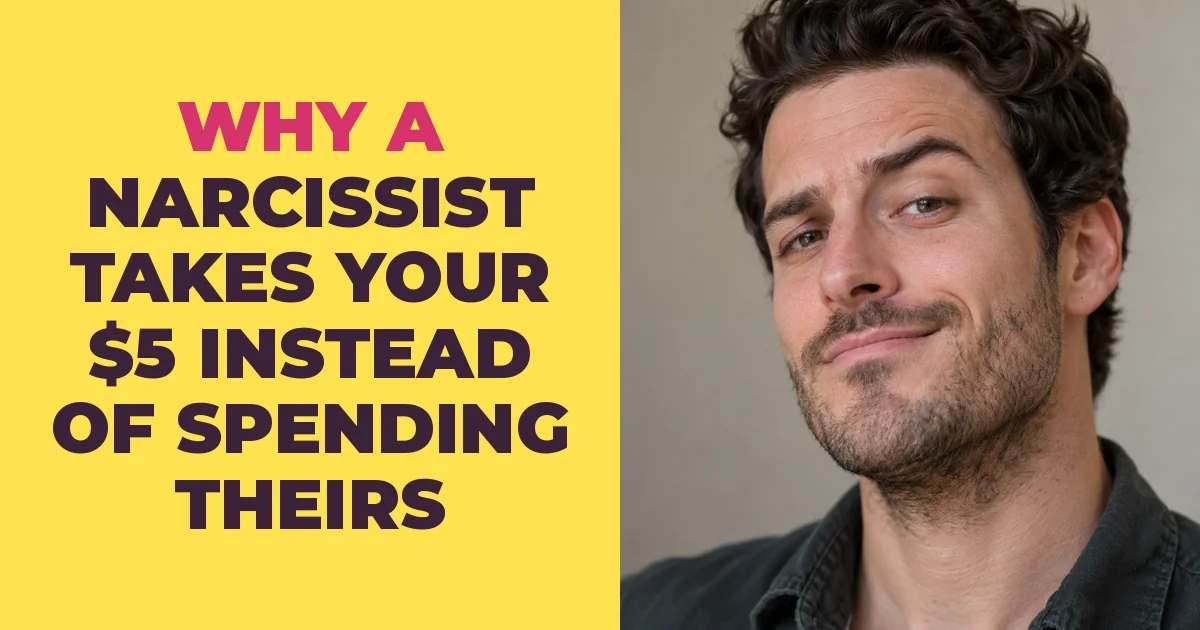
Why a Narcissist Would Sooner Take $5 From You Than Spend Their Own

A narcissist may watch you pay for their coffee and rarely reach for a wallet.
It’s often small. Five dollars for lunch. Ten for petrol. Twenty you’ll “get back Friday.”
Friday never comes.
And the moment you mention it, somehow you’re the petty one. You start wondering if you’re the problem.
You’re not imagining it. The amount was never the point.
Here are 6 reasons a narcissist reaches for your wallet before their own, and what each one tells you.
What the $5 really means
Entitlement is a steady belief that they deserve more than others, and that the rules apply to everyone else.
Research on entitlement describes how it makes ordinary limits feel like insults. So your simple “Can you pay me back?” lands like an attack.
Underneath, a narcissistic pattern often runs on outside confirmation. Other people get treated as sources of what they want, or as threats to it.
Your wallet is just one more source.
#1 Your money feels like theirs
To a narcissist, what’s yours is often quietly up for grabs.
You’re at the till. They pat their pockets, flash that easy smile and say, “Can you grab this? I’ll get you next time.”
Next time never comes.
It’s a sandwich here, a parking fee there, a top-up on the streaming account. Each one too small to make a fuss about, which is exactly how it piles up.
Research on entitlement links it with not paying back money or favours. Settling up is a rule, and in their eyes rules are mostly for other people.
So you give more and receive less. Then one evening you add it up and feel a bit sick.
One quiet habit helps: keep track of what you give. Not to win a fight. Just so your memory has something solid to stand on when you start doubting it.
On paper, the sandwiches and parking fees stop looking like nothing.
#2 Asking for it back starts a war
Asking for your own money back can turn you into the villain in seconds.
You mention, lightly, that they still owe you for Friday’s takeaway. Their face changes.
“Are you seriously keeping score over five dollars? Wow. I didn’t know you were this tight.”
Then come the tears, or the sulk, or the long speech about how hard their week has been and how little you appreciate them.
Psychologists call this DARVO: deny, attack, then reverse victim and offender. Research found it makes the person who raised the problem blame themselves more, which is why it ends the conversation so well.
And it works. You apologise for bringing it up. Next time, you just let it go.
One thing helps. You don’t have to answer every jab they throw back. Name the original issue once, calmly, and come back to it. If they meet it with anger or threats, you can skip it entirely.
Five dollars. That’s all you asked about.
#3 Saying yes becomes automatic
Small asks wrapped in guilt make saying no feel far too expensive.
“Can you just cover me till payday? After everything I’ve done for you?”
There it is.
FOG is a popular name for fear, obligation and guilt used as emotional blackmail. It isn’t a diagnosis. It sits close to what researchers call coercive control, where many small pressures add up over time.
Reminders of old favours. A long, disappointed silence until you hand over your card. Each one makes no feel heavier than yes.
So yes starts coming out before you’ve even thought. You feel responsible for their moods, their bills, their bad week.
Try a pause before you answer. “Let me check and get back to you” is a full sentence.
Their feelings are theirs. Your money is yours.
#4 They’re generous where people can see
A narcissist can be wildly generous, as long as there’s an audience watching.
At the work drinks they buy a round for the whole table. Everyone cheers! Later, in the car home, they ask you to transfer half.
Half of a round you didn’t even order.
Everyone manages the impression they give. Psychologists who study this describe narcissists investing heavily in their public image, because admiration feeds their self-worth.
Spending in front of friends earns applause. Spending quietly on you earns nothing anyone can see.
That gap is what makes it so lonely. Friends tell you how lucky you are. When you try to explain, nobody quite believes you, and you start doubting your own experience.
Trust what happens behind closed doors. That’s the version you actually live with.
Some of that applause was bought with your money.
#5 Your good news makes them sour
Your good fortune can feel like a threat to a narcissist.
You get the raise. You mention it over dinner, glowing. They shrug, “Must be nice,” and then ask if you can cover the electric bill now.
Notice the order. First they shrink it. Then they spend it.
Research links narcissism with envy, especially in its quieter, more vulnerable form. Your success threatens their need to feel superior, so they may shrink it, steal it or spoil it.
A fight picked on your birthday. A sneer at the course you worked so hard to finish.
Slowly, you learn to hide good news. You downplay the bonus. Happy moments start to feel risky.
One way to tell: watch who goes quiet when you win. Then take your wins to the people who are actually glad for you.
That raise was yours before it ever paid their electric bill.
#6 Money turns into a leash
When a narcissist controls the money, they control how far you can go.
It may start with “Let me hold your card, you’re hopeless with money.” Then it’s debt in your name. Loans that never come back.
Researchers call this financial or economic abuse: controlling, exploiting or sabotaging your money and your independence.
Why? Without money of your own, leaving gets harder. That keeps you dependent.
It rarely arrives as one big moment. Many small rules about spending pile up, which is why it’s so hard to point to the day it began.
You hide small purchases. You ask permission for a coffee. Your world gets smaller.
Keeping some money, contacts and records of your own can help. A domestic abuse service can also talk you through money and safety planning.
A coffee shouldn’t need permission.
If this read like your own bank statement, that isn’t stupidity or weakness. You were being fair with someone who wasn’t playing fair.
Start small. Write down one thing you gave this week. Tell one person you trust what you’ve been noticing.
Next time they pat their pockets at the till, you’re allowed to just wait.
If you feel unsafe: in the US, call the National Domestic Violence Hotline at 1-800-799-7233 (thehotline.org). In the UK, call the National Domestic Abuse Helpline on 0808 2000 247. If you are in immediate danger, call your local emergency number.
Sources
- Campbell, W. K., Bonacci, A. M., Shelton, J., Exline, J. J., & Bushman, B. J. (2004). Psychological entitlement: Interpersonal consequences and validation of a self-report measure. Journal of Personality Assessment, 83(1), 29-45.
- American Psychiatric Association. (2022). Diagnostic and Statistical Manual of Mental Disorders (5th ed., text rev.).
- Pincus, A. L., & Lukowitsky, M. R. (2010). Pathological narcissism and narcissistic personality disorder. Annual Review of Clinical Psychology, 6, 421-446.
- Herman, J. L. (1992). Trauma and Recovery. Basic Books.
- Bancroft, L. (2002). Why Does He Do That? Inside the Minds of Angry and Controlling Men. Berkley.
- Freyd, J. J. (1997). Violations of power, adaptive blindness, and betrayal trauma theory. Feminism & Psychology, 7(1), 22-32.
- Harsey, S. J., Zurbriggen, E. L., & Freyd, J. J. (2017). Perpetrator responses to victim confrontation: DARVO and victim self-blame. Journal of Aggression, Maltreatment & Trauma, 26(6), 644-663.
- Bushman, B. J., & Baumeister, R. F. (1998). Threatened egotism, narcissism, self-esteem, and direct and displaced aggression. Journal of Personality and Social Psychology, 75(1), 219-229.
- Forward, S., & Frazier, D. (1997). Emotional Blackmail. HarperCollins.
- Stark, E. (2007). Coercive Control: How Men Entrap Women in Personal Life. Oxford University Press.
- Goffman, E. (1959). The Presentation of Self in Everyday Life. Doubleday.
- Krizan, Z., & Johar, O. (2012). Envy divides the two faces of narcissism. Journal of Personality, 80(5), 1415-1451.
- Postmus, J. L., Plummer, S.-B., McMahon, S., Murshid, N. S., & Kim, M. S. (2012). Understanding economic abuse in the lives of survivors. Journal of Interpersonal Violence, 27(3), 411-430.
Belle Souls articles explain patterns described in psychology research and recovery writing. They are not a diagnosis and not a substitute for help from a qualified professional.
11 Things Narcissists Do That Leave You Awake at Night

It’s 2am. They’re snoring. You’re staring at the ceiling, replaying a conversation that made no sense at all.
Narcissists don’t stop at bedtime.
The row that kicks off as the light goes out. The text that says nothing. The phone glowing on their side of the bed while you lie beside them feeling like a stranger.
If you’ve started to dread the hour you’re meant to rest, that dread has a reason.
Here are 11 things narcissists do that leave you awake at night, why they do them, and what can help you claw back a little of your rest.
#1 The fight starts when the lights go out
A narcissist often saves the fight for the moment you finally close your eyes.
You’re drifting off. Then: “So are we going to talk about what you said at dinner?” You can’t even work out what you said.
Psychologists call this threatened egotism. A small dent in their pride makes them likelier to strike back, aimed squarely at whoever they hold responsible. Even three days late.
So you lie awake, apologising for nothing.
If the anger turns into threats, leave the room. Your safety outranks their point.
#2 A cryptic text, then nothing
Silence can keep you awake longer than any shouting match.
It starts with a 4pm message: “Can we talk later.” Then nothing. They come home, chat to their mum, laugh at the TV and look straight through you.
Being shut out pokes at something deep in all of us: the need to feel included and to count. Research describes the sting as close to physical pain, so giving in comes fast.
So you say sorry at midnight. For nothing.
Tell them once that you’re open to talking. Then go to sleep. Don’t chase or beg.
#3 An early night becomes their drama
The moment your attention turns to yourself, a narcissist may suddenly feel awful.
You’ve run a bath, picked up your book, planned an early night. Then the sighing starts. “Don’t worry about me. I’m a bit rough, but go on, rest.”
Psychologists describe a quiet form of narcissism. It’s prickly and self-pitying, it sulks when ignored, and it shields a fragile ego by feeling hard done by.
Somehow their letdown becomes your fault.
One way to tell? Watch them when someone else gets the spotlight, even for one evening. Notice if the sulk starts right on cue.
#4 Guilt arrives at 1am
Guilt works like a lever, and once it’s pulled, saying no feels impossible.
Midnight, phone buzzing. “I’ve had an awful week and you didn’t even notice.” Or: “I suppose I’ll just sort it myself, like always.”
There’s a popular name for this: FOG, short for fear, obligation and guilt. Tally up old favours, add reminders of everything they’ve sacrificed and a guilt trip, and caving starts to look cheaper than refusing.
So you’re up at 1am, soothing their mood.
Try a pause before you answer. Their feelings are real. They just aren’t your job.
#5 Things go missing, and it’s your fault
Gaslighting chips away at your trust in your own mind until their story is the only one left.
Your keys aren’t in the bowl. Your charger has vanished. When you ask, it’s “You lose everything. Honestly, I worry about you.”
It thrives when one person holds more power and gets to tell the story. Bit by bit, their word beats your own eyes.
So you lie awake, retracing every step.
Write things down when they happen. Paper doesn’t get rewritten.
#6 They accuse you of their own mood
The person who was cold all day is often the one asking why you’re cold.
They sighed through dinner and slammed the cupboard. Then, lights off: “What’s your problem tonight? You’ve had a face on since breakfast.”
This is projection. Pinning the feeling on you means they never have to spot it in the mirror.
Now you’re defending a mood you never had.
State the facts once. When the same accusation keeps coming back, it tells you about them. You don’t owe anyone a midnight trial.
#7 The phone glows on their side
A narcissist may treat love like a game, with the exits always left open.
It buzzes at 11:40. They smile, tilt the screen away, type for ages. “Just work stuff. Go to sleep.”
Researchers tie narcissism to a game-playing style of love. Real closeness gets dodged, and old flames and admirers stay within easy reach.
And you lie there feeling swappable.
Judge commitment by what they keep doing, week after week. Words come cheap at midnight. What do their actions say?
#8 Your sleep doesn’t count
In a narcissist’s world, the rules apply to everyone else, including the ones about sleep.
The big light goes on at midnight. The TV blares. They thrash around, steal the duvet, take a call. You ask for quiet and hear, “It’s my bed too, you know.”
Entitlement turns everyday limits into personal insults. Your perfectly normal request gets heard as an attack.
Ordinary requests sound like attacks to them, so asking for fairness feels like starting a war.
Notice how often you give in before they’ve even pushed. Wanting sleep isn’t a crime!
#9 Being tired gets you no sympathy
Many narcissists can see exactly how you feel and still decide to do nothing.
You say you’ve slept four hours. They shrug. “Everyone’s tired. Stop making a drama of it.” Then they ask what’s for dinner.
Studies found narcissists start out lower on empathy, yet show more of it when nudged to imagine your side. So it looks less like can’t and more like won’t.
So you stop mentioning it. You start doubting yourself.
Take your tiredness to people who actually respond to it. The ones who say, “Go to bed, I’ve got this.”
#10 You lie there replaying the good days
Warmth that shows up at random grips you tighter than warmth you can count on.
Tuesday they brought you tea in bed. Wednesday they wouldn’t look at you. Now it’s 3am and you’re guessing which version comes home tomorrow.
Slot machines run on this exact trick. A reward you can’t predict is the one you keep chasing longest.
One sweet morning buys a week of coldness.
Try judging the relationship by the average week instead of the best day. What does the average look like?
#11 Your body stays on guard all night
When anger can come out of nowhere, your body learns it can never fully clock off.
You can read their mood from the jangle of keys in the door. You hear the car before it’s parked. Every sigh in the dark gets decoded.
That’s hypervigilance. Fear keeps you scanning, and it teaches you to settle the danger by pleasing and going along.
You end up exhausted, and unsure what you even want anymore.
When the alarm fires, notice it and slow everything down. Your body is protecting you. Just a little too well.
If your nights look like this, it isn’t because you’re bad at sleeping. It’s because part of you is still on duty.
Start small. One person outside the relationship who hears the whole story. One note written down. One evening that belongs to you.
You were never the problem keeping you awake.
If you feel unsafe: in the US, call the National Domestic Violence Hotline at 1-800-799-7233 (thehotline.org). In the UK, call the National Domestic Abuse Helpline on 0808 2000 247. If you are in immediate danger, call your local emergency number.
Sources
- Herman, J. L. (1992). Trauma and Recovery. Basic Books.
- Bancroft, L. (2002). Why Does He Do That? Inside the Minds of Angry and Controlling Men. Berkley.
- Sweet, P. L. (2019). The sociology of gaslighting. American Sociological Review, 84(5), 851-875.
- Stern, R. (2007). The Gaslight Effect. Morgan Road Books.
- Bushman, B. J., & Baumeister, R. F. (1998). Threatened egotism, narcissism, self-esteem, and direct and displaced aggression. Journal of Personality and Social Psychology, 75(1), 219-229.
- Williams, K. D. (2009). Ostracism: A temporal need-threat model. Advances in Experimental Social Psychology, 41, 275-314.
- Wink, P. (1991). Two faces of narcissism. Journal of Personality and Social Psychology, 61(4), 590-597.
- Miller, J. D., Lynam, D. R., Hyatt, C. S., & Campbell, W. K. (2017). Controversies in narcissism. Annual Review of Clinical Psychology, 13, 291-315.
- Forward, S., & Frazier, D. (1997). Emotional Blackmail. HarperCollins.
- Baumeister, R. F., Dale, K., & Sommer, K. L. (1998). Freudian defense mechanisms and empirical findings in modern social psychology. Journal of Personality, 66(6), 1081-1124.
- Campbell, W. K., Foster, C. A., & Finkel, E. J. (2002). Does self-love lead to love for others? A story of narcissistic game playing. Journal of Personality and Social Psychology, 83(2), 340-354.
- Campbell, W. K., Bonacci, A. M., Shelton, J., Exline, J. J., & Bushman, B. J. (2004). Psychological entitlement: Interpersonal consequences and validation of a self-report measure. Journal of Personality Assessment, 83(1), 29-45.
- Hepper, E. G., Hart, C. M., & Sedikides, C. (2014). Moving Narcissus: Can narcissists be empathic? Personality and Social Psychology Bulletin, 40(9), 1079-1091.
- Ferster, C. B., & Skinner, B. F. (1957). Schedules of Reinforcement. Appleton-Century-Crofts.
- Dutton, D. G., & Painter, S. (1993). Emotional attachments in abusive relationships: A test of traumatic bonding theory. Violence and Victims, 8(2), 105-120.
- Walker, P. (2013). Complex PTSD: From Surviving to Thriving. Azure Coyote.
Belle Souls articles explain patterns described in psychology research and recovery writing. They are not a diagnosis and not a substitute for help from a qualified professional.
11 Odd Answers Narcissists Give to Dodge a Simple Question

You asked something simple. Where were you? Did you pay that bill? And somehow you’re the one apologising now.
Narcissists can dodge a straight question like it’s an Olympic sport.
They shout, sigh, laugh, sulk. Anything but answer.
After enough of this, you start rehearsing questions in your head. Or not asking at all.
Here are 11 odd answers narcissists give to dodge a simple question, and what each one is really doing to you.
Why a simple question scares them
A question asks for an answer they can’t fully control.
For many narcissists, self-worth leans on how other people see them. So anyone who might poke a hole in that picture starts to look like a threat. Even you, asking what’s for dinner.
Studies of what psychologists call threatened egotism showed narcissists hit back harder after an insult, and they hit back at whoever delivered it.
So they dodge. Creatively.
#1 A basic question starts a war
To a narcissist, a basic question can sound like an accusation.
You ask where the receipt went. Ten seconds later they’re shouting, “Why are you interrogating me? Am I on trial now?”
The fury is far bigger than the question. And it lands on you, because you dented the picture they keep of themselves.
So you start pre-editing. You soften every question, then quietly drop the ones that matter most.
If the yelling tips into threats, walk out of the room. No answer is worth your safety.
#2 Suddenly you’re the forgetful one
Some answers are really an attack on your memory.
You ask if they paid the car insurance. They sigh. “You already asked me this. Twice. Are you okay?”
Psychologists call this gaslighting. You lose faith in your own memory, and their story becomes the official one. And notice what happened. The insurance question just disappeared.
Maybe you’ve started keeping notes to prove what was said. That’s a sane response to a crazy-making loop.
Jot down what happened the same day. Run it past a friend who isn’t in the middle of it. Your memory deserves a witness.
#3 Busy is their favourite answer
“I’m busy” can stall one simple question for months.
You ask when you’re booking the trip. “Not now. After this busy stretch, I promise.” The stretch never ends.
There’s a popular name for this: future faking. It isn’t a diagnosis. It describes big plans dangled so you keep waiting, with nothing behind them. Research ties narcissism to treating love like a game, with commitment kept low.
Meanwhile, your life sits in the waiting room. And somehow you feel pushy for asking.
Look at what has really happened so far, not what’s promised. So, what has?
#4 Asking gets you treated like a fool
Some narcissists answer your question by making you feel small for asking it.
You ask how the new thermostat works. “Seriously? How do you not know this? A child could figure it out.”
Research on narcissistic rivalry fits this. The charm comes first. Later, cutting you down keeps them on top, so your not knowing becomes their chance to look clever.
So you stop asking. You google it alone instead.
Notice who answers you plainly, no lecture attached. That’s what normal sounds like.
#5 Every small ask becomes a debt
To an entitled partner, even a small request can feel like a personal insult.
You ask them to grab milk on the way home. “Oh, I see. Another favour. After everything I already do for you?”
When someone believes they deserve more than everyone else, a tiny request feels like a robbery. Then the guilt kicks in, with a list of old favours, until doing it yourself feels easier.
So you do. You give more and get less.
Keep a quiet tally of what you give. Then look at who’s really doing the favours.
#6 They turn into the victim
Ask the wrong question, and the narcissist may suddenly become the injured one.
You ask why they skipped your sister’s birthday dinner. A minute later, they’re teary. “Why is it always me? Nothing I do is ever good enough for you.”
Psychologists have a name for this move: DARVO. They deny it, go on the attack, and swap roles so they’re the wounded one. Studies show it leaves the person who spoke up blaming herself.
So you end up comforting them. About your question.
Go back to the original issue. Just the dinner.
#7 A laugh replaces the answer
Sometimes the only answer you get is a laugh at your expense.
You ask, quietly, why they told your friends about your panic attacks. They laugh. Then they watch your face and laugh harder.
Researchers have studied what they call everyday sadism: getting a kick out of small cruelties for their own sake. Not every laugh is that. A joke that stops the moment you ask is different.
The tell? Your hurt seems to cheer them up.
No wonder you’ve gone poker-faced. Less reaction, less fun for them.
#8 Your words come back in a mocking voice
Mimicking your voice lets them skip the question and make you the joke.
You ask, “Can we talk about the bills?” They pitch their voice up and whine it back. “Can we talk about the bi-ills?” Then they walk off mid-sentence.
That’s contempt. Researchers who followed couples for years found contempt and shutting down ranked high among the signs a relationship would fall apart.
In your own kitchen, you end up feeling tiny.
You can name it calmly, once. Then see if any respect returns. Does it?
#9 The topic slides back to them
Your question can vanish the second the conversation swings back to them.
You ask if they can drive you to your appointment Thursday. “Thursday? Don’t get me started. My boss…” Twenty minutes later, you know everything about their boss.
It fits a narcissistic pattern. Other people’s feelings barely register unless they touch theirs. Your needs become a nuisance.
You end up feeling like their mirror.
Look at months, not moments. One distracted evening is human. Every evening is an answer.
#10 Your question gets called drama
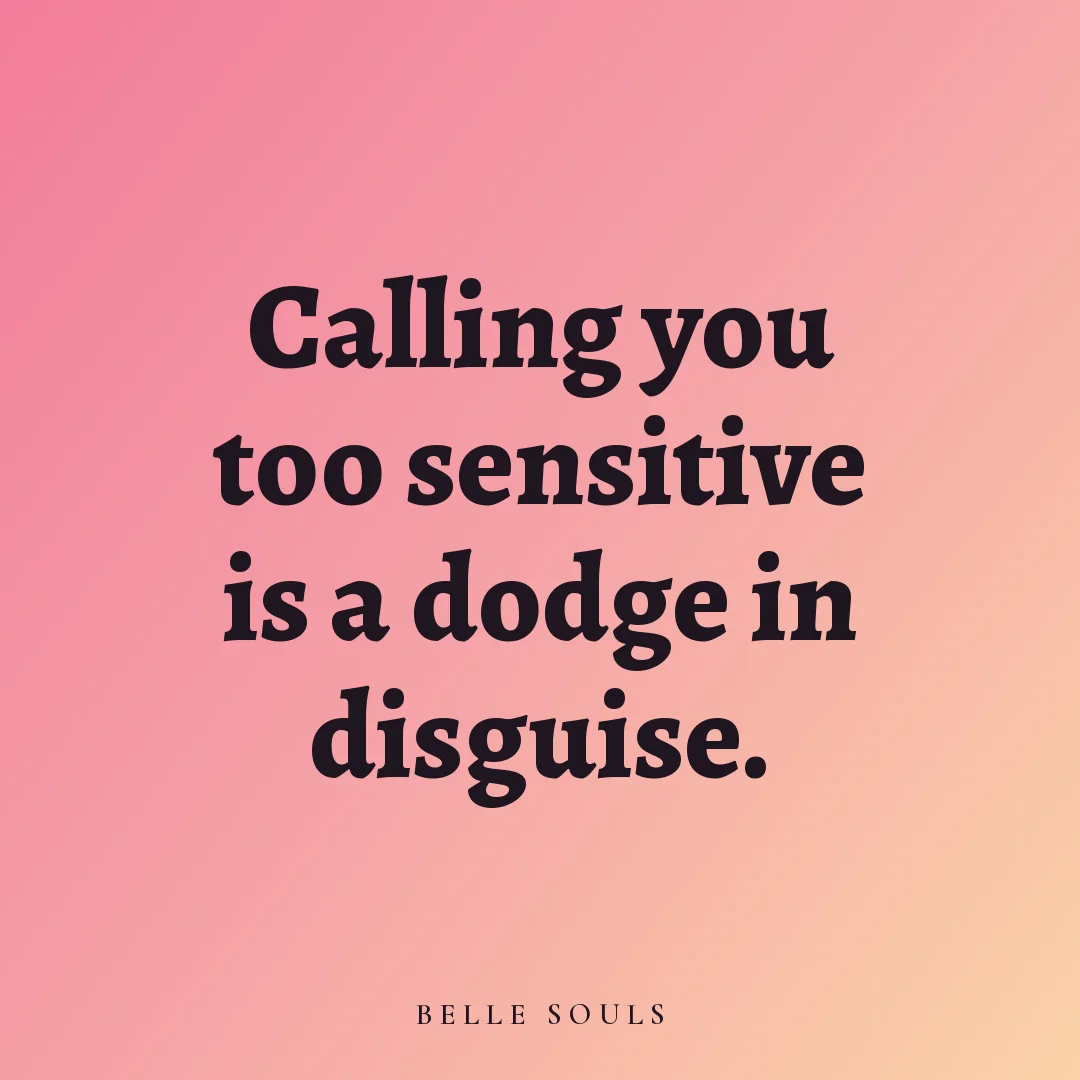
Calling you too sensitive is a dodge in disguise.
You ask, “Did you mean what you said at dinner?” They shrug. “Here we go. You’re way too sensitive, you know that?”
Studies found narcissists start out low on empathy, yet show more of it when nudged to imagine your side. So often they can care. They just choose not to bother.
So you keep things to yourself now. And second-guess every reaction you have.
Bring your feelings to people who actually show up for them. Your feelings were never the problem.
#11 They act like you never spoke
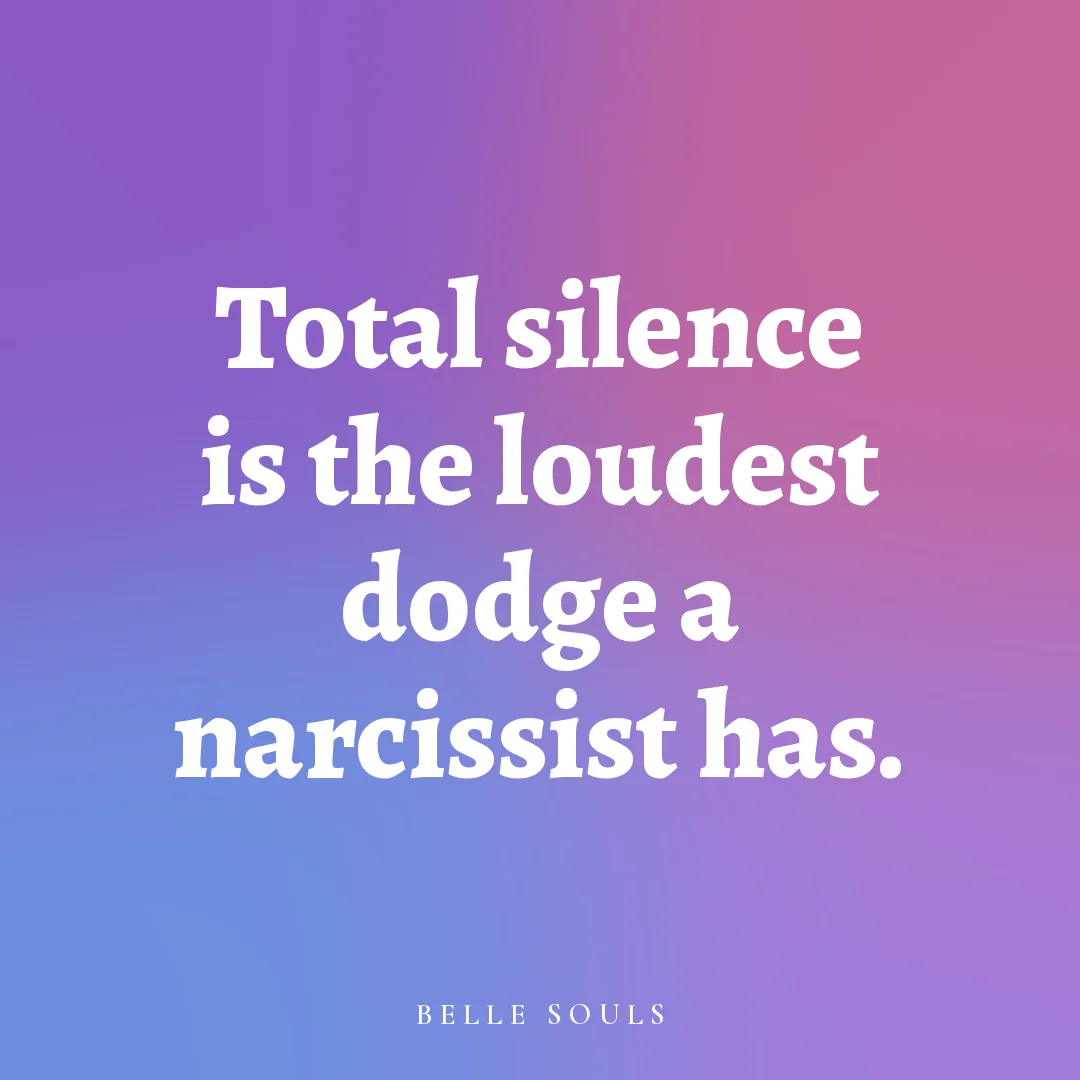
Total silence is the loudest dodge a narcissist has.
You ask a simple question in the car. Nothing. At dinner, they chat with everyone at the table and look straight through you.
Being shut out hits your deep need to feel you count and fit in. It can sting like a real injury, which is why so many give in and say sorry just to make it stop.
Then they come back as if nothing happened.
Tell them once that the door’s open. Then get on with your day. Don’t chase. Your question was fair.
Wanting a straight answer is not too much.
If several of these sounded familiar, trust what you’ve seen over time, not the excuse of the day.
When you’re ready, start with one person outside the relationship who hears the whole story. Isolation helps manipulation work. Connection helps you see clearly again.
If you feel unsafe: in the US, call the National Domestic Violence Hotline at 1-800-799-7233 (thehotline.org). In the UK, call the National Domestic Abuse Helpline on 0808 2000 247. If you are in immediate danger, call your local emergency number.
Sources
- Herman, J. L. (1992). Trauma and Recovery. Basic Books.
- Bancroft, L. (2002). Why Does He Do That? Inside the Minds of Angry and Controlling Men. Berkley.
- American Psychiatric Association. (2022). Diagnostic and Statistical Manual of Mental Disorders (5th ed., text rev.).
- Pincus, A. L., & Lukowitsky, M. R. (2010). Pathological narcissism and narcissistic personality disorder. Annual Review of Clinical Psychology, 6, 421-446.
- Bushman, B. J., & Baumeister, R. F. (1998). Threatened egotism, narcissism, self-esteem, and direct and displaced aggression. Journal of Personality and Social Psychology, 75(1), 219-229.
- Sweet, P. L. (2019). The sociology of gaslighting. American Sociological Review, 84(5), 851-875.
- Stern, R. (2007). The Gaslight Effect. Morgan Road Books.
- Arkes, H. R., & Blumer, C. (1985). The psychology of sunk cost. Organizational Behavior and Human Decision Processes, 35(1), 124-140.
- Campbell, W. K., Foster, C. A., & Finkel, E. J. (2002). Does self-love lead to love for others? A story of narcissistic game playing. Journal of Personality and Social Psychology, 83(2), 340-354.
- Back, M. D., Kufner, A. C. P., Dufner, M., Gerlach, T. M., Rauthmann, J. F., & Denissen, J. J. A. (2013). Narcissistic admiration and rivalry. Journal of Personality and Social Psychology, 105(6), 1013-1037.
- Campbell, W. K., Bonacci, A. M., Shelton, J., Exline, J. J., & Bushman, B. J. (2004). Psychological entitlement: Interpersonal consequences and validation of a self-report measure. Journal of Personality Assessment, 83(1), 29-45.
- Forward, S., & Frazier, D. (1997). Emotional Blackmail. HarperCollins.
- Freyd, J. J. (1997). Violations of power, adaptive blindness, and betrayal trauma theory. Feminism & Psychology, 7(1), 22-32.
- Harsey, S. J., Zurbriggen, E. L., & Freyd, J. J. (2017). Perpetrator responses to victim confrontation: DARVO and victim self-blame. Journal of Aggression, Maltreatment & Trauma, 26(6), 644-663.
- Buckels, E. E., Jones, D. N., & Paulhus, D. L. (2013). Behavioral confirmation of everyday sadism. Psychological Science, 24(11), 2201-2209.
- Gottman, J. M. (1994). What Predicts Divorce? The Relationship Between Marital Processes and Marital Outcomes. Lawrence Erlbaum.
- Hepper, E. G., Hart, C. M., & Sedikides, C. (2014). Moving Narcissus: Can narcissists be empathic? Personality and Social Psychology Bulletin, 40(9), 1079-1091.
- Williams, K. D. (2009). Ostracism: A temporal need-threat model. Advances in Experimental Social Psychology, 41, 275-314.
Belle Souls articles explain patterns described in psychology research and recovery writing. They are not a diagnosis and not a substitute for help from a qualified professional.
You Can Spot a Narcissist on Social Media in Less Than 60 Seconds, Here’s How

Their photos say devoted. Your kitchen says otherwise.
You scroll past the anniversary post with forty hearts under it, and you wonder if you imagined last night.
If you’re doubting your own memory right now, that’s a common effect of this pattern.
A narcissist’s feed is rarely random. If someone needs other people’s approval to feel worth anything, a screen turns into a stage, and the posts give the act away.
Here are 7 signs you can spot in a minute of scrolling, and what each one can point to.
Why the feed matters so much to them
For many narcissists, feeling okay depends on what others reflect back. So the people around them become one of two things: fans or dangers.
Social media gives them an audience that is always there, and admiration is what their sense of worth leans on.
One show-off post proves nothing. Everyone polishes their photos.
Look at what keeps happening over months, and at the distance between the person online and the person who comes home.
#1 The perfect couple only exists online
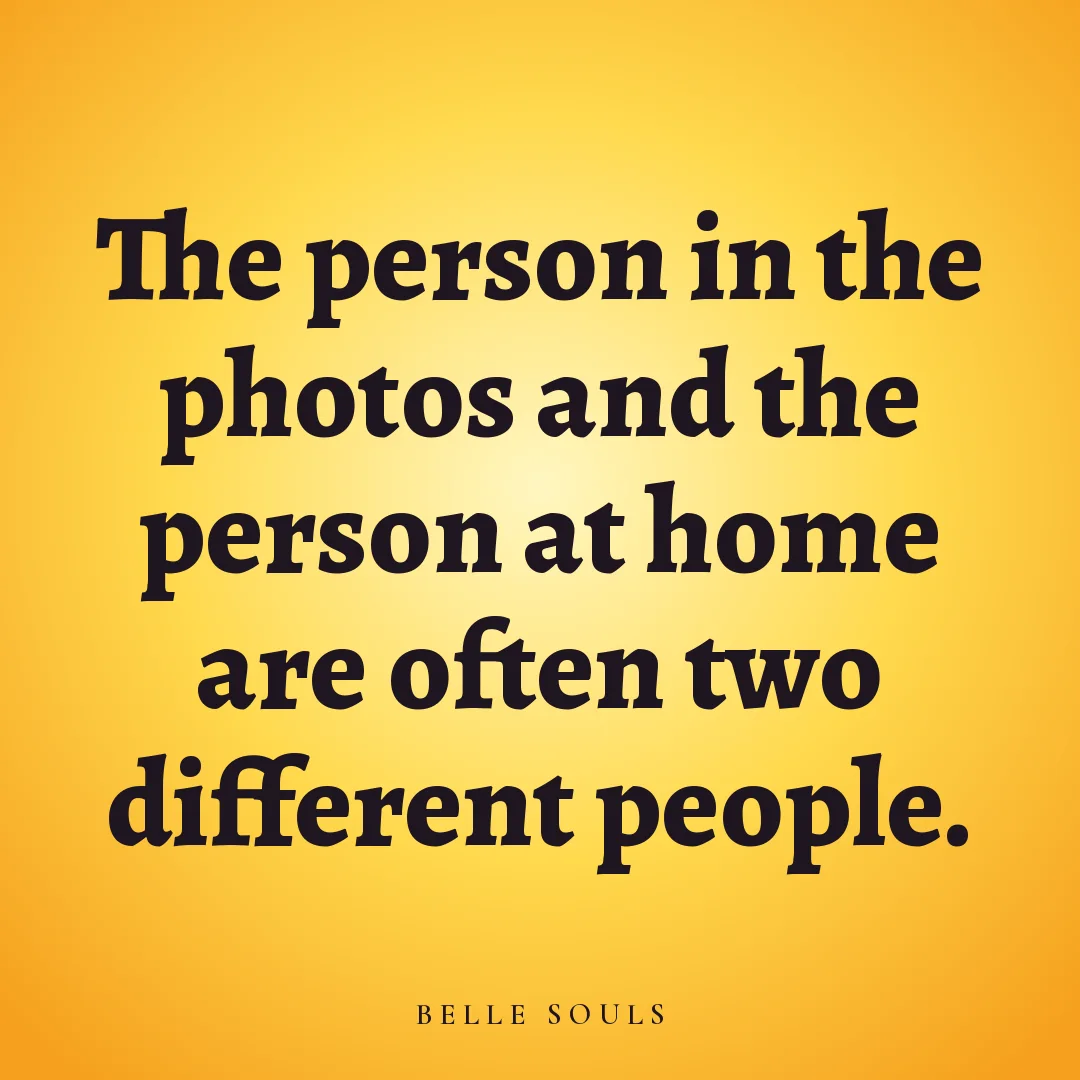
The person in the photos and the person at home are often two different people.
Online, it’s roses, a beach selfie and a caption about being the luckiest partner alive. That same evening, they barely looked up from their phone at dinner.
Same at parties. They charm the whole room, then the car ride home is dead silence.
Then your friends message: “You’re so lucky!”
Psychologists call this impression management. We all tidy up our image a little. A narcissist pours far more into it, because applause props up how they see themselves.
Warm for the crowd, cold for you. When nobody else sees the cold side, your own memory starts to feel shaky.
Believe what happens when the door closes. That’s the real profile.
#2 Their posts keep fishing for applause
For a narcissist, a post is often a request for admiration with a photo attached.
The gym selfie captioned “Ugh, feeling so fat today.” The vague “Some people just don’t know what they’ve got.” The small win at work that somehow grew bigger in every retelling.
Why? Their self-image needs propping up from outside, and every like is one more prop.
And when the likes don’t come?
Watch for the sulk. Research on the quieter, covert side of narcissism describes someone touchy about being overlooked, privately sure they’re better than everyone, and quietly counting every slight. The post gets deleted. The mood at home drops.
Somehow it becomes your fault. “You didn’t even like it.”
They’ll act like they don’t care. They care a lot.
#3 Your good news gets a cold reaction

Your best news often gets their worst reaction.
You post about the new job. Your aunt comments, your old teacher comments, a woman from your running group comments. Their reaction? Nothing. Or a flat “Nice.” six hours later.
Some go further. They pick a fight on your birthday, or copy your idea and act like it was theirs first.
Researchers find envy runs high in narcissism, and higher still in its quiet, vulnerable version. When you shine, it dents their need to come out on top. So your moment gets made smaller, taken over or ruined.
So your good news starts staying in drafts.
Everyone feels a twinge of envy. The red flag is turning it into a weapon, over and over.
Watch who goes silent when things go right for you. Then share your wins with people who cheer.
#4 Their exes keep turning up in the comments
A narcissist often keeps old flames close enough to reach with one tap.
The ex who still gets a heart on every photo. The coworker whose selfies get a fire emoji within minutes. Then, mid-argument: “At least she never complained about this.”
Studies connect narcissism to treating love like a game, with doors left open, closeness kept at arm’s length and commitment kept low.
Psychologists also describe triangulation, dragging an outsider into something between two people so jealousy does the work.
So you end up in a race against people who shouldn’t even be in the picture.
You feel replaceable. You’re chasing attention you once got for free.
Needing time before committing is fine. Leaving you guessing on purpose is the sign.
And you never signed up for a contest over your own partner.
#5 Online for everyone except you
Silence on a screen can still be a punishment.
After a disagreement, your message sits on “seen.” Meanwhile they’re posting stories, joking in the group chat and answering everybody in the thread except you.
Two days later, a meme. Like the fight never existed.
Researchers who study ostracism explain why this cuts so deep. Being shut out hits your need to belong and to count for something, and the sting can register like a bodily hurt.
No wonder you end up saying sorry just to make the quiet stop, even when you did nothing wrong.
A partner who says “I need an hour to cool off” and then comes back is being healthy. Going silent to make you pay is something else.
Tell them once the door’s open for a talk. Then get on with your day. No chasing.
#6 The vague post is about you
A vague post about “toxic people” can be a smear aimed straight at you.
“Some people show their true colours when you need them most.” Posted the night after a fight. Twelve sad-face reactions from people who have no idea what happened.
Nobody is named. Everybody knows.
Psychologists call this relational aggression. Instead of hitting your body, it goes after your name and your friendships with gossip, rumours and being left out. No bruises, so nothing to show anyone.
Suddenly you’re explaining yourself to everyone, and the people you lean on start to drift right when it hurts most.
Telling their honest side is fair. Bending the story so you end up alone is not.
If it spills into your job or custody, keep records. Otherwise, let how you act, day after day, do the talking. It outlasts any caption.
#7 They watch everything you post
Constant watching of your phone and your profile is a form of control.
They know you liked a coworker’s photo before you’ve even put the kettle on. “Who’s he?” They ask why you were online at 11pm, and want your password “because couples share.”
Then the rules. Not that dress. Not him.
Psychologists call this coercive control: lots of little rules and penalties that slowly eat away at your freedom. Often there’s no hitting at all, which makes it hard to name a single big moment.
Your life shrinks. You start asking permission to post a photo of your lunch.
Couples deciding on shared rules together is normal. One person making the rules and punishing each slip is something else.
Hold on to some money and contacts that are just yours. A domestic abuse service can help you plan for safety. Your privacy is yours.
You don’t need sixty seconds of proof to trust what you live through every day.
The feed is their story. Your memory of last night is yours.
If one of these hit hard, tell the whole story to one person you trust. Getting help doesn’t mean you’re weak, or that the relationship has to end today.
If you feel unsafe: in the US, call the National Domestic Violence Hotline at 1-800-799-7233 (thehotline.org). In the UK, call the National Domestic Abuse Helpline on 0808 2000 247. If you are in immediate danger, call your local emergency number.
Sources
- American Psychiatric Association. (2022). Diagnostic and Statistical Manual of Mental Disorders (5th ed., text rev.).
- Pincus, A. L., & Lukowitsky, M. R. (2010). Pathological narcissism and narcissistic personality disorder. Annual Review of Clinical Psychology, 6, 421-446.
- Goffman, E. (1959). The Presentation of Self in Everyday Life. Doubleday.
- Herman, J. L. (1992). Trauma and Recovery. Basic Books.
- Bancroft, L. (2002). Why Does He Do That? Inside the Minds of Angry and Controlling Men. Berkley.
- Wink, P. (1991). Two faces of narcissism. Journal of Personality and Social Psychology, 61(4), 590-597.
- Miller, J. D., Lynam, D. R., Hyatt, C. S., & Campbell, W. K. (2017). Controversies in narcissism. Annual Review of Clinical Psychology, 13, 291-315.
- Krizan, Z., & Johar, O. (2012). Envy divides the two faces of narcissism. Journal of Personality, 80(5), 1415-1451.
- Campbell, W. K., Foster, C. A., & Finkel, E. J. (2002). Does self-love lead to love for others? A story of narcissistic game playing. Journal of Personality and Social Psychology, 83(2), 340-354.
- Bowen, M. (1978). Family Therapy in Clinical Practice. Jason Aronson.
- Williams, K. D. (2009). Ostracism: A temporal need-threat model. Advances in Experimental Social Psychology, 41, 275-314.
- Crick, N. R., & Grotpeter, J. K. (1995). Relational aggression, gender, and social-psychological adjustment. Child Development, 66(3), 710-722.
- Stark, E. (2007). Coercive Control: How Men Entrap Women in Personal Life. Oxford University Press.
Belle Souls articles explain patterns described in psychology research and recovery writing. They are not a diagnosis and not a substitute for help from a qualified professional.
13 Moments That Prove a Narcissist Should Not Be a Parent

You’re an adult now, and one text from your parent can still make your stomach drop.
A narcissist can raise a child. That doesn’t mean they parent one.
You were fed, dressed and sent to school. But somewhere along the way, you learned that your feelings came second and theirs came first.
Maybe you’ve told yourself it wasn’t that bad.
Here are 13 moments that prove a narcissist should not be a parent, and why none of it was your fault.
#1 You were there to reflect them
To a narcissistic parent, you were often less a person than a mirror.
Your grades, your hair, your manners. All of it was about how they looked. “Don’t embarrass me” always came before “Are you okay?”
Why? A narcissist’s sense of worth leans on outside approval. So a child gets treated as a source of praise, or as a threat to it.
Your needs felt like a nuisance because, to them, they were.
You were never just their mirror.
#2 Love had to be earned
In a narcissist’s house, affection often arrived more like a prize than a promise.
Bring home the A and you got a hug. Bring home a B and the kitchen went cold. “I’ll help you, but don’t forget who’s paying.”
Psychologists call this intermittent reinforcement. Warmth that comes unpredictably hooks you harder than steady warmth, the same pull that keeps people at slot machines.
So you worked harder for less. And the good days made the bad ones feel bearable.
Did you ever get to stop auditioning?
#3 Your trophies became their trophies
Your talent became theirs the minute someone else noticed it.
The recital ends and they’re holding court in the foyer. “She gets it from me, of course.” You’re standing beside them, holding the flowers someone gave you.
A narcissistic parent may exaggerate their own talents and take credit for what others did. Entitlement tells them the spotlight is theirs, even at your recital.
You put in the hours. They took the bow.
You gave more and got less. Sounds familiar?
#4 Guilt ran the whole house

Guilt was the leash, and a narcissistic parent knew exactly how hard to pull.
“After everything I’ve done for you.” “Fine, go to the party. I’ll just sit here on my own.”
There’s a popular name for this: FOG, short for fear, obligation and guilt.
It’s emotional blackmail. Saying no starts to cost more than giving in, which ties it to the wider pattern researchers call coercive control.
Yes became automatic. Their moods became your job.
Try a pause before you answer. Their feelings are theirs to carry.
#5 One child shone, one took the blame
In many narcissistic families, one child can do no wrong and another can do no right.
Your brother breaks the vase: “an accident.” You sigh: “typical of you.” His certificates go on the fridge. Yours go in a drawer.
Family researchers describe these fixed roles as a way for a controlling parent to manage the family’s image and tension.
Golden child or scapegoat, you both paid. One got shame, the other got pressure to be perfect. And you were set against each other.
That role was handed to you. It was never who you are.
#6 Good news made them go sour
A narcissistic parent can treat your success as their loss.
You call to say you got the job. A pause. “Well, don’t let it go to your head.” Then twenty minutes about their back.
Envy is common in narcissism. Your win threatens their need to feel on top, so they shrink it, steal it or spoil it.
That’s why you started keeping good news to yourself. Happy moments began to feel risky.
Notice who goes quiet when you win. Then tell the people who cheer.
#7 Your privacy was never really yours
In an enmeshed family, a closed door feels like a betrayal.
They read your diary at fourteen. At thirty, they still want your passwords. Your partner gets treated like a rival, and “Why didn’t you ask me first?” follows every choice.
Research on families calls this enmeshment. Closeness gets used as control, so any separation feels dangerous to everyone.
No wonder it’s hard to tell where you end and they begin.
Start small. Make one choice this week without asking first.
#8 You were raising your own parent
You were made responsible for a grown-up’s feelings while you still needed someone for yours.
Late nights on the edge of their bed. “You’re the only one who understands me.” Packed lunches for your little sister. Secrets no ten-year-old should keep.
This is called parentification. You became the confidant or the caretaker, and you learned your own needs came last.
And everyone said how mature you were.
Now asking for help feels strange, almost wrong. That’s not a flaw. It’s training.
#9 They laughed when you flinched

Some parents enjoy your discomfort, and the joke tends to land where it hurts most.
Christmas dinner, the whole family listening. “Tell them about your bedwetting phase!” Everyone laughs. You go hot and quiet. They smile.
Researchers call this everyday sadism: small, routine cruelty that feels rewarding in itself. It sits next to narcissism in what’s known as the Dark Tetrad.
Teasing that stops when you ask is play. Teasing that grows when you flinch is something else.
You weren’t too sensitive. You were the target.
#10 Silence was the punishment
A narcissistic parent can make you vanish without leaving the room.
They answer your sister. They chat to the dog. You ask what’s for dinner and get nothing. Three days later they’re humming at the stove like it never happened.
Being ignored threatens your basic need to belong and to matter. Research on ostracism suggests it can hurt like physical pain, which is why you gave in.
You’d apologise for anything just to be seen again.
Wanting to exist in your own home was never needy.
#11 Everyone else got the nice version
Outside the house, a narcissistic parent was often the nicest person in the room.
Teachers loved them. Neighbours waved. Your friends said, “Your mum is so cool!” Then the car door shut and the smile went with it.
Narcissists tend to invest heavily in their public image, because admiration feeds their self-worth.
So nobody believed you. And you started doubting what you’d lived through.
Trust what happened behind closed doors. You were there.
#12 They rewrote what happened
A narcissistic parent may rewrite your childhood so well that you stop trusting your own memory.
“That never happened.” “You’re making things up again.” “You’re too sensitive, you always were.”
Psychologists call this gaslighting. It works best where power is unequal, and a parent holds a lot of power over a small child.
Maybe you keep notes now, just to prove your own life to yourself.
Write it down when it happens. Check it with someone outside the family. Your memory is allowed to count.
#13 Their moods ran your childhood
You learned to read the room before you could read.
The sound of keys in the door. The way the car door slammed. You could tell from the hallway whether tonight was safe.
Research on threatened egotism found that narcissists respond to insults with more aggression, aimed at whoever caused it. A small comment could set off a storm.
So your body stayed on alert. You said yes before thinking, and sorry before you knew what for.
That alarm kept you safe back then. It can learn to rest.
None of these moments were a verdict on you. They were a description of them.
You can’t rewrite the childhood you had. But you can choose what you carry forward, one small, safe no at a time.
Start with one person who believes you. That’s enough for today.
If you feel unsafe: in the US, call the National Domestic Violence Hotline at 1-800-799-7233 (thehotline.org). In the UK, call the National Domestic Abuse Helpline on 0808 2000 247. If you are in immediate danger, call your local emergency number.
Sources
- Gibson, L. C. (2015). Adult Children of Emotionally Immature Parents. New Harbinger.
- Walker, P. (2013). Complex PTSD: From Surviving to Thriving. Azure Coyote.
- Herman, J. L. (1992). Trauma and Recovery. Basic Books.
- Bancroft, L. (2002). Why Does He Do That? Inside the Minds of Angry and Controlling Men. Berkley.
- American Psychiatric Association. (2022). Diagnostic and Statistical Manual of Mental Disorders (5th ed., text rev.).
- Pincus, A. L., & Lukowitsky, M. R. (2010). Pathological narcissism and narcissistic personality disorder. Annual Review of Clinical Psychology, 6, 421-446.
- Ferster, C. B., & Skinner, B. F. (1957). Schedules of Reinforcement. Appleton-Century-Crofts.
- Dutton, D. G., & Painter, S. (1993). Emotional attachments in abusive relationships: A test of traumatic bonding theory. Violence and Victims, 8(2), 105-120.
- Campbell, W. K., Bonacci, A. M., Shelton, J., Exline, J. J., & Bushman, B. J. (2004). Psychological entitlement: Interpersonal consequences and validation of a self-report measure. Journal of Personality Assessment, 83(1), 29-45.
- Forward, S., & Frazier, D. (1997). Emotional Blackmail. HarperCollins.
- Stark, E. (2007). Coercive Control: How Men Entrap Women in Personal Life. Oxford University Press.
- Bowen, M. (1978). Family Therapy in Clinical Practice. Jason Aronson.
- McBride, K. (2008). Will I Ever Be Good Enough? Healing the Daughters of Narcissistic Mothers. Free Press.
- Krizan, Z., & Johar, O. (2012). Envy divides the two faces of narcissism. Journal of Personality, 80(5), 1415-1451.
- Back, M. D., Kufner, A. C. P., Dufner, M., Gerlach, T. M., Rauthmann, J. F., & Denissen, J. J. A. (2013). Narcissistic admiration and rivalry. Journal of Personality and Social Psychology, 105(6), 1013-1037.
- Minuchin, S. (1974). Families and Family Therapy. Harvard University Press.
- Jurkovic, G. J. (1997). Lost Childhoods: The Plight of the Parentified Child. Brunner/Mazel.
- Buckels, E. E., Jones, D. N., & Paulhus, D. L. (2013). Behavioral confirmation of everyday sadism. Psychological Science, 24(11), 2201-2209.
- Williams, K. D. (2009). Ostracism: A temporal need-threat model. Advances in Experimental Social Psychology, 41, 275-314.
- Goffman, E. (1959). The Presentation of Self in Everyday Life. Doubleday.
- Sweet, P. L. (2019). The sociology of gaslighting. American Sociological Review, 84(5), 851-875.
- Stern, R. (2007). The Gaslight Effect. Morgan Road Books.
- Bushman, B. J., & Baumeister, R. F. (1998). Threatened egotism, narcissism, self-esteem, and direct and displaced aggression. Journal of Personality and Social Psychology, 75(1), 219-229.
Belle Souls articles explain patterns described in psychology research and recovery writing. They are not a diagnosis and not a substitute for help from a qualified professional.
11 Things Narcissists Pass Off as Love That Are Really Abuse

The narcissist rarely calls it control. They call it love.
They check your phone because they worry. They pick at your clothes because they want you to look your best. They go quiet for three days because, apparently, you hurt them.
And somehow you’re the one saying sorry.
Each one comes with a loving reason. That’s what makes them so hard to call out.
Here are 11 things narcissists pass off as love that are really abuse, and how to tell the difference.
#1 Jealousy gets sold as proof they care
Checking your phone and your location is control, however sweetly it’s said.
“I just worry about you.” So they want your passcode. They ask who texted. They sulk when you see your sister without them, and slowly you stop going.
Coercive control rarely starts with one big incident. Many small rules and punishments add up, until you’re asking permission for ordinary things.
Your world gets smaller one ‘harmless’ request at a time.
Keep some money and some contacts that are only yours. Quietly.
#2 Cruelty dressed up as honesty
Some cruelty is aimed exactly where it hurts, then called a joke.
At dinner with friends, they bring up your weight, the exam you failed, the thing you told them in confidence. You flinch. They laugh. “God, you’re so sensitive. I’m just being honest.”
Research on what’s called everyday sadism describes people who find small cruelties rewarding in themselves. Not a means to an end. The point.
Playful teasing stops when you ask. This doesn’t.
Next time you’re hurt, notice their face. Do they look sorry, or pleased?
#3 Too much, too soon feels like fate

Love that arrives at full speed is built to bond you fast.
Week two, and they’re planning holidays. Morning texts, midnight texts, flowers at your work. “I’ve never felt like this. You’re my soulmate.”
Love bombing creates a strong bond before you’ve seen how they act under stress. Later, that dazzling start becomes the memory you keep chasing.
Then you blame yourself for the change.
Watch how they react to your ‘not yet’. Enthusiasm can wait. Pressure can’t.
#4 Real life always starts after this busy patch
A promise about next year can keep you waiting through this one.
They’re working late again. “It’s for us. Once this project’s done, we’ll book the trip, look at houses, do it properly.” The project ends. Another one starts.
There’s a popular name for this: future faking. It isn’t a formal diagnosis. It describes big promises that keep you invested in a shared future, so leaving starts to feel like losing it.
Judge by what has actually happened.
Count the trips you’ve taken. Not the ones you’ve planned.
#5 Taking over the money to ‘protect’ you
When they hold all the money, they also hold the door shut.
“Let me handle the bills, babe. You’ve got enough on.” Then your card lives in their wallet, and a new pair of tights needs explaining.
Financial abuse works quietly. Without money of your own, leaving gets harder, and that keeps you dependent.
Couples budgeting together is normal. One person holding every key isn’t.
If you’re hiding a coffee receipt, ask yourself why.
#6 Your choices become their punchline
An eye-roll can say more about how they see you than any ‘I love you’.
You mention the course you want to take. They do your voice back at you. “Oh, look at you, Miss Career Woman.” Everyone laughs. Except you.
Long-term studies of couples found contempt and stonewalling among the strongest predictors of a relationship breaking down. Mockery is not a love language.
So you start keeping your plans to yourself.
Feeling small in your own home isn’t you being oversensitive.
#7 Guilt trips that look like devotion
Guilt can be used as a lever, and a narcissist may pull it hard.
You want one evening with your friends. “After everything I’ve done for you? Fine. Go. I’ll just sit here on my own.” You stay home.
There’s a popular term for this: FOG, short for fear, obligation and guilt. It isn’t a clinical label. It describes emotional blackmail that makes saying no feel costlier than giving in, one more small lever of control.
Soon yes comes out automatically.
Pause before you answer. Their disappointment is theirs to carry.
#8 Silence they call ‘needing space’
Being shut out by the person you love can hurt like physical pain.
Three days. They chat to the dog, the neighbour, their mum on speaker. Not you. Then one morning they’re whistling over the kettle as if nothing happened.
Being ignored hits your basic need to belong and to matter. That’s why you end up apologising just to make it stop.
Cooling off, and saying so, is healthy. Punishment isn’t.
Say once that you’re open to talking. Then go live your day.
#9 Their sweetest side is for an audience
The most loving version of them often shows up only when someone’s watching.
At the party they hold your hand, top up your drink, and tell everyone how they knew on the first night. Your friend whispers, “You’re so lucky.” In the car home, silence. Or worse.
Many narcissists invest heavily in their public image, because admiration feeds their sense of worth. Your relationship is part of the display.
So nobody believes you.
Trust what happens behind closed doors. That’s the real relationship.
#10 Your hurt somehow turns into theirs
Raise a problem, and somehow you end the night apologising to them.
You finally say it: “You humiliated me today.” Ten seconds later it’s “I never said that. How dare you. Do you know how hard my day was?” Then the tears. You end up comforting them.
Psychologists call this DARVO: deny, attack, reverse victim and offender. Research found it makes the person raising the issue blame themselves more, which is how it shuts the conversation down so fast.
Name the original issue and go back to it. Don’t argue every counter-attack. Your hurt still counts.
#11 The make-up feels like proof of love
Kindness that comes unpredictably hooks you harder than kindness that comes every day.
After the screaming, breakfast in bed. The long hug. “I don’t know what I’d do without you.” And for one day, it’s the person you fell for.
Rewards on an unpredictable schedule are the hardest to walk away from, the same principle that keeps people at slot machines. Research on trauma bonding describes how cycles of harm and kindness can build a bond stronger than calm love.
That pull is a known reaction. Not weakness.
Count the good days and the bad ones this month. Which column is longer?
You weren’t foolish for believing it was love. It was dressed up to look exactly like it.
You don’t have to untangle this alone. Talk to someone outside the relationship, ideally a person who has seen how they act both in public and at home.
And when you’re unsure what’s real, look at the car ride home. Not the party.
If you feel unsafe: in the US, call the National Domestic Violence Hotline at 1-800-799-7233 (thehotline.org). In the UK, call the National Domestic Abuse Helpline on 0808 2000 247. If you are in immediate danger, call your local emergency number.
Sources
- Dutton, D. G., & Painter, S. (1993). Emotional attachments in abusive relationships: A test of traumatic bonding theory. Violence and Victims, 8(2), 105-120.
- Goffman, E. (1959). The Presentation of Self in Everyday Life. Doubleday.
- Stark, E. (2007). Coercive Control: How Men Entrap Women in Personal Life. Oxford University Press.
- Buckels, E. E., Jones, D. N., & Paulhus, D. L. (2013). Behavioral confirmation of everyday sadism. Psychological Science, 24(11), 2201-2209.
- Strutzenberg, C. C., Wiersma-Mosley, J. D., Jozkowski, K. N., & Becnel, J. N. (2017). Love-bombing: A narcissistic approach to relationship formation. Discovery, The Student Journal of Dale Bumpers College of Agricultural, Food and Life Sciences, 18, 81-89.
- Arkes, H. R., & Blumer, C. (1985). The psychology of sunk cost. Organizational Behavior and Human Decision Processes, 35(1), 124-140.
- Postmus, J. L., Plummer, S.-B., McMahon, S., Murshid, N. S., & Kim, M. S. (2012). Understanding economic abuse in the lives of survivors. Journal of Interpersonal Violence, 27(3), 411-430.
- Gottman, J. M. (1994). What Predicts Divorce? The Relationship Between Marital Processes and Marital Outcomes. Lawrence Erlbaum.
- Forward, S., & Frazier, D. (1997). Emotional Blackmail. HarperCollins.
- Williams, K. D. (2009). Ostracism: A temporal need-threat model. Advances in Experimental Social Psychology, 41, 275-314.
- Freyd, J. J. (1997). Violations of power, adaptive blindness, and betrayal trauma theory. Feminism & Psychology, 7(1), 22-32.
- Harsey, S. J., Zurbriggen, E. L., & Freyd, J. J. (2017). Perpetrator responses to victim confrontation: DARVO and victim self-blame. Journal of Aggression, Maltreatment & Trauma, 26(6), 644-663.
- Ferster, C. B., & Skinner, B. F. (1957). Schedules of Reinforcement. Appleton-Century-Crofts.
Belle Souls articles explain patterns described in psychology research and recovery writing. They are not a diagnosis and not a substitute for help from a qualified professional.