
Month: October 2026
Why Narcissists Spoil Special Days Before They Even Start

The narcissist doesn’t wait for your special day to ruin it.
They start days before. A cold shoulder on Tuesday. A snide comment about the cake on Thursday. By Saturday, you’re too tense to enjoy a single minute.
Birthdays, weddings, graduations, the promotion dinner. It keeps happening, and you keep wondering if you’re imagining it.
You’re not. There’s a pattern here.
Here are 7 reasons narcissists spoil your special days before they even start, and what’s really going on underneath.
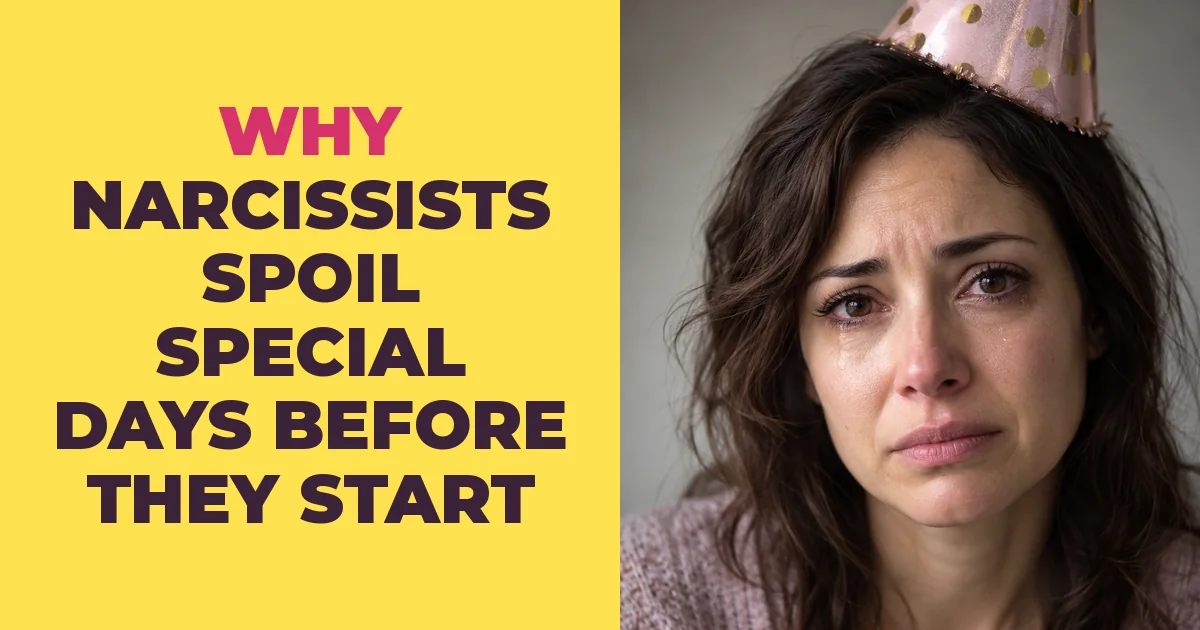
Why your day feels like a threat
Many narcissists lean on other people to tell them they’re worth something. Attention, praise, being the most important person in the room.
Your special day hands all of that to you. For a few hours, everyone is looking at someone else.
That stings. Someone else doing well pokes at their need to sit above everyone. So your moment gets made smaller, grabbed, or wrecked.
Preferably before it begins.
#1 The fight lands on your big day
A fight on the eve of your big day is rarely just bad luck.
You’re ironing the dress. They’re slamming cupboards. Then it comes: “You’ve been so selfish lately, it’s all about you this week.”
The dishwasher. Their mother. A text you sent last Tuesday.
Envy turns up a lot in narcissism, and it tends to look like bitterness when things go well for you. Your big day is things going well, with a date on the calendar.
So they get in early. A row the night before means you walk into your own celebration shaky, red-eyed and replaying every word they said.
The photos look fine. You don’t feel fine.
Look back at your last three birthdays. Notice anything?
#2 Your spotlight is their problem
A narcissist may need the spotlight so badly that your moment feels like theft.
There’s a loud, show-off style of narcissism and a quiet, touchy one. Plenty of narcissists flip between the two. The loud kind takes over. The quiet kind sulks.
The loud version gives a speech at your engagement party that’s mostly about them. Or drops their own big news right over your cake.
The quiet version stands in the corner looking wounded. Later, in the car: “Nobody even talked to me tonight.”
Underneath, both are guarding a self-image that breaks easily. One puffs up. The other nurses a grudge.
Either way, the evening ends with you managing their mood instead of enjoying yours. And somehow you’re held responsible for how let down they feel.
Your engagement party, and you spent it holding their coat and their mood.
#3 Your joy counts as their loss
To a narcissist, your win can feel like their personal loss.
Psychologists call this narcissistic rivalry. Anything you gain registers as something taken from them, so they compete instead of cheering.
You tell them about the promotion. They nod, then mention their boss says they’re “basically running the place.”
You plan a graduation lunch. They pick at the menu, the venue, the guest list, until the whole thing feels small.
At the start, the charm does the work. Further in, the putting-down side tends to win. That’s why the partner who once threw you a surprise party now seems to resent the party.
Little by little, telling them good news starts to feel unsafe.
So take your news to the friends who light up for it. Watch their faces. That’s what happy for you looks like!
#4 You spend the week reading their mood
The days before a big event can turn into a whole week of tiptoeing.
You hear the keys in the door and already know what kind of evening it’ll be. You check their face before you dare mention the dinner booking.
“Fine. Whatever you want.” Said in that tone.
When anger could flare at any moment, your body learns to stay switched on. You watch for trouble, then smooth it over by agreeing with everything.
So you cut the guest list. You skip the friend they don’t like. You say yes before you’ve even thought about it.
By the day itself, you’re worn out. What did you even want? You can’t quite recall.
When that inner alarm goes off, slow down before you answer. Your yes can wait ten seconds.
#5 Then the silence starts
The silent treatment before a special day is punishment dressed up as calm.
It’s the day before your birthday. They answer your mother’s call warmly, chat with the neighbour over the fence, and don’t say one word to you.
No reason given. Just a wall.
Being shut out hits a deep need to feel you belong and count. It can ache in your body, not just your head, and that ache is what makes you cave.
So you say sorry for something you can’t even name, just to end it. By evening, they’re back as if nothing happened.
What helps? Tell them once, calmly, that you’re happy to talk whenever they are. Then get on with your day.
Don’t chase. Don’t plead. It’s still your birthday tomorrow.
#6 Somehow it ends up your fault
Mention the cold week before your dinner, and suddenly you’re the one causing trouble.
You say, quietly, “You’ve barely spoken to me all week, and the dinner’s on Saturday.”
Then it begins. “I never did that. How dare you accuse me when I’m the one sorting out everything?”
Next comes a list of everything wrong with you. Then the tears or the sulking, until you’re the one handing over tissues.
Researchers have a name for this: DARVO. Deny, attack, then flip who’s the victim and who did the harm. Studies suggest it leaves the person who spoke up blaming herself more.
That’s exactly why it shuts things down so well. The talk is over, and two days before your own dinner, you’re saying sorry for mentioning it.
One way through: bring it back to the thing that actually happened. You don’t have to answer every accusation they throw.
Noticing it doesn’t make you the problem.
#7 You start planning smaller days
After enough spoiled birthdays, you start shrinking the day before they can.
No party this year. Just dinner. Actually, maybe just takeaway at home.
Less to wreck.
Envy in narcissism often shows up as shrinking, stealing or spoiling someone else’s good fortune. A big plan is a big target. So you hand them a smaller one.
Even then, they may find a way. You mention a quiet lunch, and suddenly they’ve booked their own night out with friends for the same day.
A flash of envy now and then is human. The sign is acting on it, year after year, until your celebrations fit inside their comfort zone.
So what would this year look like if you planned it the size you actually want?
Wanting a good birthday is not too much to ask.
If your special days keep cracking right before they start, you’re looking at a pattern. And a pattern is something you can see coming.
Next time, keep one small piece of the day just for you. A coffee with a friend. A walk at sunrise. Something they can’t touch.
What Narcissists Do to You Just Before They Cut You Out for Good

Narcissists rarely announce the end. They let you feel it first.
The texts get shorter. The eye contact stops. You catch yourself replaying every conversation, hunting for the thing you did wrong.
Then one day the door closes, and it looks like it came out of nowhere.
It didn’t.
The weeks before a narcissist cuts you out often follow a pattern. Once you see it, it stops looking like your fault.
Here are 7 things narcissists do to you just before they cut you out for good.
Why the ending follows a script
There’s a popular name for the arc many people describe: idealise, devalue, discard. First the pedestal. Then the criticism. Then you’re dropped or replaced.
It isn’t a diagnosis. But research on narcissistic admiration and rivalry helps explain it.
In the beginning, they chase your admiration with charm. Later, guarding their status matters more, and the put-downs and coldness move in. It’s why the first months felt like a dream and the last ones feel like a trial.
Every relationship cools after the early high. This pattern ends in contempt and replacement.
#1 The silence starts without a reason
The silent treatment is punishment dressed up as a bad mood.
They answer everyone at dinner but you. They leave the house without saying where. Your message sits on ‘read’ all afternoon.
You ask what’s wrong. “Nothing.” Said flat, eyes on the phone.
Why does it work? Being frozen out hits two deep needs: to belong, and to count. Research on ostracism says the sting is a lot like physical pain. No wonder you scramble to make it stop.
So you say sorry for something you can’t even name, just to get the quiet to lift. Whole topics quietly go off-limits.
What helps? Tell them, once, that you’re happy to talk when they are. Then go live your Tuesday. Don’t chase. Don’t plead.
Cooling off comes with a ‘give me an hour.’ Punishment comes with nothing.
#2 Everything you do annoys them now
The person who once adored you now rolls their eyes when you speak.
You tell a story at dinner and they sigh halfway through. They mock the way you laugh. Your promotion gets a shrug, then a dig.
“Can you not do that thing with your face?”
Psychologists who study narcissistic rivalry describe exactly this turn. Over time, they start competing with you. Your win gets counted as their loss.
And contempt is no small thing. In studies that followed couples for years, sneering and mockery stood out as some of the clearest signs a couple would split.
You shrink in your own kitchen. Sharing good news starts to feel like a mistake. One way to tell: compare how they light up for a stranger with how they look at you.
Same charm. Different audience.
#3 Future plans quietly disappear

The house, the trip, the wedding: those big promises start to quietly vanish.
The holiday gets pushed to “after this busy time.” The weekend away is cancelled and never rebooked. Mention the ring and you get a blank look.
“I never said that.”
Online, this gets called future faking. That’s a popular label, not a clinical one. It means painting a vivid future so you keep investing, when they have no intention of building it.
Why does it hold you? Plans bind people. The more of yourself you’ve put into that picture, the more leaving feels like throwing it all away.
So you keep holding a place for a life that never shows up. Ask about it, and somehow you’re the difficult one.
Count what’s real: dates booked, money spent, promises kept. Ignore the talk. How long is that list?
#4 Someone new is already waiting
By the time a narcissist cuts you out, someone new may already be lined up.
An ex starts liking their photos again. A ‘friend from work’ texts late at night. They flirt with the server while you sit right there.
“You’re being paranoid. She’s just a friend.”
Why? Studies tie narcissism to treating love like a game. Commitment stays low, a back-up stays handy, and once the chase is over, so is the interest.
Suddenly you’re fighting for the attention that used to come without asking. You feel swappable. That feeling isn’t paranoia.
One way to tell: watch the rhythm. Does every warm stretch come right before they pull away?
#5 Suddenly the blame is all yours
Raise one problem and somehow the conversation ends with you apologising.
You mention the late-night texts. Within a minute you’re hearing about the birthday you forgot, how you nag, how you’re never happy.
“I never did that, and how dare you accuse me!”
Then come the tears. Or the sulk. And you end up comforting them.
Psychologists have a name for this move: DARVO. Deny, attack, then flip who’s the victim and who did the harm. In research, the person who spoke up came away feeling more to blame. So the talk dies.
Little by little, you stop bringing anything up. What helps: say your original point, and steer back to it. You don’t have to answer each new charge they throw.
The late-night texts are still the topic.
#6 The sweetness shows up right after the cruelty
Right after the worst week, they suddenly turn warm again.
Flowers after a cruel fight. A tender text after three days of silence. Your favourite dinner on the table like nothing ever happened.
“See? I do love you.”
Rare warmth after cruelty feels like a jackpot.
Warmth you can’t predict grips harder than warmth you can count on. Psychologists call it intermittent reinforcement. Slot machines run on the same principle.
You end up trying harder and getting less back. One sweet evening covers a month of cold ones. Then the cold comes back. Round and round.
Try this: put a tick or a cross on the calendar each night. After a month, look at the whole page, not the best square. What do you see?
#7 They tell their story first
Before the door closes, a narcissist may already be telling everyone it’s your fault.
A mutual friend goes oddly quiet. Your sister-in-law asks if you’re “doing okay” in that tone. A vague post appears about people who “show their true colours.”
They’ve told people you’re unstable. Maybe that you were the cruel one.
Researchers call this relational aggression. The target is your name and your friendships, not your body, so there’s no mark to show anyone.
And it lands just as you need your people most.
You don’t owe every person a rebuttal. Keep being who you are, and let the months do the talking. If it reaches your work or custody of your kids, keep a written record.
Telling their side is one thing. Twisting it to leave you alone is a smear.
If you’re wondering how you missed it, go easy on yourself. When you need someone, the mind can quietly hide what would break that bond. That’s self-protection, not stupidity.
Today, tell one person you trust what’s really been happening. Just one.
You can see the pattern now. They can’t take that back.
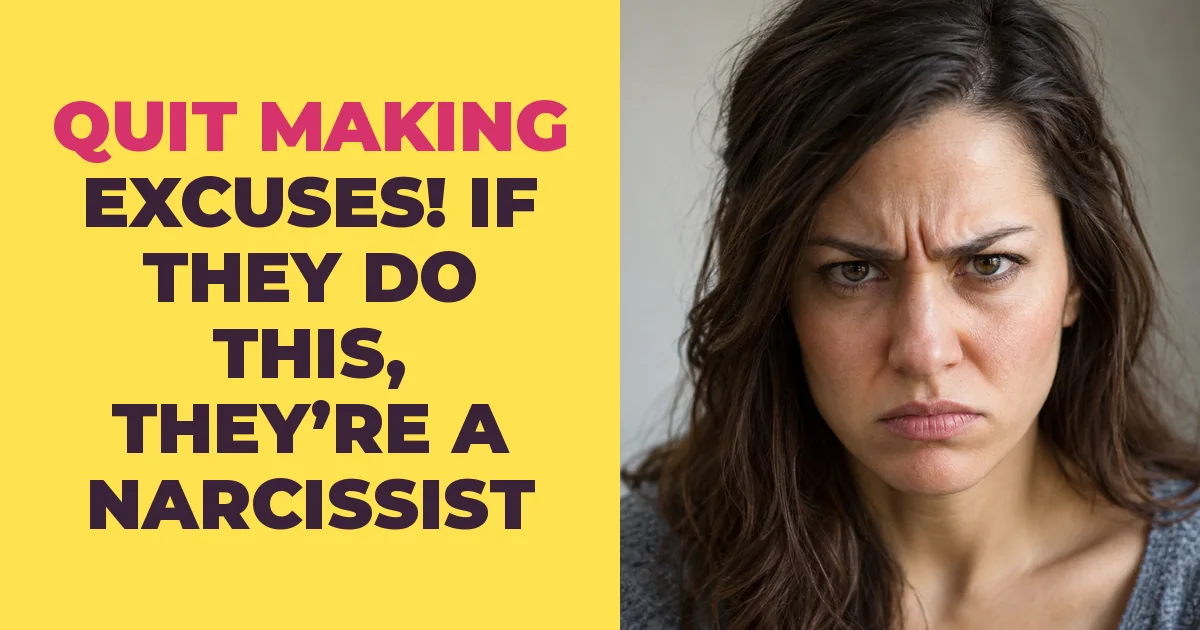
Quit Making Excuses! If Your Partner Does This, They’re a Narcissist

Narcissists rarely look like the villain from the outside.
They look like your partner on an ordinary Tuesday.
Forgetting what they promised. Going flat when you’re happy. Somehow turning every argument into your fault.
And you keep explaining it away.
They’re tired. Work is brutal. Maybe you did overreact a little. When someone you love hurts you, it makes sense to reach for a reason.
No list can diagnose anyone. But here are 7 patterns worth taking seriously: six in what they do, and one in why you keep covering for them.
Why one bad day proves nothing
Everyone snaps sometimes. Everyone has selfish moments.
Narcissism is steadier: a lasting pattern of needing admiration and showing little interest in how you feel unless it affects them. Only a clinician can diagnose it. And tactics like gaslighting show up in many manipulative relationships.
A narcissist’s sense of worth often leans on outside confirmation. So you get treated as a mirror, or as a threat.
One sign proves nothing. The pattern does.
#1 They rewrite what happened
“That never happened” is one way their version of events wins.
You bring up the comment they made at dinner on Saturday. The one that made your sister go quiet. They look at you, puzzled, as if you invented it.
Push, and you hear it: “You’re too sensitive.”
Psychologists call this gaslighting. It means making you doubt your own memory so their version wins. It works best when they hold more power and you trust them. Their story becomes the official one.
So you start saving screenshots and dated notes, just to prove you’re not imagining it. Two people recalling an evening differently is normal. Gaslighting means denying what you saw.
Check what happened with one person outside the relationship.
Doubting yourself was the goal, not the truth.
#2 Everyone else gets the nice version
The person your friends adore at parties often isn’t the one who drives you home.
At the barbecue they’re funny, helpful, topping up everyone’s drink. In the car? Silence. Or a list of everything you said wrong.
Next morning your friend texts: “You’re so lucky!”
Psychologists who study impression management point out that all of us polish the image we show. A narcissist often pours extra effort into that image, since being admired props up their self-worth.
Everyone is more polite in public. Here, the gap runs from kind to cruel. And nobody believes you, because they’ve only met the charming side. So you wonder if you’re the problem.
Behind the front door is the real relationship.
Believe that version.
#3 Your complaint turns into your fault
Raise one problem with a narcissist and you may end up apologising for it.
You mention, calmly, that they forgot to collect your mum from the station. Again. Ten minutes later, you’re hearing about every time you’ve ever been late.
“I never said I’d do that. And how dare you, after the week I’ve had?”
Then the sulks, the tears, until you’re comforting them.
There’s a name for this: DARVO. Deny, attack, reverse victim and offender. Research found it tends to make the one who spoke up blame herself more, which is why it shuts the conversation down so fast.
After enough rounds, you stop raising problems. You don’t have to answer each accusation they throw back. And if it heats up, you can stop and step out of the conversation.
Leaving a rigged fight isn’t losing it.
#4 Your good news turns sour
Your best day can turn into your worst evening once they hear about it.
You got the job and called them first, buzzing. “Oh. Good for you.” Then a long sigh about how tired they are. Or they pick a fight on your birthday, right before the dinner you booked.
Envy is common in narcissism, especially the quieter, touchier form. Your success threatens their need to feel superior. So they shrink it, spoil it or take it.
A flash of envy is human. Acting on it to bring you down is the pattern.
You start hiding good news. Happy moments feel risky.
Notice who goes quiet when you win.
Take your next win to someone who cheers loudly.
#5 Their plans come first

In their world, the rules apply to everyone else, and that includes you.
You’ve had Friday booked for weeks. Thursday night: “You’ll have to cancel. My thing matters more.” They take credit for the party you planned and sigh if they wait five minutes for you.
Your time bends. Theirs doesn’t.
Research on entitlement describes a fixed sense that they’re owed more than anyone else. Through that lens, a normal limit feels like an insult. So a fair request lands as an attack.
You hand over more and get back less. Even a small ask for fairness feels like lighting a fuse, so most days you let it go.
Asking for what you need isn’t entitlement. Keep a quiet tally of what you give. And stop pre-paying, pre-forgiving and pre-agreeing.
Your yes is worth more than that.
#6 The good days keep you hooked
Kindness that shows up at random hooks you harder than steady kindness ever could.
Monday they’re cold. Tuesday they barely look up from their phone. Wednesday there are flowers on the counter and you’re “babe” again.
And it feels like winning.
It has a name: intermittent reinforcement. Rewards that come on an unpredictable schedule build the hardest habits to break. Same pull that keeps a gambler at the slot machine.
So you work harder for less, chasing the version who brought flowers. The good days make the bad ones feel bearable. Normal moods go up and down. This is affection handed out like a prize you can never predict.
Try marking good and bad days on a calendar for a month.
Judge it by the average. Not the best Wednesday.
#7 You end up making their excuses
The longer it goes on, the more their excuses start coming out of your mouth.
“They had a hard childhood.” “They’re under so much stress.” “We’ve been together eight years.”
Sound familiar?
Psychologists describe this as cognitive dissonance. Believing they love me and they hurt me at the same time is painful, so the mind eases it by explaining the bad behaviour away.
Then there’s sunk cost: the years you’ve already given can make every decision feel heavier. An excuse feels like relief, because it lets the two beliefs stop fighting for a while.
Mixed feelings are normal. The problem is when they keep you explaining away harm. One thing helps: write down what happened. Not what it meant. Not why they did it.
Whatever you decide, weigh what lies ahead. The past years are already spent.
If you’ve been covering for them, it makes sense that you did. Excuses are how a mind copes when love and hurt come from the same person.
You don’t have to decide anything tonight. Telling one trusted person the full story is a start. And if you ever feel afraid of how they’ll react, a domestic abuse service can help you think it through, whatever you choose.
Write down what happened today. On paper, a pattern is much harder to explain away.
The Real Narcissist Only Shows Up When It’s Just the Two of You — And It’s Chilling

The narcissist saves their best self for everyone else.
At the party they’re warm, funny, attentive. They top up your drink and squeeze your hand. Your friends say you’ve found a keeper.
Then the car door shuts.
And the person beside you is someone nobody else ever gets to meet. Colder. Sharper. A stranger with a familiar face.
Below are 7 things that happen when the audience leaves, why the switch is so sudden, and why it shakes you so badly.
Why the mask comes off
A little extra politeness in public is normal. We all do it. With a narcissist, the distance between the two versions is huge.
Research on how people manage the impression they give points to a reason: other people’s admiration feeds their sense of worth, so they pour huge effort into the public picture. What changes isn’t manners. It’s kindness itself.
Studies of narcissistic admiration and rivalry describe a split. Early on, charm draws people in. Later, once they know someone well, the cold and cutting side wins.
You’re not a newcomer now. So you get the other side.
#1 The charm switches off when the door closes
The warmth you saw all evening was a performance for the room.
At dinner they laughed at your stories and called you their rock. Touched your shoulder every time you spoke. Your sister leaned over and whispered, “You two are so cute together.”
In the car home? Nothing. Eyes on the road, jaw tight. You ask if everything’s okay and get a flat “Fine.”
Why the sudden drop? The dinner table was the audience. Applause from the room was fuel for their image, and now the room is empty.
So you sit there replaying the night, hunting for your mistake. Was it the joke? The wine? The dress?
A better question than what you did wrong: who shows up once the guests have gone home? That’s the person you share a home with. Believe that one.
The dinner was the show. The car is real.
#2 Your pain only matters when someone’s watching
A narcissist often knows exactly how you feel and simply decides it doesn’t count.
In front of friends, they rub your back when you mention your awful week. Concerned face. Soft voice. They tell everyone how worried they’ve been.
At home, you cry about that same week and they pick up their phone. Or switch to talking about their boss. Or sigh, “You’re too sensitive.”
In studies, narcissists showed less empathy at first, yet more once they were asked to imagine the other person’s view. That points to choice more than inability.
Over time, you share less. You wonder if your feelings are too big, if you’re too big.
They aren’t. Give your hurt to people who actually respond to it.
Who in your life leans in when you’re hurting?
#3 The jokes get crueller behind closed doors

Contempt is the private language of the narcissist, and it’s spoken in eye-rolls.
You start telling them about a problem at work. Their eyes roll before you’ve even finished.
Or they repeat what you said in a whiny, high-pitched voice. Then the shrug: “Relax, it’s a joke.”
Sometimes they just walk off mid-sentence and leave you talking to an empty kitchen.
This isn’t harmless banter. When researchers tracked couples for years, scorn and shutting down stood out as some of the clearest signals that a couple wouldn’t last.
At home, you shrink. Guests get the compliments, you get the sneer. So you raise less and less.
One way to tell: point it out once, calmly, then watch. Does respect ever return?
#4 Silence becomes their favourite weapon
The silent treatment is punishment dressed up as calm.
You disagree about something small. Then come the days. No good morning. No reply to your texts. They pass you in the hallway like you’re furniture.
And then, out of nowhere, they’re back. Chatting about dinner plans as if nothing happened. No apology, no explanation.
Why does it cut so deep? Being treated as invisible pokes at two needs everyone carries: to be part of something and to count. That’s why it can ache like an actual injury.
So you say sorry just to break the quiet, even when you can’t name your crime.
What helps: say once, simply, that the door is open whenever they want to talk. After that, carry on with your plans. Don’t run after them. Don’t beg.
Your day doesn’t belong to their silence.
#5 You start bracing before they walk in
When one person comes in two versions, your body learns to stay on guard.
You hear keys in the door and your stomach drops. Which one is coming home tonight? The sweet one with flowers? Or the one who slams cupboards?
You never know. That’s the hook.
Warmth that shows up on no schedule, wedged between cold spells, holds on tighter than warmth you can count on. Gamblers at a slot machine get caught by that same pull.
Meanwhile your body tries to keep the peace. Yes slips out before you’ve thought. Sorry comes before they’ve spoken. What you want gets lost.
No wonder you’re exhausted!
Grab two pens. Mark good days in one colour, bad days in the other. After a month, look at the ordinary week, not the best one. What does yours look like?
#6 Nobody believes you about the person at home
The better the public mask, the lonelier the truth feels.
You finally hint at what goes on at home, and your friend looks puzzled. “Really? They’re always so lovely.”
That’s the trap.
Everyone else sees someone calm, generous and reasonable. Research on calculating, long-game manipulators describes exactly this: a clean reputation out front, quiet moves against you out of sight.
So when nobody believes you, you start to doubt your own experience. Maybe it’s not that bad? Maybe it’s you?
Think about it.
Look for one person who has caught a glimpse of the other side. A sibling who saw that look. A friend who heard the tone change on the phone.
The gap is real. And you’re the only one standing in it.
#7 Then they say it never happened

The final twist is being told your own memory is wrong.
You bring up the car ride, the eye-rolls, the three days of silence. They look at you, almost amused. “That never happened.”
Or: “You’re being dramatic again.”
Psychologists call this gaslighting. Where power is lopsided, it works best: you trust them, they control the story, and the past quietly gets edited.
And since nobody else was in the room, their version has space to win. You catch yourself apologising for moments that left you hurt.
Jot each incident down the same day, in a place only you can reach. That record is for you and nobody else.
Your memory was right the first time.
What you saw in the car, the kitchen and the quiet hallway was real. The version you meet alone counts just as much as the one everyone else applauds.
If it feels possible, share the whole story with one person you trust. Just one. Isolation keeps this pattern running. Connection starts to loosen it.
You saw the real one. Trust that.
Why Every Gift From a Narcissist Somehow Feels Like an Insult in Wrapping Paper

A narcissist can turn a present into a punishment.
You peel back the paper, and your stomach drops before your brain catches up.
The perfume you told them gives you headaches. The diet cookbook on your birthday. The ‘funny’ gift the whole table laughs at, except you.
Then you’re supposed to smile, say thank you, and mean it.
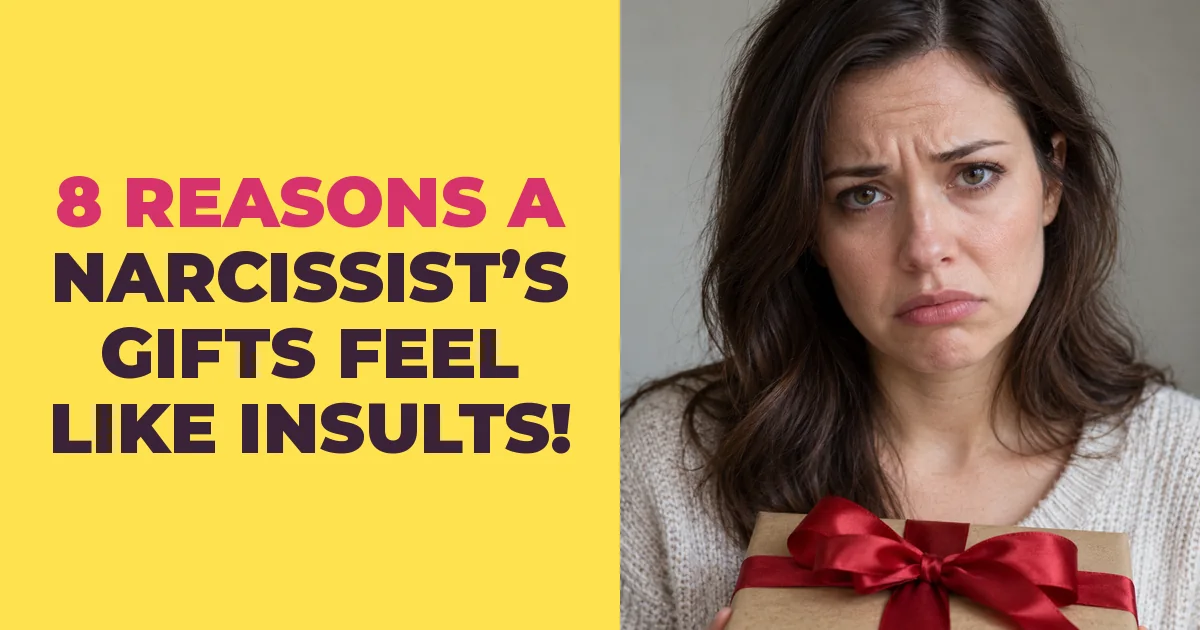
Here are 8 reasons why gifts from a narcissist so often feel like insults in wrapping paper.
What a gift means to them
To most of us, a gift says ‘I see you.’
A narcissist’s self-worth tends to lean on what others reflect back. So the people around them get quietly sorted: fans, or dangers.
So the gift is rarely about what you’d enjoy. It’s about what giving does for them.
And your reaction becomes their scorecard.
#1 The insult is folded inside
Some gifts are built to sting, and the sting is the whole point.
Anti-wrinkle cream, opened in front of your sisters. A dress two sizes small with ‘Something to aim for!’ on the tag. A self-help book about being less needy.
Then the laugh, while you’re still holding the paper.
Psychologists call this everyday sadism. For some, watching you squirm is its own little prize. No bigger goal needed.
That’s why it lands right on your soft spots. They watch for the flinch, so you learn to hide it, even at your own party.
Here’s a quick check. A friend who’s only kidding backs off once you say it hurt. This doesn’t. ‘God, it was a joke.’
Does your hurt seem to cheer them up? There’s your answer.
#2 They buy for themselves, not you

A narcissist often knows exactly what you’d love, and buys something else.
You’ve mentioned the book three times, even left the page open on your phone. They hand you a gadget they’ve wanted for months, then spend your birthday evening setting it up.
Studies on narcissism and empathy point somewhere chilling. Many can read your feelings fine. They simply choose not to bother, unless there’s something in it for them.
So the gift tells you whose wishes count.
And when you hint at what you’d hoped for? ‘You’re too sensitive about presents.’
Bit by bit, wanting anything starts to feel like a nuisance you’re causing. Even to you.
It isn’t. It never was.
#3 Your big day is their problem
Your big days often bring out the worst in a narcissist.
The promotion dinner where they sulk over the menu. The graduation where the gift is late, cheap and handed over with a sigh, in the car park.
‘Didn’t think you’d make such a fuss about it.’
Researchers have tied envy to narcissism, most of all to the quieter, prickly kind. When you shine, their need to sit higher feels threatened. So your moment gets made smaller, or ruined.
A careless gift is an easy way to shrink a day.
Little by little, good news starts to feel dangerous to have. You play it down before they get the chance to.
Who goes quiet in your life when you win?
#4 Every gift comes with a bill

A narcissist’s gift can be a loan you’ll be paying back for months.
The necklace comes up in the next argument. And the one after that. ‘After everything I’ve done for you, this is how you treat me?’
Suddenly saying no feels ungrateful.
There’s a popular nickname for this: FOG, short for fear, obligation and guilt. It isn’t a diagnosis. It just describes how a ‘no’ gets made to feel pricier than a ‘yes’.
Researchers describe a related pattern, coercive control, where lots of little rules and punishments quietly shrink your independence.
Next time they ask for something, give yourself a beat before you answer. Their sulk is theirs to carry.
A gift you owe for was never a gift.
#5 Gifts look generous in front of others

The most generous gifts often show up when there’s an audience.
At the family party they hand you a huge bouquet and a little speech. Everyone sighs. Your friend leans over and whispers, ‘You’re so lucky.’
In the car home, not a word.
Their public image is worth a lot to them. Applause is fuel, and a crowd is the easiest place to get it. The gift is for the room. You’re just where they set it down.
Sure, everyone’s a bit nicer with company. This is a different gap: warm out there, cold at home.
Then nobody believes the other side. You start to doubt it yourself.
What happens with the door shut counts more. So who gets the gift when nobody’s watching?
#6 Your honest face sets them off
One flicker of disappointment on your face can start a whole evening of fury.
You open the box. You pause half a second too long. ‘Wow. Thanks.’ And it begins.
Studies on what psychologists call threatened egotism showed narcissists hitting back harder after a blow to their pride, aimed at the person they hold responsible. To them, your pause is the blow.
Then comes the flip. ‘I spent hours on that! You’re so ungrateful.’ The name for this is DARVO. They deny, go on the attack, then swap places with you and play the wronged one.
By midnight, you’re the one apologising.
You can skip arguing each counter-charge. And if the anger tips into threats, get yourself out of the room.
A gift you’re not allowed to react to is a test you can’t pass.
#7 Sweet gifts show up after cruel days
The nicest gift often arrives the morning after the worst night.
Flowers on the kitchen counter. Your favourite pastry. A note: ‘I know I’ve been stressed. You know I love you.’
No apology. Just the box.
There’s a well-known pattern called the cycle of abuse. Tension builds, something blows up, then come apologies and presents, then a quiet spell. That quiet brings hope back, so the next storm is easier to miss.
And kindness you can’t predict grips tighter than kindness you can count on. Slot machines run on the same trick.
Try marking the bad days and the gift days on a calendar. Then look at the whole month, not its sweetest morning.
What does your calendar say?
#8 You start dreading every occasion

After enough ruined birthdays, your body starts bracing for them weeks ahead.
You read their mood from the jangle at the front door. You rehearse your thank-you face. You say ‘I love it!’ before the paper is even off.
That’s fear, doing its job.
When anger can come out of nowhere, your nervous system learns to keep watch and smooth things over by pleasing. It works, sort of. It also wears you out, and buries what you actually want.
So ask yourself, quietly: what would you like this year?
Then talk to yourself the way you’d talk to a friend who’d had this kind of year. Studies tie that kind of gentleness to less shame and less blaming yourself.
Your joy was never the problem.
You weren’t ungrateful. You were paying attention.
A gift is meant to say I know you. When the gifts keep saying something smaller, you get to believe your own eyes.
Share your good days with the people who light up for you. Let the rest stay in the wrapping.
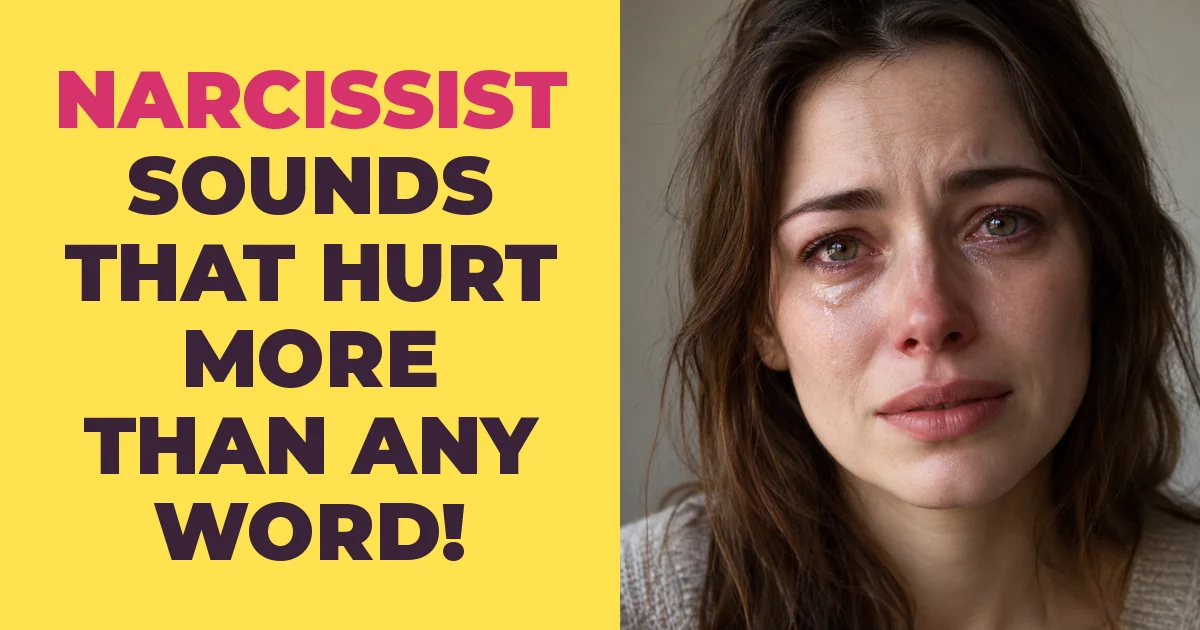
The Dismissive Sounds a Narcissist Makes That Hurt More Than Any Word Ever Could

That long sigh when you walk in. The little scoff while you’re mid-sentence.
Nobody said a word, and still you feel about two inches tall.
A narcissist doesn’t need words to cut you down.
And if you mention it, you already know the answer: “What? I didn’t say anything.”
It’s not in your head. Those sounds carry a message, and it lands.
Here are 8 dismissive sounds a narcissist makes, what each one is really doing to you, and what helps.
Why a sound hurts more than words
A sound is the perfect weapon for anyone who wants deniability.
Words can be quoted back. A sigh can’t. So when you react, they get to say “That never happened” or “You’re too sensitive,” and the spotlight swings onto you.
Psychologists call this gaslighting. The aim is to shake your trust in your own eyes and ears until their story is the only one left standing. It takes hold most easily where one person holds more power.
One habit helps right away. Jot the moment down while it’s fresh, and run it past a friend who isn’t part of the relationship.
#1 Their sigh is a guilt trip
A narcissist’s sigh can do the work of a whole guilt trip.
You ask if you can see your sister on Saturday. They don’t say no. They just breathe out, long and slow, and stare at the sink.
Five minutes later you’ve cancelled. Nobody asked you to.
There’s a popular name for this: FOG, short for fear, obligation and guilt. It isn’t a diagnosis. It sits close to what researchers call coercive control, where lots of little pressures stack up until your life shrinks.
That sigh is disappointment with the sound turned up. It makes a no feel expensive and a yes feel cheap. Before long, agreeing happens on autopilot, and keeping them content feels like your duty.
Try this: wait a beat before replying. How they feel is not yours to fix.
Your Saturday is allowed to stay yours.
#2 That scoff is pure contempt
A scoff while you’re talking shows exactly how little respect is in the room.
You’re explaining why the bill went up. Halfway through, they let out that short, nasal laugh. “Wow. Okay.” Then the eye-roll.
That’s contempt. It talks down to you without a full sentence.
Couples researchers spent years following marriages. Contempt, along with shutting down mid-conversation, showed up as one of the clearest warning signs that a relationship would fall apart. Eye-rolls, mocking and snide “jokes” belong to the same family.
And it shrinks you. Home stops feeling like a place where you’re allowed to take up space. So the topics go unspoken.
One way to see it clearly: point it out once, in a calm voice. Then pay attention to whether any respect returns.
You were talking. That deserved better than a snort.
#3 A grunt is how they shut you out
A grunt is the silent treatment with just enough sound to deny it.
You ask how the meeting went. “Mm.” You ask about dinner. A grunt. Then their brother calls, and suddenly they’re chatty and laughing.
Warm with everyone else, a wall with you. That’s no accident.
Being shut out hits something deep: the need to feel included and to count. Research on ignoring describes it hurting in a way close to physical pain. No wonder so many of us say sorry just to end it.
Slowly, whole subjects go off-limits, because they might set off the grunting.
What helps? Tell them, one time, that you’re happy to talk whenever they are. Then get on with your day. No chasing. No pleading for full sentences.
You’re worth more than a syllable.
#4 Your good news gets a flat hm

Your best news often gets their flattest sound: a tut, a “hm”, nothing more.
You got the promotion. You’re glowing as you tell them. They glance up from their phone. “Hm. More hours, then.” Tut.
That sound lets the air out of you in one second.
Envy shows up a lot in narcissism. When you shine, it pokes at their need to stay on top, so they cut your moment down to size. A sour little noise does that neatly, and “I was just tired” covers it.
After enough of these, you start keeping wins to yourself. Even happy days feel like a gamble.
A simple way to tell: watch whose face goes blank when something good happens to you. Then take your next win to someone who’ll cheer.
Your promotion was still a big deal!
#5 They hum while you’re hurting
Humming while you cry is a choice, and it isn’t a kind one.
You’re on the edge of the bed, telling them your friend is sick. They wander off to the kitchen, humming. Maybe whistling. Fridge door. Kettle.
Cheerful. Unbothered. Loud enough to hear.
What stings most? Studies suggest many narcissists do grasp what you’re feeling. Their empathy runs low on its own, yet rises when they’re nudged to imagine your side. So it looks more like won’t than can’t.
The humming tells you your pain can wait. Bring it up, and “You’re too sensitive” tends to follow.
Little by little, you keep your feelings to yourself. Then you start second-guessing whether you should have felt them at all.
Someone clumsy with emotions still tries to help. This isn’t that. Bring your hurt to the people who show up for it.
#6 Your flinch is the fun part
For some, your flinch is the reward, and the little laugh gives it away.
At dinner with friends, they bring up the weight you’ve been self-conscious about. You go quiet. They chuckle, a soft “heh”, and reach for the wine.
Then the smirk.
Researchers describe a trait called everyday sadism: getting a kick out of other people’s discomfort in small, ordinary ways. For people high in it, the cruelty is the payoff, not just a means to something else.
That’s why the laugh lands right when you’re hurting. Living with it can feel less like being loved and more like being prey.
Playful teasing ends when you ask. This doesn’t. Watch whether your upset seems to cheer them up, and where you can, keep your reactions small.
Your hurt was never the punchline.
#7 The low growl is a warning

A low growl often means their ego just got bruised, and you’re about to pay.
You mention, lightly, that the turn was back there. A sound comes from their throat, deep and tight. The car goes cold.
Two days later, out of nowhere: “You made me look stupid.”
Research on what’s called threatened egotism found that when narcissists feel insulted, they tend to hit back harder, and they aim it squarely at the person they blame. A tiny correction can register as an attack.
So you rehearse every sentence in your head first. You say sorry for things that were never yours.
Keep any criticism brief and stick to facts, or let it go when it doesn’t feel safe. If the anger turns into threats or smashing things, get out of the room and reach out for help.
Your safety comes first. Always.
#8 You learned to read every sound
You can read their mood from the sound of their keys in the door.
A heavy jangle means trouble. A drawer shut a bit too hard means tread carefully. You know their sighs better than your own thoughts.
That isn’t paranoia.
When anger can arrive at any moment, your body learns to stay switched on. It listens for danger, then tries to soothe it by agreeing and smoothing things over. Psychologists call this hypervigilance and fawning.
It grows out of fear, and it wears you down. Somewhere along the way, what you actually want gets lost.
When your stomach drops at a sound, notice it. Slow down. Then try one tiny no in a safe spot, like turning down a coffee you don’t want.
Your ears have worked overtime long enough.
Those sounds were meant to make you doubt yourself. Now you can hear them for what they are.
You don’t need them to admit it. Your notes, your body and your gut already know.
Start small this week. Write it down when it happens.
Everyday Humiliations a Narcissistic Partner Expects You to Take Without a Word

A narcissistic partner rarely humiliates you with one big blow.
It’s a sigh at dinner. A joke at your expense in front of friends. A look at your dress as you walk out the door.
Each one feels small enough to let go. And you’re expected to let it go, every single time, quietly.
Add them up, though, and you start to shrink inside your own house.
Here are 8 everyday humiliations a narcissistic partner expects you to swallow without a word, and what’s really going on behind each one.
#1 They turn you into the joke
A joke that only hurts one person in the room isn’t really a joke.
You’re telling a story at a friend’s dinner. Your partner cuts in, fixes a detail, rolls their eyes and adds, “She always gets this wrong.” Everyone laughs.
You laugh too. What else can you do?
Couples researchers have a name for sarcasm, eye-rolls and mocking: contempt. In studies that followed couples for years, it was one of the clearest warning signs of a breakup.
There’s also a trait called everyday sadism, where small cruelties feel rewarding to the one dishing them out.
So you go quieter. Your stories shrink. You say less at parties.
One way to tell: good-natured ribbing ends the second you say it hurts. Does your upset seem to cheer them up?
If it does, that’s not banter.
#2 Your clothes become their business
When your partner decides what you wear, it’s rarely about the outfit.
“You’re wearing that?” You’re at the door, keys in hand. They look you up and down, and wait.
You go back upstairs and change.
Dress codes are one of the quieter forms of control, right next to rules about food, time and who you see. Research on coercive control shows how lots of little rules, each with a penalty attached, slowly chip away at your freedom.
That’s why it’s so hard to name. There’s no single big moment. Just the dress you stopped buying, and the friend you stopped seeing.
Couples swap opinions on outfits all the time. This is different: one person makes the rule, and you pay for ignoring it.
Be honest with yourself. What happens when you don’t change?
#3 Dinner is never good enough
A narcissistic partner often knows exactly where you feel weakest, and aims right there.
You spent an hour on dinner. They take one bite, push the plate away and say, “You still can’t cook, can you?”
If you look hurt, you hear the next line: “God, you’re so sensitive.”
Studies on narcissism and empathy turned up something uncomfortable. Many narcissists can read your feelings just fine. Left alone they don’t bother, yet when nudged to imagine your side, their empathy goes up. That looks less like can’t and more like won’t.
Think about it.
They know feeding the family matters to you. That’s why the comment lands where it does.
Slowly you stop sharing what matters and start second-guessing yourself. Your hurt is real. Take it to people who treat it that way.
#4 Money turns into a weapon
In a narcissistic relationship, money is often used to keep you small.
“We’d have so much more if you actually worked.” Said over the bank statement, or in front of their parents, as if you’d been on holiday for years.
Meanwhile, they blew the weekend’s budget on themselves.
Researchers call this economic abuse: taking charge of a partner’s money, or quietly wrecking her chances of earning her own. The less you have, the harder walking away becomes.
Add entitlement, the sense that ordinary rules are for other people, and the double standard feels fair to them.
So you hide small purchases. You feel guilty buying shampoo.
Planning a budget as a team is ordinary. One person holding every purse string, then sneering that you have nothing, is something else.
Call it what it is: a leash.
#5 Raising kids is suddenly not work

To an entitled partner, the work you do at home simply doesn’t count.
You’ve done the school run, two loads of washing, a sick child and dinner. They walk in and ask, “So what did you actually do all day?”
Then they tell friends how hard they work for the family.
Entitlement means they genuinely feel owed more than anyone around them. Research on it describes partners who claim joint effort as their own and assume your plans will bend around theirs.
You give more. You get less back.
And asking for fairness? It can feel like starting a war.
One quiet step: jot down what you do each day, just for yourself. Seeing it on paper helps. You know what your day held.
#6 Big dreams get cut down to size
Your good news can feel like a threat to a narcissistic partner.
You mention the course, the promotion, the little business idea. They laugh. “Bit above your station, isn’t it?”
Or they go oddly quiet, then pick a fight that evening.
Researchers find envy is common in narcissism, especially the quieter, touchier form. Your success pokes at their need to stay on top, so they make it smaller, ruin it or take the credit.
Psychologists also describe a rivalry streak: when you get ahead, they feel robbed. Ambition is fine. Competing with your own partner isn’t.
So you start keeping good news to yourself.
Watch who goes silent at your good news, and who cheers. Your next win belongs with the ones who cheer.
#7 Everyone else gets the charming version

The partner who mocks you at home is often adored by everyone else.
At the party they’re funny, warm, attentive. They top up your glass. Your friend whispers, “You’re so lucky.”
Then the car door shuts. Silence the whole way home.
Research on impression management looks at how we all curate the image we show. A narcissist may pour huge effort into theirs, because being admired props up how they feel about themselves.
The price is yours. Nobody believes you, and some days you don’t quite believe yourself.
Most of us are a bit more polite with company. That’s normal. Here the switch is from warm to cruel.
Believe what you see when no one else is watching. That’s the real version.
#8 Objecting makes you the villain
The moment you object, a narcissistic partner may turn you into the problem.
You finally say it, quietly: that comment in front of your sister really hurt.
“I never said that. And honestly, after the week I’ve had, you’re attacking me?”
Within minutes, you’re comforting them.
Psychologists have a name for this: DARVO. It stands for deny, attack, and swap who’s the victim and who did the harm. Studies show it makes the one who spoke up blame herself more, so the talk ends fast.
So you stop raising things. You swallow the next joke, and the one after that.
What helps is simple and hard: bring it back, calmly, to the comment that hurt, and don’t take the bait on their accusations. Your hurt was the topic. It still is.
None of these moments is small when it happens every week. Your discomfort is information, not oversensitivity.
If any of this sounded like your week, start with one person outside the relationship who has seen your life up close. Tell them one true thing.
You were never too sensitive. You were paying attention.
The Things a Narcissist Takes From You So Slowly You Only Notice Once They Are Gone

Some days you barely recognise yourself.
You used to laugh louder. Make plans. Say what you thought without rehearsing it first.
Nobody took any of it in one go. It went a little at a time, while you were busy keeping the peace.
That’s how control often works. The pieces are small enough to explain away, every single time.
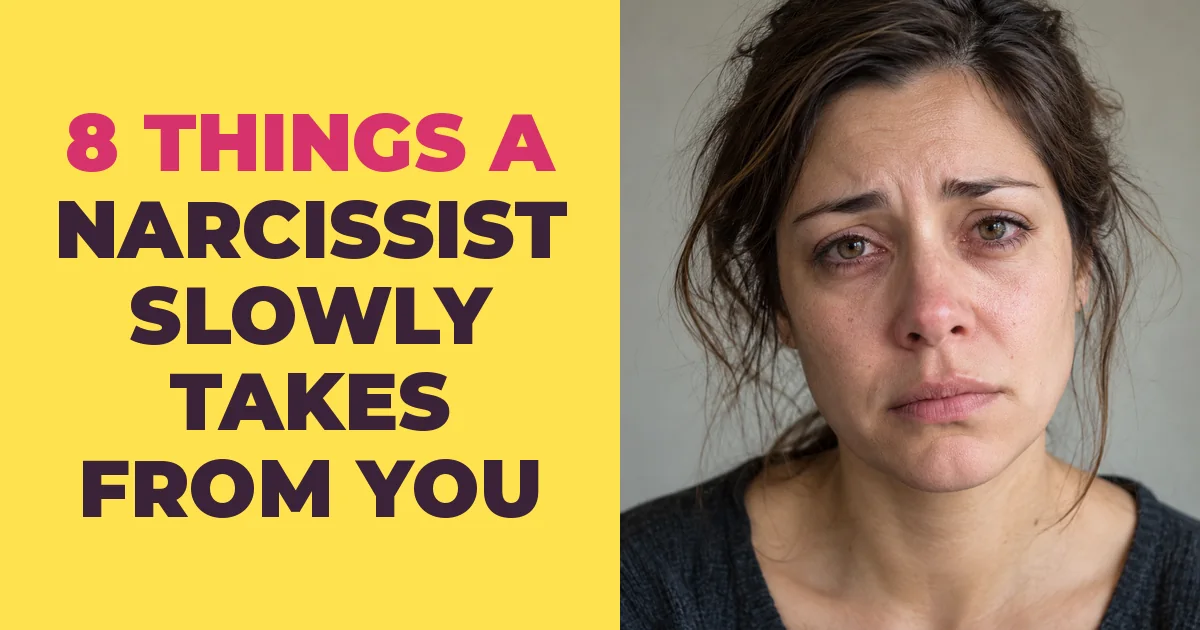
Here are 8 things a narcissist takes from you so slowly you only notice once they’re gone.
Why it never feels like theft
Nothing big goes missing on a single day. That’s the trick.
Control often works through many small rules and small punishments. That’s why it’s so hard to point to one big incident.
The good days muddy things as well. When warmth turns up at random, between cold spells, it grips tighter than warmth you can count on. One sweet evening can make a rotten week seem survivable.
So the losses pile up quietly. Here’s what tends to go.
#1 You stop trusting your own memory
A narcissist can wear down your trust in your own memory one argument at a time.
You know what they said. You heard it in the car on the way home. Then comes the calm, flat answer: “That never happened.”
Then the follow-up. “You’re too sensitive.”
By the third time, you’re not so sure anymore.
Psychologists call this gaslighting. It works best when the power is unequal, because your trust in them gives them room to rewrite what happened.
So you start keeping notes on your phone. You apologise when you were the one who got hurt. Writing things down as they happen helps, and so does checking with one person outside the relationship.
Those notes are you holding on to what’s real.
#2 Bringing things up gets too expensive
Every time you raise a problem, it somehow ends with you apologising.
You mention the money they said they’d pay back. Within a minute it’s “I never did that, and how dare you accuse me.” Then comes the list of everything wrong with you.
Then the sulking, until you’re the one comforting them.
Research has a name for this: DARVO. Deny, attack, reverse victim and offender. It makes the person who spoke up blame themselves more, which is exactly why it shuts the conversation down.
Add an eye-roll, or a walk-out mid-sentence, and you learn fast.
So you stop bringing things up. Not because they’re fixed.
One way back is to name the original issue and keep returning to it, without arguing the counter-attack point by point. What was the thing you actually came to say?
#3 Good news starts to feel risky
A narcissist can treat your good news as their bad news.
You get the promotion. You text them first. The reply is “Cool.” Later that night, a fight about the dishes comes out of nowhere.
Or your birthday ends in tears. Again.
Research links narcissism with envy. Your success threatens their need to feel superior, so they shrink it, steal it or spoil it. In their eyes, your gain is their loss.
So you start hiding things. The raise. The compliment. The idea you were excited about.
Happy moments begin to feel like something to get through.
Notice who goes quiet when you win, and take your wins to people who are glad for you. Your good news deserves a better audience.
#4 Your world gets quietly smaller
Control rarely arrives as one big rule. It arrives as a hundred small ones.
“Do you really need to see her again?” “Why did you spend that?” “Text me the second you get there.”
Each one sounds almost reasonable on its own.
Researchers call this pattern coercive control. Rules about money, friends, clothes, food or time, plus little punishments for breaking them, add up to a slow loss of independence.
Your Saturdays shrink. Your group chat goes quiet.
Then one day you catch yourself asking permission to buy shampoo. Keeping some money and contacts of your own helps, and a domestic abuse service can talk you through safety planning.
Your life was never theirs to run.
#5 Your feelings go back in the drawer

Many narcissists can read your hurt perfectly well. They just don’t do anything with it.
You finally say how much that comment at dinner stung. They start talking about their own day.
Push it, and you hear the line: “You’re being dramatic.”
Research on empathy in narcissism found something telling. Left to themselves, they showed less of it. Asked to imagine the other person’s side, they showed more. So the gap looks less like a missing ability and more like a choice.
Notice how warm they can be with the neighbours.
So you go quiet about what hurts. Then you begin second-guessing whether it should hurt at all.
Bring your hurt to the friends who lean in when you talk. They exist.
#6 The alarm in your body never switches off
Living with unpredictable anger trains your body to stay on alert.
You hear keys in the door and you already know the mood. Your shoulders are up before they’ve said a word.
You say yes before you’ve thought. You say sorry for the weather.
This is what’s described as hypervigilance and fawning. Your body learns to scan for danger, then calm it down by agreeing and appeasing.
It kept you safe. It also wears you out.
That exhaustion isn’t laziness. It’s the cost of being on guard all day.
When you feel the alarm go off, slow down, and practise small no’s in safe places. Start with “no thanks” to the waiter.
#7 That future they promised keeps moving
A narcissist can keep you holding your breath for a life that keeps getting postponed.
The holiday in spring. The move. The ring. “Once work calms down, babe.”
The date slides. Nothing gets rebooked. Mention it months later and you get, “When did I ever say that?”
Online, people call this future faking. It’s a community label rather than a clinical one, and it lines up with research tying narcissism to treating love as a game, with commitment kept low.
Why does it hold you so well? Every plan is something you’ve invested in. Walking away starts to feel like throwing that imagined life in the bin.
So the waiting stretches on. Asking starts to feel like nagging.
Look at what has really happened, not what was promised, and pick your own dates. Which plan could you book for yourself this month?
#8 You forget what you actually want
After enough time orbiting their needs, your own wants go silent.
A friend asks where you’d like to eat and your mind goes blank. Without thinking, you’re picturing their face first.
Over-giving, or codependency, is a popular name for organising your life around someone else’s moods. It’s not a diagnosis. It overlaps with what researchers call fawning: pleasing others to stay safe.
A self-focused partner rewards it. You fix their problems first and feel guilty when you rest.
Losing track of what you want is one of fawning’s quietest costs.
Try asking what you want before what they need. Keep it small: the film, the radio station, your side of the bed.
Your answer is still in there.
Nothing on this list went missing because you were weak. It went in pieces small enough to miss.
And things taken in pieces can come back in pieces. One honest note. One friend who gets it. One small no.
Victims of Narcissistic Abuse Feel The Most Stress When The Narcissist Does These 8 Things

Narcissists rarely hurt you in one big blow.
It’s the small things. The broken plan. The silence. The story about yourself that you hear secondhand.
You end up tense all the time, and you can’t always explain why to anyone, including yourself.
That isn’t you being dramatic.
Here are 8 things a narcissist does that stress you most, what’s behind each one, and something that helps.
Why your body never relaxes
Research on fawning and hypervigilance points to something simple. When anger can show up at any moment, your body learns to stay switched on. You read their face, their tone, the way the keys hit the counter.
You say yes before the thought is even finished, just to keep the peace.
It works, sort of. It also leaves you exhausted.
Every item below sets off that alarm. Some do it loudly. Most do it quietly.
#1 Your feelings get called wrong
Few things wear you down faster than being told your feelings are wrong.
You say the comment at dinner hurt. They sigh and say, “You’re too sensitive.” Or worse, “That never happened.”
Conversation over.
What stings most? Studies on narcissism and empathy suggest the understanding is often there. Acting on it is the part they skip, unless your feelings happen to be useful to them.
Then gaslighting piles on. If they deny what you saw often enough, you begin to distrust your memory, and their story becomes the official one.
Slowly, you go quiet about how you feel. Before trusting a reaction, you check it against theirs.
Jot it down the day it happens. A notebook won’t argue back.
#2 Bringing up a problem backfires
One fair complaint can somehow end with you saying sorry.
You mention they skipped your sister’s dinner again. Within a minute it’s “How dare you accuse me?” Then comes a list of your failings going back years.
Then the sulk. Now you’re the one comforting them.
The name for this is DARVO. They deny it, go on the attack, then swap places so they’re the injured one. Studies show it leaves the woman who spoke up blaming herself more.
No wonder it’s so effective. The talk shuts down, and over months you quit bringing anything up.
What helps? Say the original issue again and stay on it. Let the counter-attack details slide past.
Your sister’s dinner still got missed.
#3 Their promises go nowhere
Some promises exist only to keep you hanging on.
The trip to Italy. The new kitchen. The wedding date. It’s all coming “after this busy patch at work.” The busy patch never ends.
There’s a popular label for it, future faking. It isn’t a diagnosis, just a name for big, detailed plans dangled so you stay put.
It fits with studies tying narcissism to treating love like a game, with weaker commitment. Talking about a shared future makes you feel bound to it, even if they aren’t.
So bringing it up feels unfair. Are you nagging?
Look at what’s actually happened so far, not what’s been described. Then pick a date that’s yours.
How many “next years” has it been?
#4 Big days turn into fights
Your best news can be the hardest thing for a narcissist to hear.
You get the promotion. They say “Good for you” in a flat voice and change the subject. On your birthday, a fight starts over nothing in the car.
Coincidence? Probably not.
Envy shows up a lot in narcissism, studies suggest, and most of all in its quieter, touchier form. When you rise, they feel smaller. So your moment gets cut down or wrecked.
Before long, joy feels dangerous. You sit on your news instead of sharing it.
Watch who goes silent when things go well for you. Then take your news to the ones who light up.
Your news is still good news.
#5 Warm today, ice cold tomorrow
Never knowing who’ll come through the door is exhausting.
Monday, they bring flowers and call you their whole world. Wednesday, they barely look up from their phone. Nothing happened in between. Nothing you can find, anyway.
So you keep searching.
The research term is intermittent reinforcement. Affection handed out at random, between cold spells, grips harder than kindness you can count on. Slot machines run on the same idea.
A good day lands like a win. It makes the rough ones easier to swallow, and you keep putting in more for less back.
Keep a quick tally: good days, bad days. Then look at the whole month, not the one lovely Sunday.
Which way does your month lean?
#6 They vanish without a word
Being frozen out by someone you love can feel like a physical blow.
After a small disagreement, they go quiet. For days. They chat with everyone in the room but you, as if your chair is empty.
Sometimes they just leave, phone off, no word on where they’ve gone. Then they come back as if nothing happened.
Studies on being shut out explain the sting. It hits your need to belong and to count, and that’s why so many end up caving.
Maybe you say sorry only to make the quiet stop. Maybe you steer clear of anything that could start it again.
Tell them once that you’re happy to talk when they are. Then go live your day. Don’t chase.
Your day still belongs to you.
#7 Your secrets become their ammo
What you share in private can turn up later as a weapon in public.
Late one night, you told them how anxious you get about your weight. Months later at a barbecue, they joke about it in front of everyone. “Relax, it’s just a joke.”
Everyone laughs. You flinch.
Studies of Machiavellian traits describe quietly storing up details for later, while looking calm and reasonable in public. That’s why others see someone harmless.
And some, research on everyday sadism suggests, simply enjoy your discomfort. Poking at insecurities in company. A smirk when you’re upset.
You learn to hide your face. You learn to say less.
That second one helps. Keep the tender stuff for people who’ve earned it. And if your hurt seems to cheer them up, take note. That tells you plenty.
#8 They rewrite you behind your back
Hearing what they’ve told people about you can rattle you more than any fight.
A friend goes oddly cold. Your cousin asks if you’re “okay, mentally.” Then you hear it: they’ve been telling people you’re unstable.
And people believe it.
Why? Narcissists often pour a lot into how they look in public. Charming at the party. Silent on the drive home. Friends tell you you’re lucky.
The gossip has a research name: relational aggression. It goes after your place in the group rather than your body, so there’s nothing anyone can see.
Suddenly you’re explaining yourself to everyone, right when people are drifting off.
You don’t have to. Stay steady and let time do the talking. If it reaches your job or custody, keep records. Trust what you saw at home. You know what you lived.
If your shoulders crept up near your ears while reading this, there’s a reason. None of these are small things, and your stress makes sense.
You don’t have to fix anything tonight. Pick the one that rang truest and just notice it this week.
Seeing it clearly is where steady ground starts.
10 Ways Survivors of Narcissistic Abuse Let Go of Stress

You jump when your phone buzzes. You rehearse sentences in your head before you say them out loud.
Even on a quiet Sunday, your chest stays tight.
That isn’t you being dramatic. Living with unpredictable anger trains your body to stay on alert.
That alarm can be turned down. Slowly, but it can.
Here are 10 ways survivors of narcissistic abuse let go of stress, with one small thing to try from each.
#1 Your shoulders finally drop
Letting go of stress starts with noticing how hard your body has been working.
You know the drill. Keys in the door. The car door slamming a little too hard. Whether they say ‘Hi, love’ or just ‘Hey.’
In two seconds you’ve read the mood and adjusted.
Why? Psychologists call it hypervigilance. When anger can come out of nowhere, your body learns to stay on guard and to calm things down by agreeing.
No wonder you’re exhausted.
Survivors start by catching the alarm. Jaw clenched? Breath shallow? They name it, then slow down on purpose.
Your body has been on duty for years. It’s allowed to clock off.
#2 Rest stops feeling like a crime
Guilt about resting is one of the hardest habits to shake.
You sit down with a cup of tea and they walk past. ‘Must be nice.’ Suddenly you’re up, wiping a counter that was already clean.
Organising your life around someone else’s moods can feel like safety. A self-focused partner rewards it, so rest starts to feel risky.
The price is burnout, plus resentment you can’t say out loud.
Research on self-compassion describes treating yourself with the kindness you’d give a friend. It lowers shame and self-blame.
So survivors take the nap. They leave the dishes.
Nobody needs to earn a sit-down.
#3 Putting it on paper
Writing things down is one of the quietest ways to stop doubting yourself.
‘That never happened.’ ‘You’re too sensitive.’ Hear that enough and you start wondering if your memory is broken.
It isn’t. Gaslighting works by making you doubt what you saw, so their version of events wins.
Some survivors keep a plain note on their phone. The date. What was said. What happened. No guessing at why.
Why does that help? When someone you love hurts you, your mind works overtime explaining it away. A list of facts cuts through the excuses.
Paper doesn’t argue back.
#4 Learning there’s a name for it
Finding out your feelings have a name can lift a huge weight.
Maybe you’ve lain awake asking why you still miss them. Why you defended them to your sister. Why you went back.
Psychologists call this trauma bonding. Cycles of harm and kindness, plus a power imbalance, can build a bond stronger than in calm relationships.
So the pull is real. It’s a known reaction, and weakness has nothing to do with it.
Reading about it late at night isn’t wasted time. One word can turn ‘What’s wrong with me?’ into ‘Oh. That’s what happened.’
You weren’t weak. You were hooked.
#5 Going grey rock on purpose
Being boring is one of the most underrated ways to protect your peace.
Maybe you can’t cut contact. You share kids, a lease or a family group chat. Then: ‘Wow. Nice of you to finally answer.’
The old you would’ve written three paragraphs back.
Grey rock, as it’s popularly called, means short, dull, factual replies. ‘Pickup is at 5.’ Done. Others choose no contact and block every account.
Either way, fewer reactions give a manipulator less to work with, and the trauma bond starts to fade. It’s rough at first. Calmer later.
If they might escalate, a domestic violence service can help you plan for safety first.
Nothing to grab onto. That’s the point.
#6 A pause before every yes
A pause of a few seconds can break years of automatic yes.
‘After everything I’ve done for you.’ ‘I thought I could count on you.’ Your mouth says yes before your brain catches up.
There’s a popular name for this: fear, obligation and guilt, or FOG. Guilt trips and reminders of old favours make no feel costlier than giving in.
Stacked up day after day, small pressures like this are part of what researchers call coercive control. Your world gets smaller.
So survivors buy time. ‘Let me check and get back to you.’
Their feelings are theirs to carry.
What would happen if you didn’t answer straight away?
#7 Getting help from people who get it
Isolation is part of how manipulation works, so reconnection is part of how recovery works.
Think about it. How often did you hear ‘Your friends are just jealous’ or ‘Therapists only hear one side’?
Survivors often start with one trusted person who hears the full, messy story.
Some find a therapist who understands abuse. Some join a support group. Some call a hotline just to talk it through.
None of that means you’re weak. It doesn’t mean the relationship has to end today, either.
Stuck? Write down what you want help with.
One person. One honest conversation. That’s a start.
#8 The inner critic loses its grip
The harshest voice in your head is often the one that sounds like yours.
‘How did I not see it?’ ‘Everyone else knew.’ ‘I’m so stupid.’ It plays on a loop at 2 a.m.
Research on betrayal blindness describes what’s going on. When you depend on someone, your mind can block out signs of their betrayal to keep the bond intact.
That isn’t stupidity. It’s protection.
Survivors start catching the critic mid-sentence. Would I say this to a friend? Then they say what they’d tell her instead.
Self-compassion lowers shame and self-blame, two of the heaviest leftovers of manipulation.
Your mind was protecting you. Return the favour.
#9 Old friends come back in

Friends who are glad when you win are worth more than any spa day.
Maybe you stopped calling them. Good news got a flat ‘Good for you, I guess’ at home, so you learned to keep wins quiet.
Research on narcissistic rivalry describes this shift. Over time, your gain gets treated as their loss, and the cheering stops.
Feelings went the same way. You cried, they changed the subject.
So survivors send the text they’ve been putting off. ‘I miss you. Coffee soon?’
They take the promotion, the small win and the bad day to people who actually respond.
Who used to light up when you called?
#10 Taking back what they mocked
The hobby they mocked might be the thing that brings you back to yourself.
The guitar in the cupboard. The sketchbook. ‘Bit old for that, aren’t you?’ ‘Who do you think you are, an artist?’
A sneer like that can come from envy. Your joy threatens their need to feel superior, so they shrink it.
And it worked. You stopped.
Reconnecting with old interests is part of rebuilding, the kind of self-compassion you can actually see. Small routines that belong only to you.
Ten minutes of bad drawing counts. One wobbly chord counts.
They buried it. You get to dig it up!
Stress doesn’t leave all at once. It loosens, one quiet evening at a time.
Pick one thing from this list. Just one. Try it this week and notice what your shoulders do.